Stacked Area 100 Chart in .NET MAUI Cartesian Chart
18 Nov 20189 minutes to read
The stacked area 100% chart enables users to visually represent data points vertically, one above the other, to indicate the cumulative value of the data points at 100%.
Prerequisite: Ensure that the required NuGet package is installed, the necessary namespaces are imported, and the SfCartesianChart control is properly configured in your application. For detailed setup and configuration instructions, refer to the Getting Started guide.
StackedArea100 Chart
To render the StackedArea100 chart, create an instance of the StackingArea100Series and add it to the Series collection property of the SfCartesianChart.
The Cartesian chart has a Series as its default content.
<chart:SfCartesianChart>

    <chart:SfCartesianChart.XAxes>
        <chart:CategoryAxis/>
    </chart:SfCartesianChart.XAxes>

    <chart:SfCartesianChart.YAxes>
        <chart:NumericalAxis/>
    </chart:SfCartesianChart.YAxes>

    <chart:StackingArea100Series ItemsSource="{Binding Data1}"
                                 XBindingPath="Year"
                                 YBindingPath="Value"/>

    <chart:StackingArea100Series ItemsSource="{Binding Data2}"
                                 XBindingPath="Year"
                                 YBindingPath="Value"/>

    <chart:StackingArea100Series ItemsSource="{Binding Data3}"
                                 XBindingPath="Year"
                                 YBindingPath="Value"/>

    <chart:StackingArea100Series ItemsSource="{Binding Data4}"
                                 XBindingPath="Year"
                                 YBindingPath="Value"/>

</chart:SfCartesianChart>
SfCartesianChart chart = new SfCartesianChart();
CategoryAxis primaryAxis = new CategoryAxis();
chart.XAxes.Add(primaryAxis);
NumericalAxis secondaryAxis = new NumericalAxis();
chart.YAxes.Add(secondaryAxis);
ViewModel viewModel = new ViewModel();
StackingArea100Series series1 = new StackingArea100Series()
{
ItemsSource = viewModel.Data1,
XBindingPath = "Year",
YBindingPath = "Value",
};
StackingArea100Series series2 = new StackingArea100Series()
{
ItemsSource = viewModel.Data2,
XBindingPath = "Year",
YBindingPath = "Value",
};
StackingArea100Series series3 = new StackingArea100Series()
{
ItemsSource = viewModel.Data3,
XBindingPath = "Year",
YBindingPath = "Value",
};
StackingArea100Series series4 = new StackingArea100Series()
{
ItemsSource = viewModel.Data4,
XBindingPath = "Year",
YBindingPath = "Value",
};
chart.Series.Add(series1);
chart.Series.Add(series2);
chart.Series.Add(series3);
chart.Series.Add(series4);
this.Content = chart;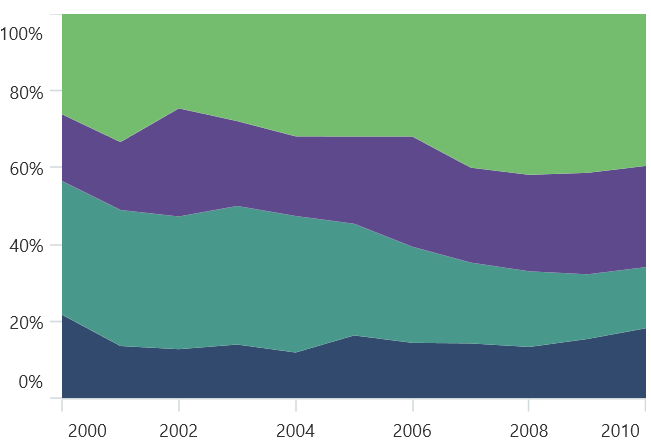
Enable Marker
A marker, also known as a symbol, is used to determine or highlight the position of the data point. To enable markers in the series, set the ShowMarkers property to true.
<chart:SfCartesianChart>
    <!-- code omitted for brevity -->
    <chart:StackingArea100Series ItemsSource="{Binding StackData}"
                                 XBindingPath="Year"
                                 YBindingPath="Value"
                                 ShowMarkers="True"/>
</chart:SfCartesianChart>
SfCartesianChart chart = new SfCartesianChart();
// code omitted for brevity
StackingArea100Series series = new StackingArea100Series()
{
ItemsSource = new ViewModel().StackData,
XBindingPath = "Year",
YBindingPath = "Value",
ShowMarkers = true
};
chart.Series.Add(series);
this.Content = chart;Marker customization
To change the series markers’ appearance, create an instance of the MarkerSettings property. The following properties are used to customize marker appearance.
-
Type, of type
ShapeType, describes the shape of the series marker. The default value of this property is the ShapeType.Circle. -
Stroke, of type
Brush, indicates the brush used to paint the marker border. -
StrokeWidth, of type
double, indicates the width of the marker border. -
Fill, of type
Brush, indicates the color of the marker. -
Width, of type
double, indicates the width of the marker. -
Height, of type
double, indicates the height of the marker.
<chart:SfCartesianChart>
    <!-- code omitted for brevity -->
    <chart:StackingArea100Series ItemsSource="{Binding StackData}"
                                 XBindingPath="Year"
                                 YBindingPath="Value"
                                 ShowMarkers="True">
        <chart:StackingArea100Series.MarkerSettings>
            <chart:ChartMarkerSettings Type="Diamond"
                                       Fill="LightBlue"
                                       Stroke="Blue"
                                       StrokeWidth="1"
                                       Height="8"
                                       Width="8"/>
        </chart:StackingArea100Series.MarkerSettings>
    </chart:StackingArea100Series>
</chart:SfCartesianChart>
SfCartesianChart chart = new SfCartesianChart();
// code omitted for brevity
ChartMarkerSettings chartMarker= new ChartMarkerSettings()
{
Type = ShapeType.Diamond,
Fill = Colors.Brown,
Stroke = Colors.Black,
StrokeWidth = 1,
Height = 8,
Width = 8
};
StackingArea100Series series = new StackingArea100Series()
{
ItemsSource = new ViewModel().StackData,
XBindingPath = "Year",
YBindingPath = "Value",
ShowMarkers = true,
MarkerSettings = chartMarker
};
chart.Series.Add(series);
this.Content = chart;