Localization in WPF Diagram
18 Nov 20186 minutes to read
Localization is the process of adapting an application to a specific language or culture. WPF Diagram lets you localize all static text used for annotations and context menu contents.
The following items can be localized:
- Annotation content (e.g.,
AnnotationEditorViewModel.Content). - Context menu items on nodes, connectors, groups, and the diagram surface.
- Status bar messages and tooltips displayed by the diagram.
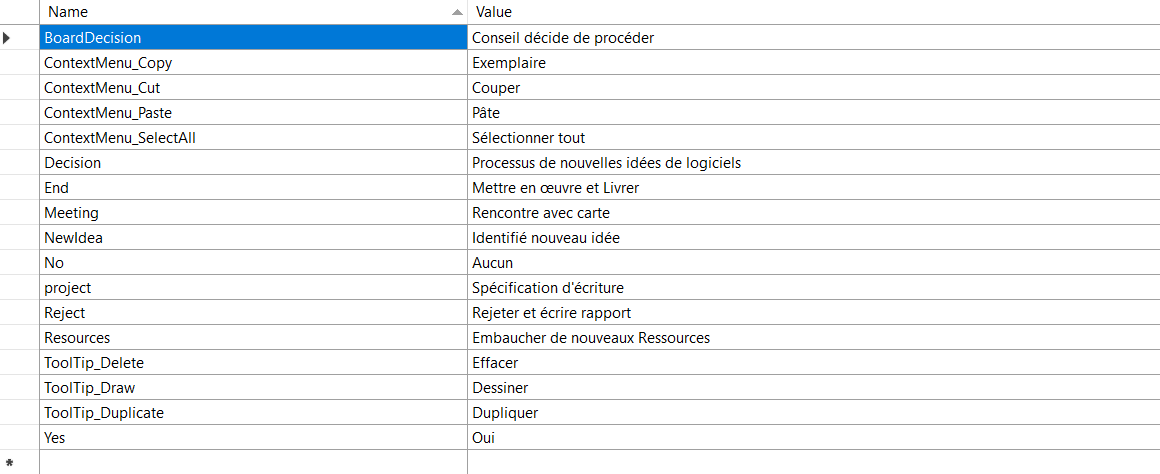
You can refer to the WPF Localization overview to add a resource file to the application.
Set
CurrentUICultureinApp.OnStartup(or inApp.xaml.csbeforeApplication.Run) so the culture is applied before any UI is created. Setting it insideMainWindowonly affects that window’s flow after construction, too late for resources resolved during layout.
Localize the Annotations Using ResourceManager
Diagram supports localizing the annotations of nodes and connectors. The following code illustrates how to provide localization support for an annotation.
The NewIdea resource key referenced below uses the following .resx entry (default Resources.resx) and culture-specific overrides:
| File | Key | Value |
|---|---|---|
Resources.resx |
NewIdea |
New Idea |
Resources.fr.resx |
NewIdea |
Nouvelle idée |
Resources.de.resx |
NewIdea |
Neue Idee |
The fallback chain (de-DE → de → invariant) is resolved automatically by ResourceManager; provide region-specific .resx files (Resources.de-DE.resx) only when you need to override regional differences.
<!-- Style for the node. -->
<Style TargetType="Path" x:Key="NodeStyle">
    <Setter Property="Stretch" Value="Fill"/>
    <Setter Property="Fill" Value="#FF5B9BD5"/>
</Style>
manager.GetString("NewIdea")returnsnullwhen the resource key is missing. Fall back to a default value withmanager.GetString("NewIdea") ?? "New Idea"if you want to avoid empty annotation content.
For right-to-left (RTL) cultures such as
ar-SA, setFlowDirection="RightToLeft"on the hostWindowor on the diagram’s panel.
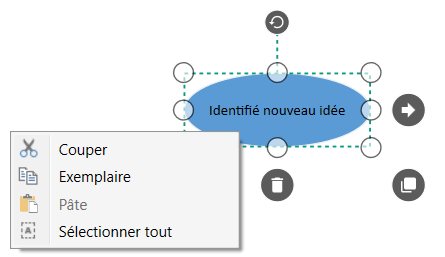
Localize the Context Menu Items
Diagram exposes its context menu items through SfDiagram.Menu so the labels can be localized. The following example binds the menu text to a ResourceManager.
void MainWindow_Loaded(object sender, RoutedEventArgs e)
{
    foreach (var item in diagram.Menu.Items)
    {
        if (item is DiagramMenuItem menuItem &&
            menuItem.Content is string key &&
            !string.IsNullOrEmpty(key))
        {
            menuItem.Content = manager.GetString(key) ?? key;
        }
    }
}
Define the textual descriptions of the context menu items for each custom culture you support (for example, “Cut” → “Couper” in
Resources.fr.resx).