Convert Word to PDF in Linux
19 Aug 20269 minutes to read
Syncfusion® DocIO is a .NET Core Word library used to create, read, edit, and convert Word documents programmatically without Microsoft Word or interop dependencies. Using this library, you can convert a Word document to PDF in a .NET Core application on Linux.
Steps to convert a Word document to PDF in a .NET Core application on Linux
Prerequisites:
- Visual Studio 2022.
- Install .NET 8 SDK or later.
Step 1: Execute the following command in the Linux terminal to create a new .NET Core Console application.
dotnet new console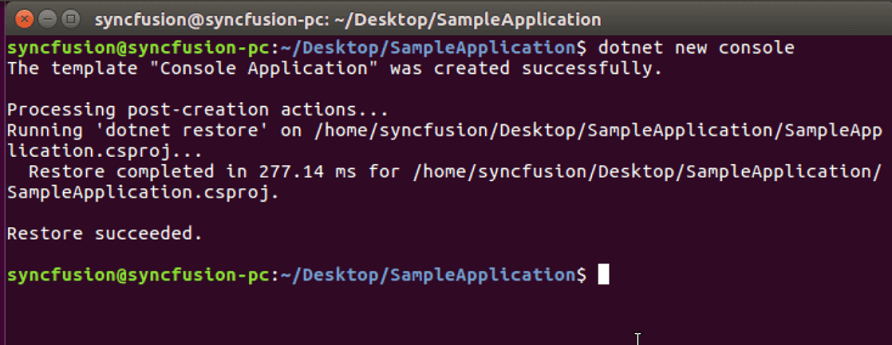
Step 2: Install the following NuGet packages in your application from NuGet.org by executing the following command.
- Syncfusion.DocIORenderer.Net.Core (latest version)
- SkiaSharp.NativeAssets.Linux v4.150.1
- HarfBuzzSharp.NativeAssets.Linux v14.2.1.1
dotnet add package Syncfusion.DocIORenderer.Net.Core -s https://www.nuget.org/
dotnet add package SkiaSharp.NativeAssets.Linux -v 4.150.1 -s https://www.nuget.org/
dotnet add package HarfBuzzSharp.NativeAssets.Linux -v 14.2.1.1 -s https://www.nuget.org/
- From v32.1.19 onward, the dependent SkiaSharp package was upgraded to v4.150.1. The
SkiaSharp.NativeAssets.Linux v4.150.1andHarfBuzzSharp.NativeAssets.Linux v14.2.1.1packages are mandatory in this environment. For other Linux environments (such as AWS Lambda or AWS Elastic Beanstalk), refer to the documentation for the appropriate native asset packages.- Starting with v16.2.0.x, if you reference Syncfusion® assemblies from trial setup or from the NuGet feed, you also have to add the “Syncfusion.Licensing” assembly reference and include a license key in your projects. Please refer to this link to know about registering Syncfusion® license key in your applications to use our components.
- If you are using a version prior to v23.1.40, please refer here to know about how to perform Word to PDF conversion in Linux.
Step 3: Add the following namespaces in Program.cs file.
using System.IO;
using Syncfusion.DocIO;
using Syncfusion.DocIO.DLS;
using Syncfusion.DocIORenderer;
using Syncfusion.Pdf;
Step 4: Add the following code snippet in Program.cs file.
//Open the file as Stream
using (FileStream docStream = new FileStream(Path.GetFullPath("Data/Template.docx"), FileMode.Open, FileAccess.Read))
{
    //Loads an existing Word document
    using (WordDocument wordDocument = new WordDocument(docStream, FormatType.Docx))
    {
        //Instantiation of DocIORenderer for Word to PDF conversion
        using (DocIORenderer render = new DocIORenderer())
        {
            //Converts Word document into PDF document
            using (PdfDocument pdfDocument = render.ConvertToPDF(wordDocument))
            {
                //Create FileStream to save the PDF file.
                using (FileStream outputStream = new FileStream("Sample.pdf", FileMode.Create, FileAccess.ReadWrite, FileShare.ReadWrite))
                {
                    //Saves the PDF file.
                    pdfDocument.Save(outputStream);
                }
            }
        }
    }
}
Ensure the application is run from the project root directory so that the relative
Data/Template.docxpath resolves correctly.
Step 5: Execute the following command to restore the NuGet packages.
dotnet restore
Step 6: Execute the following command in terminal to run the application.
dotnet run
You can download a complete working sample from GitHub.
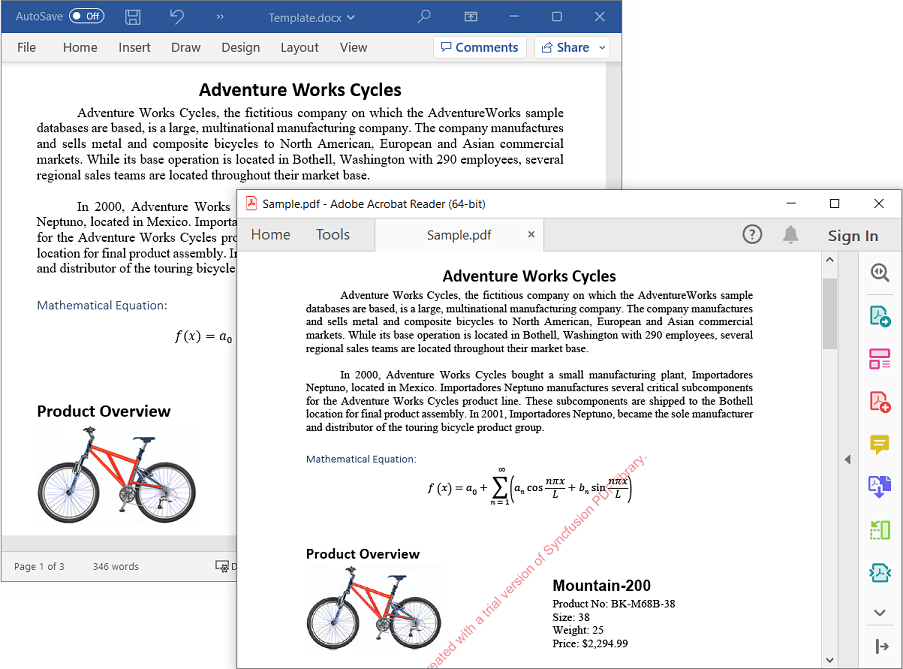
By executing the program, you will get the PDF as follows. The output will be saved alongside Program.cs in the project output directory.
Prerequisites:
- JetBrains Rider.
- Install .NET 8 SDK or later.
Step 1: Open JetBrains Rider and create a new .NET Core console application project.
- Launch JetBrains Rider.
- Click New Solution on the welcome screen.

- In the New Solution dialog, select Project Type as Console.
- Select the target framework (e.g., .NET 8.0, .NET 9.0).
- Enter a project name and specify the location.
- Click create.

Step 2: Install the NuGet packages from NuGet.org.
- Click the NuGet icon in the Rider toolbar and type Syncfusion.DocIORenderer.Net.Core in the search bar.
- Ensure that nuget.org is selected as the package source.
- Select the latest Syncfusion.DocIORenderer.Net.Core NuGet package from the list.
- Click the + (Add) button to add the package.

- Click the Install button to complete the installation.
- Repeat the steps above to install the additional NuGet packages required for Linux: SkiaSharp.NativeAssets.Linux v4.150.1 and HarfBuzzSharp.NativeAssets.Linux v14.2.1.1.

- From v32.1.19 onward, the dependent SkiaSharp package was upgraded to v4.150.1. The
SkiaSharp.NativeAssets.Linux v4.150.1andHarfBuzzSharp.NativeAssets.Linux v14.2.1.1packages are mandatory in this environment. For other Linux environments (such as AWS Lambda or AWS Elastic Beanstalk), refer to the documentation for the appropriate native asset packages.- Starting with v16.2.0.x, if you reference Syncfusion® assemblies from trial setup or from the NuGet feed, you also have to add the “Syncfusion.Licensing” assembly reference and include a license key in your projects. Please refer to this link to know about registering Syncfusion® license key in your application to use our components.
- If you are using a version prior to v23.1.40, please refer here to know about how to perform Word to PDF conversion in Linux.
Step 3: Add the following namespaces in Program.cs file.
using Syncfusion.DocIO;
using Syncfusion.DocIO.DLS;
using Syncfusion.DocIORenderer;
using Syncfusion.Pdf;
Step 4: Add the following code snippet in Program.cs file.
//Open the file as Stream
using (FileStream docStream = new FileStream(Path.GetFullPath("Data/Template.docx"), FileMode.Open, FileAccess.Read))
{
    //Loads an existing Word document
    using (WordDocument wordDocument = new WordDocument(docStream, FormatType.Docx))
    {
        //Instantiation of DocIORenderer for Word to PDF conversion
        using (DocIORenderer render = new DocIORenderer())
        {
            //Converts Word document into PDF document
            using (PdfDocument pdfDocument = render.ConvertToPDF(wordDocument))
            {
                //Create FileStream to save the PDF file.
                using (FileStream outputStream = new FileStream("Result.pdf", FileMode.Create, FileAccess.ReadWrite, FileShare.ReadWrite))
                {
                    //Saves the PDF file.
                    pdfDocument.Save(outputStream);
                }
            }
        }
    }
}
Ensure the application is run from the project root directory so that the relative
Data/Template.docxpath resolves correctly.
Step 5: Build the project.
Click the Build button in the toolbar or press Ctrl+Shift+B to build the project.
Step 6: Run the project.
Click the Run button (green arrow) in the toolbar or press F5 to run the app.
You can download a complete working sample from GitHub.
By executing the program, you will get the PDF as follows. The output will be saved alongside Program.cs in the project output directory.
Looking for the full .NET Word Library overview, features, pricing, and documentation? Visit the .NET Word Library page.
An online sample link to convert Word document to PDF in ASP.NET Core.