Convert Word to PDF in ASP.NET
13 Aug 20264 minutes to read
Note: ASP.NET Web Forms is deprecated. We recommend using the ASP.NET Core platform for new development. For more information on migrating the .NET Word library from .NET Framework to .NET Core, refer here.
Syncfusion® Essential® DocIO is a .NET Word library used to create, read, edit, and convert Word documents programmatically without Microsoft Word or interop dependencies. Using this library, you can convert a Word document to PDF in ASP.NET Web Forms on the .NET Framework.
Prerequisites
- Visual Studio with the ASP.NET and web development workload installed.
- .NET Framework 4.5 or later.
- A sample Word document named
Template.docxavailable in your project (placed under theApp_Datafolder, as referenced in the code below).
Steps to convert Word document to PDF in C#
Step 1: Create a new ASP.NET Web Application (.NET Framework) project in Visual Studio.
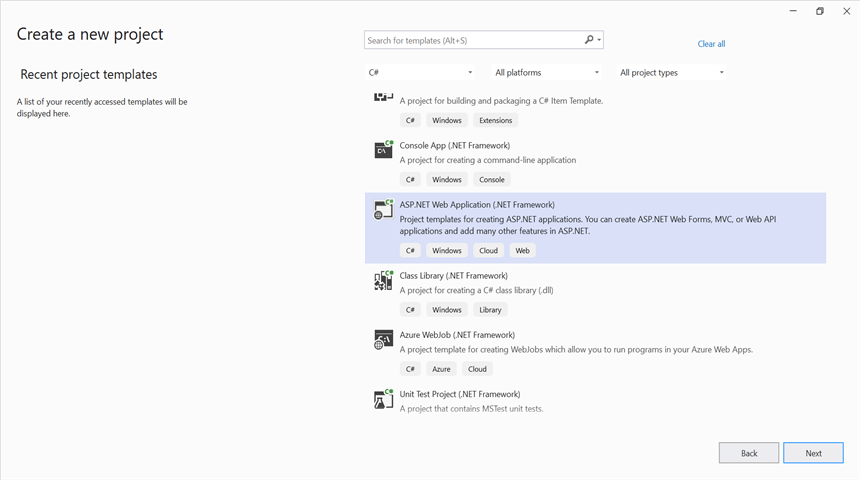
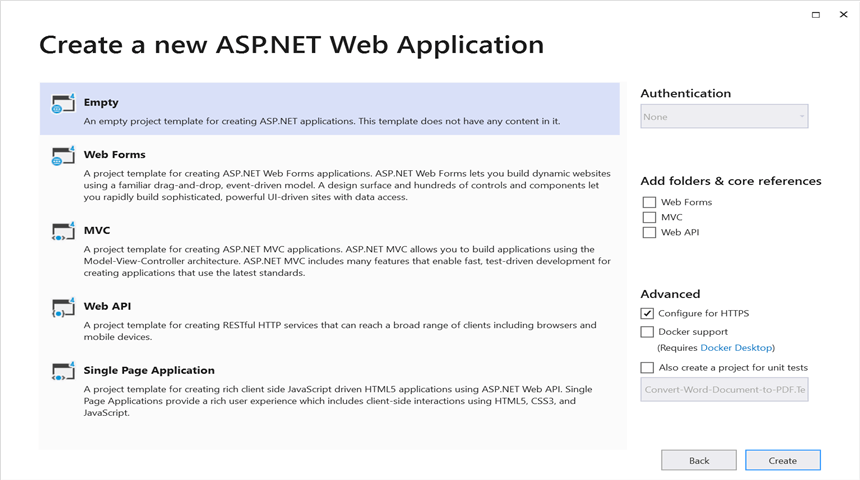
Step 2: Select the Empty project template.
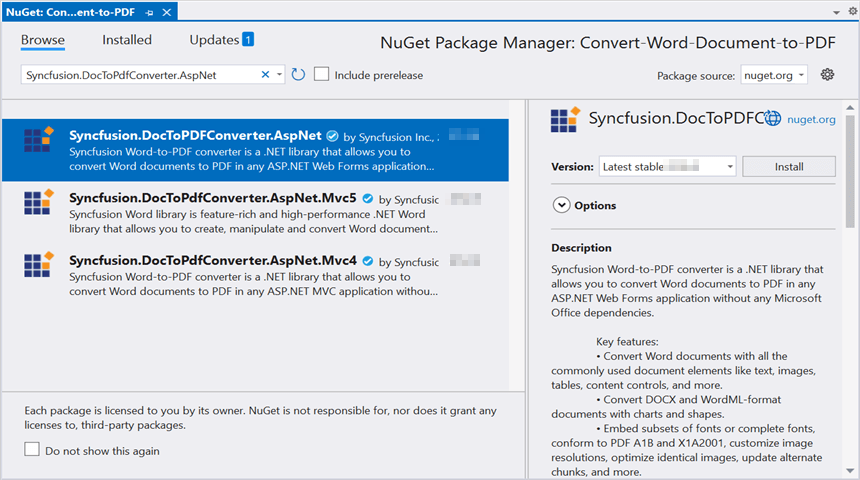
Step 3: Install the Syncfusion.DocToPDFConverter.AspNet NuGet package as a reference to your project from NuGet.org.
Starting with v16.2.0.x, if you reference Syncfusion® assemblies from trial setup or from the NuGet feed, you also have to add “Syncfusion.Licensing” assembly reference and include a license key in your projects. Please refer to this link to know about registering Syncfusion® license key in your application to use our components.
Step 4: Add a new Web Form in your project. Right click on the project and select Add > New Item and add a Web Form from the list. Name it as MainPage.
Step 5: Add a new button in the MainPage.aspx as shown below.
<%@ Page Language="C#" AutoEventWireup="true" CodeBehind="MainPage.aspx.cs" Inherits="Convert_Word_Document_to_PDF.WebForm1" %>

<!DOCTYPE html>

<html xmlns="http://www.w3.org/1999/xhtml">
<head runat="server">
    <title></title>
</head>
<body>
    <form id="form1" runat="server">
        <div>
             <asp:Button ID="Button1" runat="server" Text="Convert Word to PDF" OnClick="OnButtonClicked" />
        </div>
    </form>
</body>
</html>
Step 6: Include the following namespaces in your MainPage.aspx.cs file.
using System.IO;
using Syncfusion.DocIO;
using Syncfusion.DocIO.DLS;
using Syncfusion.DocToPDFConverter;
using Syncfusion.Pdf;
Step 7: Include the below code snippet in the click event of the button in MainPage.aspx.cs, to convert the Word document to PDF and download it.
This sample uses
Server.MapPathandHttpContext.Current, which are available only in the .NET Framework ASP.NET Web Forms environment. Ensure a sample Word document named Template.docx exists in theApp_Datafolder of your project.
//Open an existing Word document.
string filePath = Server.MapPath("~/App_Data/Template.docx");

//Loads file into Word document
using (WordDocument document = new WordDocument(filePath))
{
    //Instantiation of DocToPDFConverter for Word to PDF conversion
    using (DocToPDFConverter converter = new DocToPDFConverter())
    {
        //Converts Word document into PDF document
        using (PdfDocument pdfDocument = converter.ConvertToPDF(document))
        {
            //Saves the PDF document to MemoryStream.
            MemoryStream stream = new MemoryStream();
            pdfDocument.Save("sample.pdf", HttpContext.Current.Response, HttpReadType.Save);
            stream.Position = 0;
        }
    }
}
You can download a complete working sample from GitHub.
Step 8: Build the project.
Click on Build → Build Solution or press Ctrl+Shift+B to build the project.
Step 9: Run the project.
Click the Start button (green arrow) or press F5 to run the app.
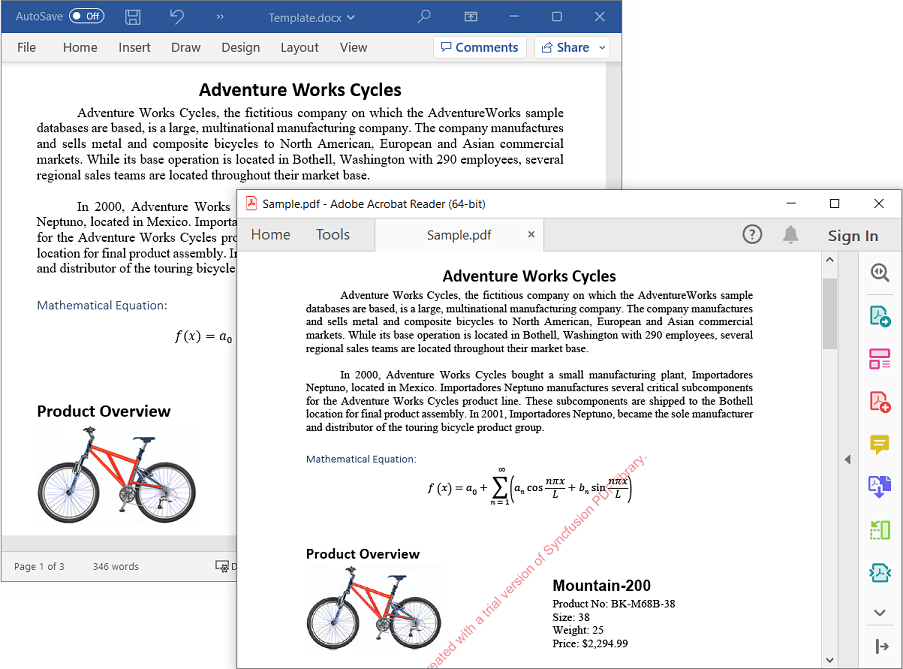
By executing the program, you will get the PDF document as follows.
See also
- .NET Word Library — Full overview, features, pricing, and documentation.