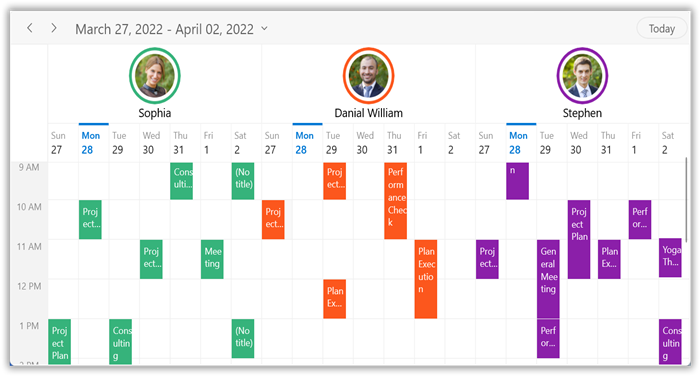
Resource Grouping in WinUI Scheduler
The scheduler resource view will allow the group appointments based on the resources or dates, arranged by the column, or row in the day, week, workweek, timeline day, timeline week, timeline workweek, and timeline month views. It also allows to share the events or appointments to the multiple resources and resource appointment details that can be edited by using a built-in appointment editor dialog.
Grouping by resources
Resources can be added to the scheduler by setting the ResourceGroupType property as Resource in SfScheduler. Set the Id, Name, Foreground, and Background properties of SchedulerResource to create a resource. Add the resource to the scheduler by using the ResourceCollection property of SfScheduler and also add or remove the scheduler resources dynamically.
No resource view will be displayed even the resource added using the ResourceCollection property when the ResourceGroupType property value is set to None.
<scheduler:SfScheduler x:Name="schedule"
                       ViewType="Week"
                       ResourceGroupType="Resource"
                       ResourceCollection="{Binding ResourceCollection}">
</scheduler:SfScheduler>
// Adding schedule resource in the scheduler resource collection.
var ResourceCollection = new ObservableCollection<SchedulerResource>()
{
new SchedulerResource() { Name = "Sophia", Foreground = new SolidColorBrush(Colors.White), Background = new SolidColorBrush(Color.FromArgb(255,54, 179, 123)), Id = "1000" },
new SchedulerResource() { Name = "Zoey Addison", Foreground = new SolidColorBrush(Colors.White), Background = new SolidColorBrush(Color.FromArgb(255,252,87,29)), Id = "1001" },
new SchedulerResource() { Name = "James William", Foreground = new SolidColorBrush(Colors.White), Background = new SolidColorBrush(Color.FromArgb(255, 139,31,169)), Id = "1002" },
};
// Adding the scheduler resource collection to the schedule resources of SfSchedule.
this.Schedule.ResourceCollection = ResourceCollection;
Resource grouping types
Group the resource order by Date or order by Resource using the ResourceGroupType property of SfScheduler.
Group the resource order in the day, week, workweek, timeline day, timeline week, timeline workweek, and timeline month views.
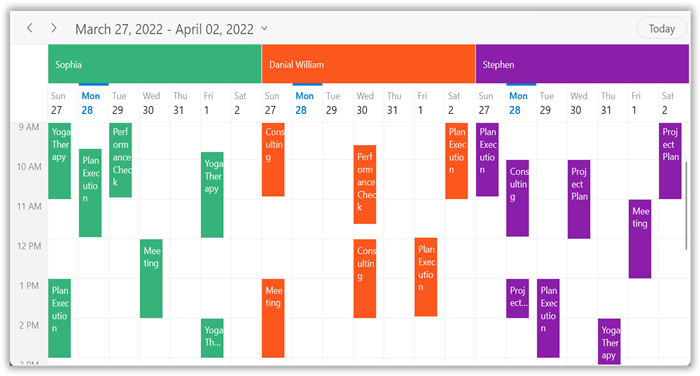
Resource
The ResourceGroupType is set to Resource to group the number of dates under each resource.
<scheduler:SfScheduler x:Name="Schedule"
ViewType="Week"
ResourceGroupType="Resource">
</scheduler:SfScheduler>this.Schedule.ViewType = SchedulerViewType.Week;
this.Schedule.ResourceGroupType = ResourceGroupType.Resource;
// Adding schedule resource in the scheduler resource collection.
var ResourceCollection = new ObservableCollection<SchedulerResource>()
{
   new SchedulerResource() { Name = "Sophia", Foreground = new SolidColorBrush(Colors.White), Background = new SolidColorBrush(Color.FromArgb(255,54, 179, 123)), Id = "1000" },
   new SchedulerResource() { Name = "Zoey Addison", Foreground = new SolidColorBrush(Colors.White), Background = new SolidColorBrush(Color.FromArgb(255,252,87,29)), Id = "1001" },
   new SchedulerResource() { Name = "James William", Foreground = new SolidColorBrush(Colors.White), Background = new SolidColorBrush(Color.FromArgb(255, 139,31,169)), Id = "1002" },
};

// Adding the scheduler resource collection to the schedule resources of SfSchedule.
this.Schedule.ResourceCollection = ResourceCollection;
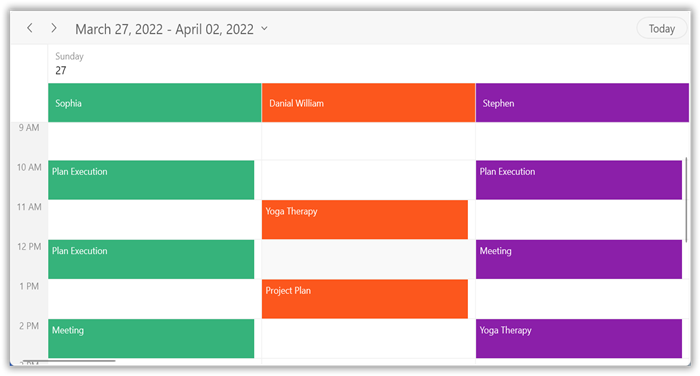
Date
The ResourceGroupType is set to Date to group the number of resources under each date.
<scheduler:SfScheduler x:Name="schedule"
ViewType="Week"
ResourceGroupType="Date">
</scheduler:SfScheduler>this.Schedule.ViewType = SchedulerViewType.Week;
this.Schedule.ResourceGroupType = ResourceGroupType.Date;
// Adding schedule resource in the scheduler resource collection.
var ResourceCollection = new ObservableCollection<SchedulerResource>()
{
new SchedulerResource() { Name = "Sophia", Foreground = new SolidColorBrush(Colors.White), Background = new SolidColorBrush(Color.FromArgb(255,54, 179, 123)), Id = "1000" },
new SchedulerResource() { Name = "Zoey Addison", Foreground = new SolidColorBrush(Colors.White), Background = new SolidColorBrush(Color.FromArgb(255,252,87,29)), Id = "1001" },
new SchedulerResource() { Name = "James William", Foreground = new SolidColorBrush(Colors.White), Background = new SolidColorBrush(Color.FromArgb(255, 139,31,169)), Id = "1002" },
};
// Adding the scheduler resource collection to the schedule resources of SfSchedule.
this.Schedule.ResourceCollection = ResourceCollection;
Assigning resources to appointments
Appointments associated with the scheduler ResourceCollection will be displayed by setting the schedule resource Id in the ScheduleAppointment by using the ResourceIdCollection. For ResourceGroupType set as Resource or Date. Also assign the resources to recurrence appointments.
<scheduler:SfScheduler x:Name="Schedule"
                       ViewType="Week"
                       ResourceGroupType="Resource">
</scheduler:SfScheduler>// Creating an instance for the schedule appointment collection.
var scheduleAppointmentCollection = new ScheduleAppointmentCollection();
//Adding schedule appointment in the schedule appointment collection.
var appointments = new ScheduleAppointment()
{
StartTime = DateTime.Now,
EndTime = DateTime.Now.AddHours(2),
Subject = "General Meeting",
ResourceIdCollection = new ObservableCollection<object>() { "1000", "1001" }
};
//Adding the schedule appointment to the schedule appointment collection.
scheduleAppointmentCollection.Add(appointments);
//Adding the schedule appointment collection to the ItemsSource of SfScheduler.
this.Schedule.ItemsSource = scheduleAppointmentCollection;
- When the
ResourceIdCollectionis not added toScheduleAppointmentthen the appointment will not be displayed whenResourceGroupTypeis set toResourceorDate.- When
ResourceGroupTypeis set toNone,the resource view will be collapsed and all scheduler DataSource events will be displayed.- Also add or remove the appointment resources dynamically.
Multiple resource sharing
Multiple resources can share the same events or appointments. If the appointment details are edited or updated, then the changes will be reflected on all other shared instances simultaneously.
<scheduler:SfScheduler x:Name="Schedule"
                       ViewType="Week"
                       ResourceGroupType="Resource">
</scheduler:SfScheduler>
// Creating an instance for schedule appointment collection.
var scheduleAppointmentCollection = new ScheduleAppointmentCollection();
//Adding schedule appointment in the schedule appointment collection.
var appointments = new ScheduleAppointment()
{
StartTime = DateTime.Now,
EndTime = DateTime.Now.AddHours(2),
Subject = "General Meeting",
ResourceIdCollection = new ObservableCollection<object>() { "1000", "1001","1002" },
AppointmentBackground = new SolidColorBrush(Color.FromArgb(255, 133, 81, 242)),
};
//Adding the schedule appointment to the schedule appointment collection.
scheduleAppointmentCollection.Add(appointments);
//Adding the schedule appointment collection to the ItemsSource of SfScheduler.
this.Schedule.ItemsSource = scheduleAppointmentCollection;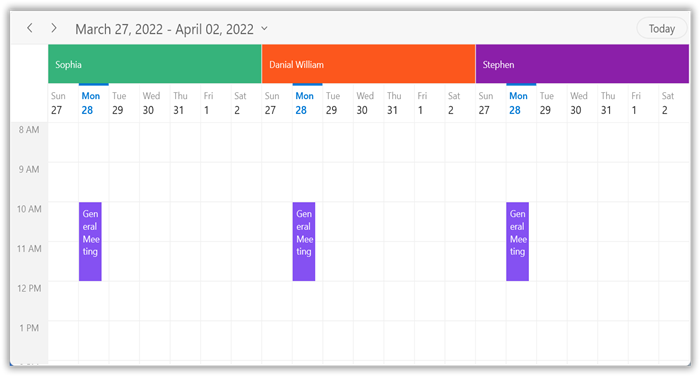
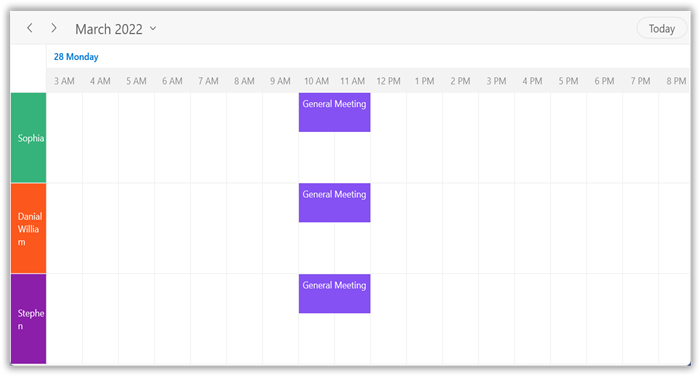
Scheduler resource mapping
The Schedule supports full data binding to ResourceCollection. Specify the ResourceMapping attribute to map the properties in the underlying data source to the schedule resource.
| Property Name | Description |
|---|---|
| Name | Maps the property name of custom class, which is equivalent to Name in ScheduleResource. |
| Id | Maps the property name of custom class, which is equivalent to Id in ScheduleResource. |
| Background | Maps the property name of custom class, which is equivalent to Background in ScheduleResource. |
| Foreground | Maps the property name of custom class, which is equivalent to Foreground in ScheduleResource. |
Custom resource class should contain a mandatory field for resource
Id.
Create business object for resource
Create a custom class employee with mandatory fields Name, Id, ForegroundColor, and BackgroundColor. Also assign the resources to recurrence appointments.
public class Employee
{
public string Name {get; set;}
public string Id {get; set;}
public Brush BackgroundColor {get; set; }
public Brush ForegroundColor {get; set; }
}
- Inherit this class from
NotificationObjectfor dynamic changes in custom data.- The SchedulerResource.Data property is used to get the details of custom data.
Map the properties of the Employee class with SfScheduler control using the Scheduler ResourceMapping.
<scheduler:SfScheduler Name="Schedule" ViewType="Week" ResourceGroupType="Resource">
<scheduler:SfScheduler.ResourceMapping>
<scheduler:ResourceMapping Id="Id" Name="Name" Background="BackgroundColor" Foreground="ForegroundColor"/>
</scheduler:SfScheduler.ResourceMapping>
</scheduler:SfScheduler>// Schedule data mapping for custom resource.
ResourceMapping resourceMapping = new ResourceMapping();
resourceMapping.Name = "Name";
resourceMapping.Id = "Id";
resourceMapping.Background = "BackgroundColor";
resourceMapping.Foreground = "ForegroundColor";
this.Schedule.ResourceMapping = resourceMapping;
Assign resource object collection
Add the resources of Employee collection that can be assigned to the scheduler using the ResourceCollection property which is of IEnumerable type. Also add or remove scheduler resources dynamically.
<scheduler:SfScheduler Name="Schedule" ViewType="Week" ResourceGroupType="Resource">
<scheduler:SfScheduler.ResourceMapping>
<scheduler:ResourceMapping Id="Id" Name="Name" Background="BackgroundColor" Foreground="ForegroundColor"/>
</scheduler:SfScheduler.ResourceMapping>
</scheduler:SfScheduler>// Creating and Adding custom resource in scheduler resource collection.
var ResourceCollection = new ObservableCollection<Employee>()
{
new Employee () {Name = "Sophia", BackgroundColor = new SolidColorBrush((Color.FromArgb(255, 157, 101, 201))), Id = "1000", ForegroundColor = new SolidColorBrush(Colors.White) },
new Employee () {Name = "Zoey Addison", BackgroundColor = new SolidColorBrush(Color.FromArgb(255, 240, 138, 93)), Id = "1001" , ForegroundColor = new SolidColorBrush(Colors.White)},
new Employee () {Name = "James William", BackgroundColor = new SolidColorBrush(Color.FromArgb(255,103, 155, 155)), Id = "1002" , ForegroundColor = new SolidColorBrush(Colors.White)},
};
// Adding the scheduler resource collection to the schedule resources of SfSchedule.
this.Schedule.ResourceCollection = ResourceCollection;
Assign the resource objects to appointment business object
Associate the scheduler ResourceMapping to the custom appointment by mapping resource Id in the ResourceIdCollection property of AppointmentMapping. The custom appointments associated with the scheduler resources will be displayed when the ResourceGroupType is set to Resource or Date. Also assign the resources to recurrence appointments.
/// <summary>
/// Represents the custom data properties.
/// </summary>
public class Meeting
{
public string EventName {get; set;}
public DateTime From {get; set;}
public DateTime To {get; set;}
public ObservableCollection<object> Resources {get; set;}
}Inherit this class from the
NotificationObjectfor dynamic changes in custom data.
Map those properties of the Meeting class to schedule appointments by using the AppointmentMapping properties.
<scheduler:SfScheduler x:Name="schedule" ItemsSource="{Binding Appointments}" ViewType="Week">
<scheduler:SfScheduler.AppointmentMapping>
<scheduler:AppointmentMapping
Subject="EventName"
StartTime="From"
EndTime="To"
ResourceIdCollection ="Resources"/>
</scheduler:SfScheduler.AppointmentMapping>
</scheduler:SfScheduler>//Schedule data mapping for custom appointments
AppointmentMapping dataMapping = new AppointmentMapping();
dataMapping.Subject = "EventName";
dataMapping.StartTime = "From";
dataMapping.EndTime = "To";
dataMapping.AppointmentBackground = "Color";
dataMapping.ResourceIdCollection= "Resources";
this.Schedule.AppointmentMapping = dataMapping;
Schedule meetings for a resource by setting From, To, and Resources of the Meeting class.
Meeting meeting = new Meeting ();
meeting.From = new DateTime(2020, 07, 01, 10, 0, 0);
meeting.To = meeting.From.AddHours(1);
meeting.EventName = "Meeting";
meeting.Resources = new ObservableCollection<object> { (Resources[0] as Employee).Id, (Resources[1] as Employee).Id };
var Meetings = new ObservableCollection<Meeting> ();
Meetings.Add(meeting);
this.Schedule.ItemsSource = Meetings;Resource header size
Customize the resource header size in the day, week, workweek, timeline day, timeline week, timeline workweek, and timeline month views by using the ResourceHeaderSize property of DaysViewSettings or TimelineViewSettings in SfScheduler.
Resource header height in days view
The DaysViewSettings is applicable for Day, Week, and WorkWeek views. By default, the value of this property is set to 50.
<scheduler:SfScheduler x:Name="schedule"
ViewType="Week"
ResourceGroupType="Resource">
<scheduler:SfScheduler.DaysViewSettings>
<scheduler:DaysViewSettings
ResourceHeaderSize="100"/>
</scheduler:SfScheduler.DaysViewSettings>
</scheduler:SfScheduler>this.Schedule.ViewType = SchedulerViewType.Week;
this.Schedule.DaysViewSettings.ResourceHeaderSize = 100;
Resource header width in timeline view
The TimelineViewSettings is applicable for timeline day, timeline week, timeline workweek, and timeline month views. By default, the value of this property is set to 50.
<scheduler:SfScheduler x:Name="schedule"
ViewType="TimelineWeek"
ResourceGroupType="Resource">
<scheduler:SfScheduler.TimelineViewSettings>
<scheduler:TimelineViewSettings
ResourceHeaderSize="100"/>
</scheduler:SfScheduler.TimelineViewSettings>
</scheduler:SfScheduler>this.Schedule.ViewType = SchedulerViewType.TimelineWeek;
this.Schedule.TimelineViewSettings.ResourceHeaderSize = 100;
Resource auto height
The resource row height gets auto-adjusted based on the number of overlapping appointments occupied on the same time range by setting RowAutoHeight property as true in TimelineViewSettings. By default, value of this property is set to false.
<Schedule:SfScheduler Name="schedule"
ViewType="TimelineWeek"
ResourceGroupType="Resource">
<Schedule:SfScheduler.TimelineViewSettings>
<Schedule:TimelineViewSettings
RowAutoHeight="True" />
</Schedule:SfScheduler.TimelineViewSettings>
</Schedule:SfScheduler>schedule.TimelineViewSettings.RowAutoHeight = true;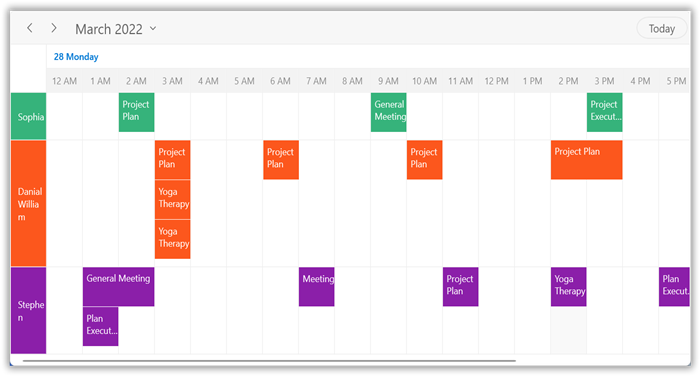
- This auto row height adjustment is applicable only on all the Timeline views such as timeline day, timeline week, timeline workweek and timeline month views.
- If auto resource row height is enabled then VisibleResourceCount will not be applicable and if resources have no appointments, then RowMinHeight will be considered as default resource row height.
Resource minimum height
You can customize minimum row height of visible resources in timeline day, timeline week, timeline workweek and timeline month views by using the RowMinHeight property of TimelineViewSettings in SfScheduler. By default, value of this property is set to 50.
<Schedule:SfScheduler Name="schedule"
ViewType="TimelineWeek"
ResourceGroupType="Resource">
<Schedule:SfScheduler.TimelineViewSettings>
<Schedule:TimelineViewSettings
RowMinHeight="100" />
</Schedule:SfScheduler.TimelineViewSettings>
</Schedule:SfScheduler>schedule.TimelineViewSettings.RowMinHeight = 100;The minimum resource row height adjusted based on view port size and the VisibleResourceCount will not be applicable.
Visible resource count
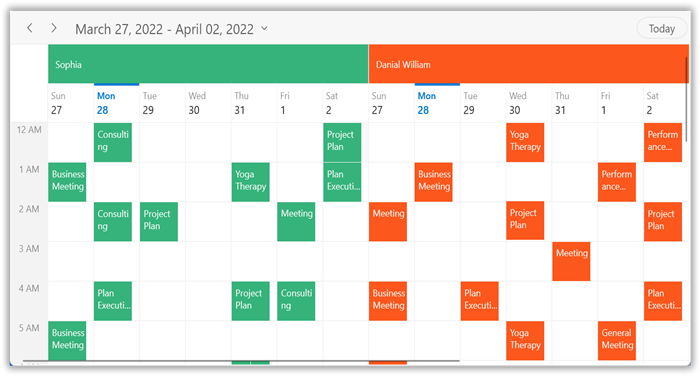
Customize the number of visible resources in the day, week, workweek, timeline day, timeline week, timeline workweek, and timeline month views by using the VisibleResourceCount property of DaysViewSettings or TimelineViewSettings in SfScheduler.
If the visible resource count exceeds the count of schedule
ResourceCollectioncount then the scheduleResourceCollectioncount will be displayed.
Visible resource count in days view
The DaysViewSettings applicable for Day, Week, and WorkWeek views. By default, the value of this property is set to 3.
<scheduler:SfScheduler x:Name="schedule"
ViewType="Week"
ResourceGroupType="Resource">
<scheduler:SfScheduler.DaysViewSettings>
<scheduler:DaysViewSettings
VisibleResourceCount="2"/>
</scheduler:SfScheduler.DaysViewSettings>
</scheduler:SfScheduler>this.Schedule.ViewType = SchedulerViewType.Week;
this.Schedule.DaysViewSettings.VisibleResourceCount = 2;
Visible resource count in timeline views
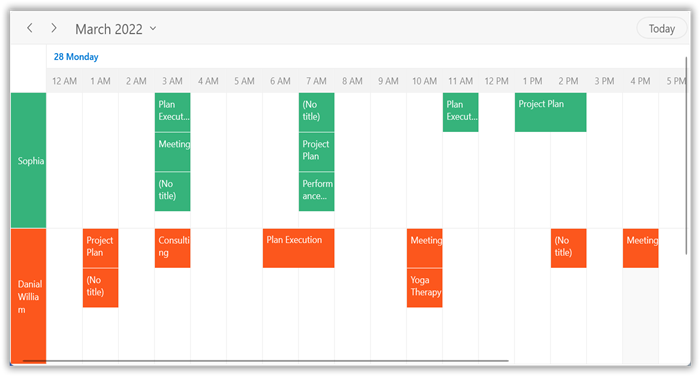
The TimelineViewSettings is applicable for timeline day, timeline week, timeline workweek, and timeline month views. By default, the value of this property is set to 3.
<scheduler:SfScheduler x:Name="schedule"
ViewType="TimelineWeek"
ResourceGroupType="Resource">
<scheduler:SfScheduler.TimelineViewSettings>
<scheduler:TimelineViewSettings
VisibleResourceCount="2"/>
</scheduler:SfScheduler.TimelineViewSettings>
</scheduler:SfScheduler>this.Schedule.ViewType = SchedulerViewType.TimelineWeek;
this.Schedule.TimelineViewSettings.VisibleResourceCount = 2;
Assign resources to special time regions
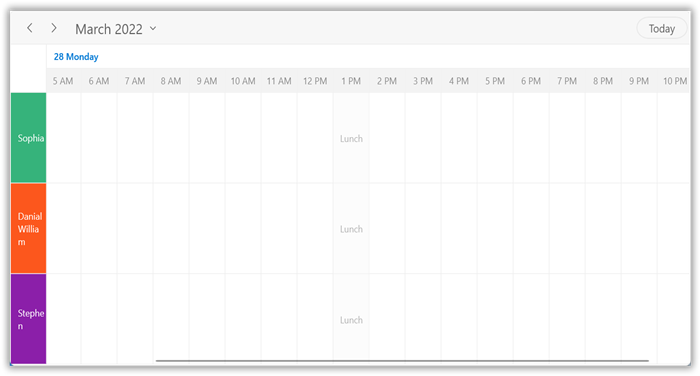
Special time region can be created based on the resources in the day, week, workweek, timeline day, timeline week, timeline workweek, and timeline month views.
<scheduler:SfScheduler x:Name="Schedule"
                       ViewType="Week"
                       ResourceGroupType="Resource">
</scheduler:SfScheduler>this.Schedule.DaysViewSettings.SpecialTimeRegions.Add(new SpecialTimeRegion
{
StartTime = new System.DateTime(2021, 04, 04, 13, 0, 0),
EndTime = new System.DateTime(2021, 04, 04, 14, 0, 0),
Text = "Lunch",
CanEdit = false,
RecurrenceRule = "FREQ=DAILY;INTERVAL=1",
CanMergeAdjacentRegions = false,
ResourceIdCollection = new ObservableCollection<object>() { "1000", "1001", "1002" }
});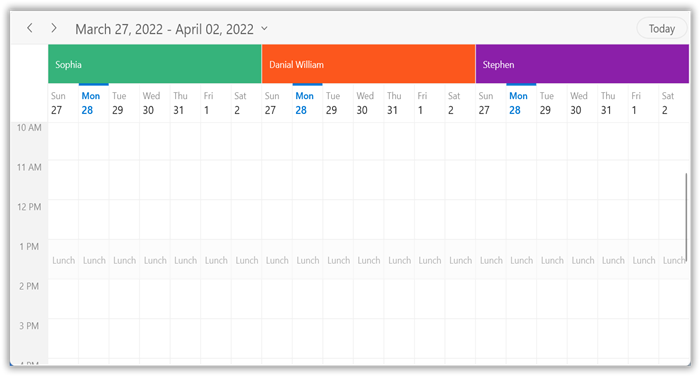
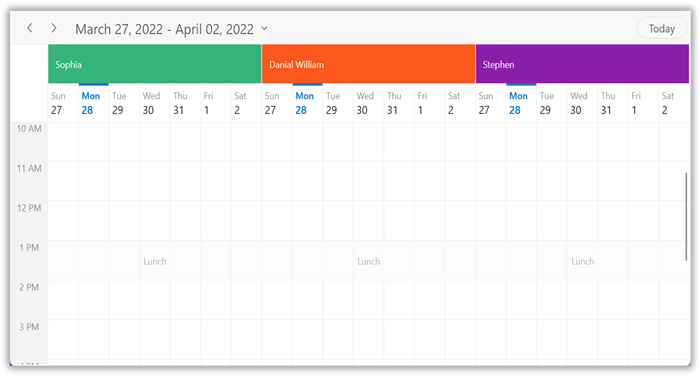
The SpecialTimeRegion in a
Time basiscan be displayed by setting the value of CanMergeAdjacentRegions toTrue.
Assign resources to special time regions in timeline view
<scheduler:SfScheduler x:Name="Schedule"
                       ViewType="Week"
                       ResourceGroupType="Resource">
</scheduler:SfScheduler>this.Schedule.TimelineViewSettings.SpecialTimeRegions.Add(new SpecialTimeRegion
{
StartTime = new System.DateTime(2021, 04, 04, 13, 0, 0),
EndTime = new System.DateTime(2021, 04, 04, 14, 0, 0),
Text = "Lunch",
CanEdit = false,
RecurrenceRule = "FREQ=DAILY;INTERVAL=1",
CanMergeAdjacentRegions = false,
ResourceIdCollection = new ObservableCollection<object>() { "1000", "1001", "1002" }
});
Appearance customization
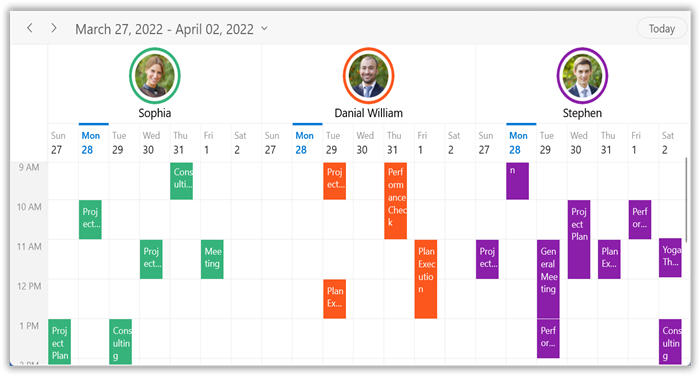
The resource appearance customization can be achieved by using the ResourceHeaderTemplate and ResourceHeaderTemplateSelector properties of the SfScheduler.
Customize resource appearance using ResourceHeaderTemplate
<!--used to find Image Source and Name properties.-->
<Grid>
   <Grid.DataContext>
      <local:Employee />
   </Grid.DataContext>
   <Grid.Resources>
      <DataTemplate  x:Key="DayViewResourceTemplate">
         <Grid Background="Transparent">
            <Border Background="Transparent" >
               <StackPanel VerticalAlignment="Center" Orientation="Vertical">
                  <Border CornerRadius="36" Height="72" Width="72" BorderThickness="4" BorderBrush="{Binding Data.BackgroundBrush}">
                        <Border CornerRadius="36" Height="64" Width="64" BorderThickness="4" BorderBrush="White">
                        <Image HorizontalAlignment="Center" VerticalAlignment="Center" Width="55"
                          Height="55" Source="{Binding Data.ImageSource}" />
                        </Border>
                  </Border>
                  <TextBlock HorizontalAlignment="Center" VerticalAlignment="Center" FontSize="15"
                  Foreground="Black" Text="{Binding Data.Name}" />
               </StackPanel>
            </Border>
         </Grid>
      </DataTemplate>
   </Grid.Resources>
   <scheduler:SfScheduler x:Name="schedule"
                          ViewType="Week"
                          ResourceGroupType="Resource"
                          ResourceCollection="{Binding ResourceCollection}"
                          ResourceHeaderTemplate="{StaticResource DayViewResourceTemplate}">
      <scheduler:SfScheduler.ResourceMapping>
         <scheduler:ResourceMapping Id="Id" Name="Name" Background="BackgroundBrush" Foreground="ForegroundBrush"/>
      </scheduler:SfScheduler.ResourceMapping>
   </scheduler:SfScheduler>
</Grid>
- By default, the
SchedulerResourceis set as theDataContextfor theResourceHeaderTemplatefor bothSchedulerResourceand custom data object in theResourceCollection.- The custom data object can be bound in the
ResourceHeaderTemplateby using the property ofSchedulerResource.Data.
Customize resource appearance using ResourceHeaderTemplateSelector
<Grid>
   <Grid.Resources>
        <DataTemplate  x:Key="DayViewResourceTemplate">
            <Grid Background="Transparent">
                <Border Background="Transparent" >
                    <StackPanel VerticalAlignment="Center" Orientation="Vertical">
                        <Border CornerRadius="36" Height="72" Width="72" BorderThickness="4" BorderBrush="{Binding Data.BackgroundBrush}">
                            <Border CornerRadius="36" Height="64" Width="64" BorderThickness="4" BorderBrush="White">
                                <Image HorizontalAlignment="Center" VerticalAlignment="Center" Width="55"
                          Height="55" Source="{Binding Data.ImageSource}" />
                            </Border>
                        </Border>
                        <TextBlock HorizontalAlignment="Center" VerticalAlignment="Center" FontSize="15"
                   Foreground="Black" Text="{Binding Data.Name}" />
                    </StackPanel>
                </Border>
            </Grid>
        </DataTemplate>
        <DataTemplate x:Key="TimelineViewResourceTemplate">
            <Grid Background="Transparent">
                <StackPanel VerticalAlignment="Center" Orientation="Vertical">
                    <Border CornerRadius="36" Height="72" Width="72" BorderThickness="4" BorderBrush="{Binding Data.BackgroundBrush}">
                        <Border CornerRadius="36" Height="64" Width="64" BorderThickness="4" BorderBrush="Transparent">
                            <Image HorizontalAlignment="Center" VerticalAlignment="Center"
                                   Width="55"
                                   Height="55"
                                   Source="{Binding Data.ImageSource}" />
                        </Border>
                    </Border>
                    <TextBlock HorizontalAlignment="Center"
                               VerticalAlignment="Center"
                               FontSize="15"
                               Text="{Binding Data.Name}"/>
                </StackPanel>
            </Grid>
        </DataTemplate>
        <local:ResourceTemplateSelector x:Key="resourceTemplateSelector" DayViewResourceTemplate="{StaticResource DaysViewResourceTemplate}" TimelineViewResourceTemplate="{StaticResource TimelineResourceTemplate}"/>
    <Grid.Resources>
      <Grid.DataContext>
         <local:BindingViewModel/>
      </Grid.DataContext>
        <scheduler:SfScheduler x:Name="schedule"
                                ViewType="Week"
                                ResourceGroupType="Resource}"
                                ResourceCollection="{Binding Resources}"
                                ItemsSource="{Binding ResourceAppointments}" HeaderHeight="32"
                                DisplayDate="{Binding DisplayDate}"
                                ResourceHeaderTemplateSelector="{StaticResource resourceTemplateSelector}"/>

</Grid>
public class ResourceTemplateSelector : DataTemplateSelector
{
/// <summary>
/// Initializes a new instance of the <see cref="ResourceTemplateSelector" /> class.
/// </summary>
public ResourceTemplateSelector()
{
}
public DataTemplate DayViewResourceTemplate {get; set;}
public DataTemplate TimelineViewResourceTemplate {get; set;}
/// <summary>
/// Template selection method
/// </summary>
/// <param name="item">return the object</param>
/// <param name="container">return the bindable object</param>
/// <returns>return the template</returns>
public override DataTemplate SelectTemplateCore(object item, DependencyObject container)
{
var schedule = container as SfScheduler;
if (schedule == null)
return null;
if (schedule.ViewType == SchedulerViewType.Day || schedule.ViewType == SchedulerViewType.Week || schedule.ViewType == SchedulerViewType.WorkWeek)
return DayViewResourceTemplate;
else
return TimelineViewResourceTemplate;
}
}
- By default, the SchedulerResource is set as the DataContext for the
ResourceHeaderTemplateSelectorfor both SchedulerResource and custom data object in theResourceCollection.- The custom data object can be bound in the
ResourceHeaderTemplateSelectorby using the property of SchedulerResource.Data.