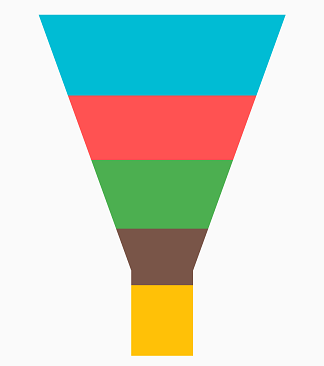
Series customization in Flutter Funnel Chart
18 Nov 201814 minutes to read
Animation
SfFunnelChart provides animation support for the series. The series is animated while rendering. Animation is enabled by default, and you can also control the duration of the animation using the animationDuration property. You can disable the animation by setting that property to 0.
@override
    Widget build(BuildContext context) {
        return Scaffold(
            body: Center(
                child: Container(
                    child: SfFunnelChart(
                        series:FunnelSeries<ChartData, String>(
                            dataSource: chartData,
                            xValueMapper: (ChartData data, _) => data.x,
                            yValueMapper: (ChartData data, _) => data.y,
                            animationDuration: 1000,
                        )
                    )
                )
            )
        );
    }
Animation delay
The animationDelay property is used to specify the delay duration of the series animation. This takes a millisecond value as input. By default, the series will animate for the specified duration. If animationDelay is specified, then the series will begin animating after the specified duration. The default is 0.
@override
    Widget build(BuildContext context) {
        List<ChartData> data = [
            ChartData('Jan', 35),
            ChartData('Feb', 28),
            ChartData('Mar', 38),
            ChartData('Apr', 32),
            ChartData('May', 40)
        ];

        return Center(
            child: SfFunnelChart(
                series: FunnelSeries<ChartData, String>(
                    dataSource: data,
                    animationDuration: 4500,
                    animationDelay: 2000,
                    xValueMapper: (ChartData data, _) => data.x,
                    yValueMapper: (ChartData data, _) => data.y,
                )
            ),
        );
    }

    class ChartData {
      ChartData(this.x, this.y);
      final String x;
      final double y;
    }
Empty points
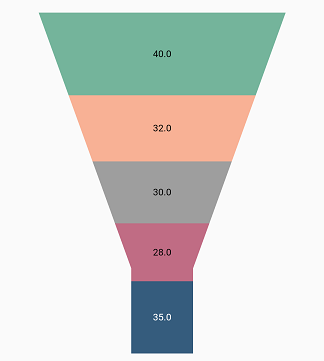
Data points that have null values are considered empty points. Empty data points are ignored and not plotted in the chart. By using the emptyPointSettings property in the series, you can decide the action taken for empty points. Available modes are EmptyPointMode.gap, EmptyPointMode.zero, EmptyPointMode.drop, and EmptyPointMode.average. The default mode for the empty point is EmptyPointMode.gap.
@override
    Widget build(BuildContext context) {

         final List<ChartData> chartData = [
            ChartData('Jan', 35),
            ChartData('Feb', 28),
            ChartData('Mar', null),
            ChartData('Apr', 32),
            ChartData('May', 40)
        ];
        return Scaffold(
            body: Center(
                child: SfFunnelChart(
                    series:FunnelSeries<ChartData, String>(
                        dataSource: chartData,
                        dataLabelSettings: DataLabelSettings(isVisible:true),
                        emptyPointSettings: EmptyPointSettings(mode: EmptyPointMode.average),
                        xValueMapper: (ChartData data, _) => data.x,
                        yValueMapper: (ChartData data, _) => data.y
                    )
                )
            )
        );
    }
Empty point customization
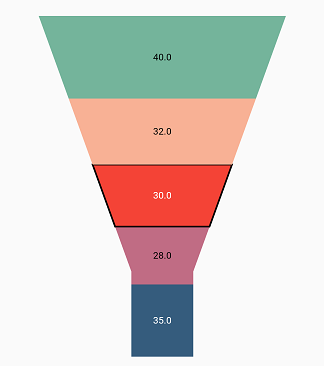
You can set a specific color for an empty point by using the color property in emptyPointSettings. The borderWidth property is used to change the stroke width of the empty point, and borderColor is used to change the stroke color of the empty point.
@override
    Widget build(BuildContext context) {
        final List<ChartData> chartData = [
            ChartData('Jan', 35),
            ChartData('Feb', 28),
            ChartData('Mar', null),
            ChartData('Apr', 32),
            ChartData('May', 40)
        ];
        return Scaffold(
            body: Center(
                child: Container(
                    child: SfFunnelChart(
                        series:FunnelSeries<ChartData, String>(
                            dataSource: chartData,
                            dataLabelSettings: DataLabelSettings(isVisible:true),
                            emptyPointSettings: EmptyPointSettings(mode: EmptyPointMode.average,
                            color: Colors.red,
                            borderColor: Colors.black,
                            borderWidth: 2),
                            xValueMapper: (ChartData data, _) => data.x,
                            yValueMapper: (ChartData data, _) => data.y
                        )
                    )
                )
            )
        );
    }
Color mapping for data points
The pointColorMapper property is used to map the color field from the data source.
@override
    Widget build(BuildContext context) {
            dynamic chartData = <ChartData>[
                ChartData('Rent', 1000,Colors.teal),
                ChartData('Food', 2500,Colors.lightBlue),
                ChartData('Savings', 760,Colors.brown),
                ChartData('Tax', 1897,Colors.grey),
                ChartData('Others', 2987,Colors.blueGrey)
            ];
            return Scaffold(
                body: Center(
                    child: Container(
                        child: SfFunnelChart(
                            series:FunnelSeries<ChartData, String>(
                                dataSource: chartData,
                                xValueMapper: (ChartData data, _) => data.x,
                                yValueMapper: (ChartData data, _) => data.y,
                                //map Color for each dataPoint dataSource.
                                pointColorMapper: (ChartData data,_) => data.color,
                            )
                        )
                    )
                )
            );
    }