Cards in WPF Kanban Board
18 Nov 201824 minutes to read
The default elements of a card can be customized using the following properties of KanbanModel.
-
Title- Used to set the title of a card. -
ImageURL- Used to set the image URL of a card. The image will be displayed at the right side in the default card template. -
Category- Used to set the category of a card. Based on the category, theCardswill be added to the respective columns. -
Description- Used to set the description text of a card. -
ColorKey- Used to specify the indicatorColorKey. TheColorvalue of the correspondingKeyshould be added to theIndicatorColorPalettecollection ofSfKanban. -
Tags- Used to specify the tags of a card. The tags will be displayed at the bottom in the default card template. -
ID- Used to set the ID of a card.
The following example shows how to set the values for these properties in a KanbanModel instance:
new KanbanModel()
{
    Title = "Universal App",
    ID = "27654",
    Description = "Incorporate feedback into functional specifications",
    Category = "Open",
    ColorKey = "Low",
    Tags = new string[] { "Deployment" },
    ImageURL = new Uri("/images/icon.jpg", UriKind.RelativeOrAbsolute)
};
The following code snippet defines the colors for each indicator key.
<kanban:SfKanban.IndicatorColorPalette>
    <kanban:ColorMapping Key="Low" Color="Blue" />
    <kanban:ColorMapping Key="Normal" Color="Green" />
    <kanban:ColorMapping Key="High" Color="Red" />
</kanban:SfKanban.IndicatorColorPalette>
using Syncfusion.UI.Xaml.Kanban;
using System.Windows.Media;
IndicatorColorPalette indicatorColorPalette = new IndicatorColorPalette();
indicatorColorPalette.Add(new ColorMapping() { Key = "Low", Color = Colors.Blue });
indicatorColorPalette.Add(new ColorMapping() { Key = "High", Color = Colors.Red });
indicatorColorPalette.Add(new ColorMapping() { Key = "Normal", Color = Colors.Green });
sfKanban.IndicatorColorPalette = indicatorColorPalette;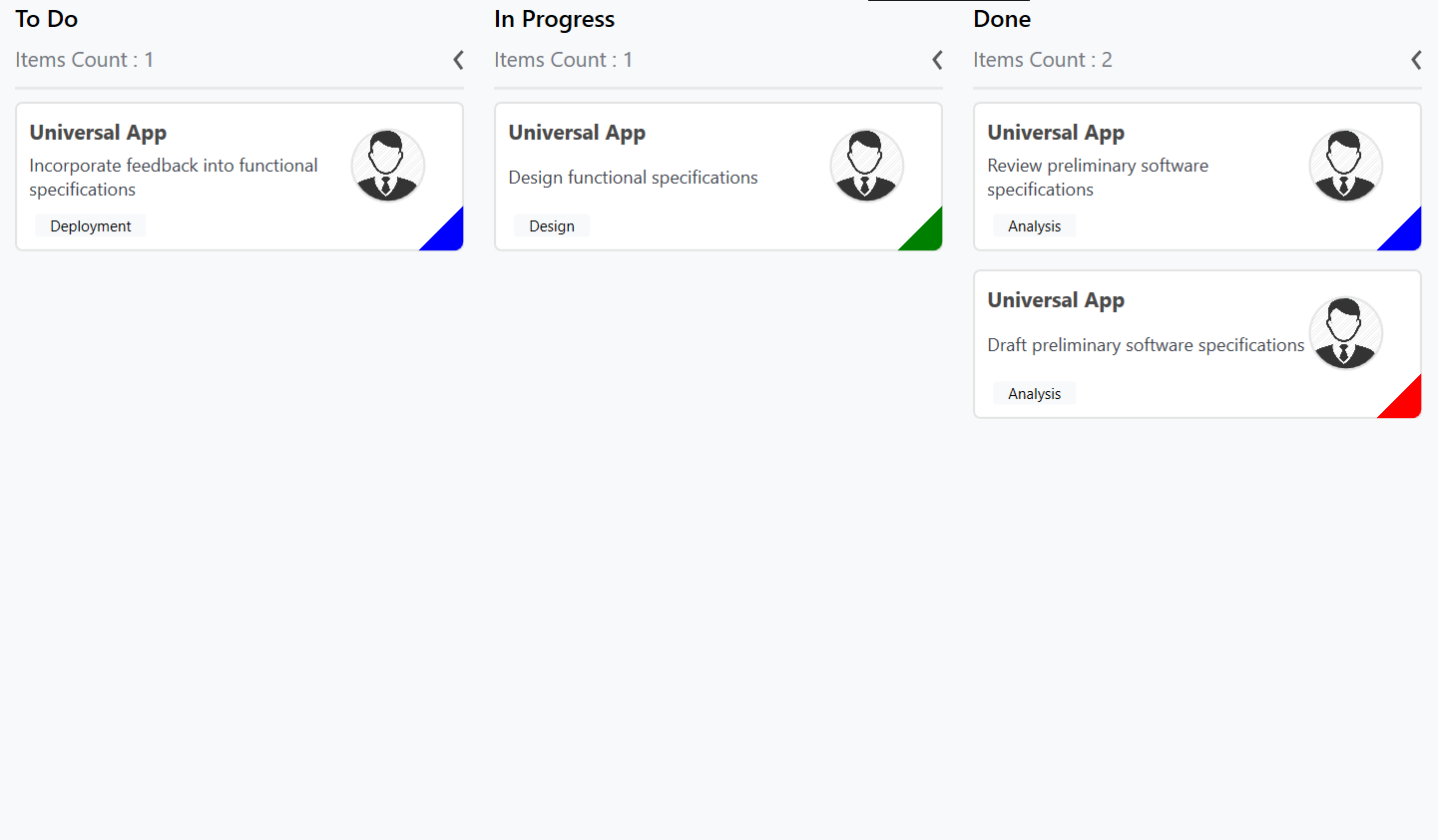
Customizing Kanban Cards
The CardStyle property customizes the cards. The following properties of CardStyle are used to customize its appearance:
-
Background- Changes the background color of a card. -
BorderBrush- Changes the border brush of a card. -
BorderThickness- Changes the border thickness of a card. -
CornerRadius- Adds rounded corners to a card. -
IconVisibility- Changes the icon visibility of a card. -
IndicatorVisibility- Changes the indicator visibility of a card. -
TagVisibility- Changes the tag panel visibility of a card. -
TitleColor- Changes the header color of a Kanban card item. -
TitleFontSize- Changes the font size of a card title. -
TitleHorizontalAlignment- Changes the horizontal alignment of a card title. -
FontSize- Changes the font size of a card description. -
Foreground- Changes the foreground color of a card description. -
TagBackground- Changes the background color of a tag. -
TagForeground- Changes the foreground color of a tag.
The following example shows how to apply these CardStyle properties in XAML:
<kanban:SfKanban.CardStyle>
    <kanban:KanbanCardStyle Background="LightYellow"
                             BorderBrush="DarkGray"
                             BorderThickness="1"
                             CornerRadius="5"
                             Foreground="Black"
                             FontSize="12"
                             TitleColor="DarkSlateGray"
                             TitleFontSize="14"
                             TagBackground="SteelBlue"
                             TagForeground="White" />
</kanban:SfKanban.CardStyle>
Template
You can replace the entire card template with your own design using the CardTemplate property of SfKanban. The following code snippet and screenshot illustrate this.
<kanban:SfKanban.CardTemplate>
    <DataTemplate>
        <Border BorderBrush="Black"
                BorderThickness="0.75"
                CornerRadius="10"
                Background="AliceBlue"
                Margin="0,5,0,5">
            <Grid Margin="10,5,5,10">
                <Grid.ColumnDefinitions>
                    <ColumnDefinition Width="7*" />
                    <ColumnDefinition Width="3*" />
                </Grid.ColumnDefinitions>
                <Grid.RowDefinitions>
                    <RowDefinition Height="Auto" />
                    <RowDefinition Height="Auto" />
                </Grid.RowDefinitions>
                <TextBlock Text="{Binding Path=Title}"
                           FontWeight="Bold"
                           FontSize="16" />
                <TextBlock Grid.Row="1"
                           FontSize="14"
                           HorizontalAlignment="Left"
                           Text="{Binding Description}"
                           TextWrapping="Wrap" />
                <Border Grid.Row="1"
                        Grid.Column="1"
                        Height="50"
                        CornerRadius="50"
                        Width="50"
                        BorderBrush="Silver"
                        BorderThickness=".75">
                    <Border.Background>
                        <ImageBrush ImageSource="{Binding ImageURL}" />
                    </Border.Background>
                </Border>
            </Grid>
        </Border>
    </DataTemplate>
</kanban:SfKanban.CardTemplate>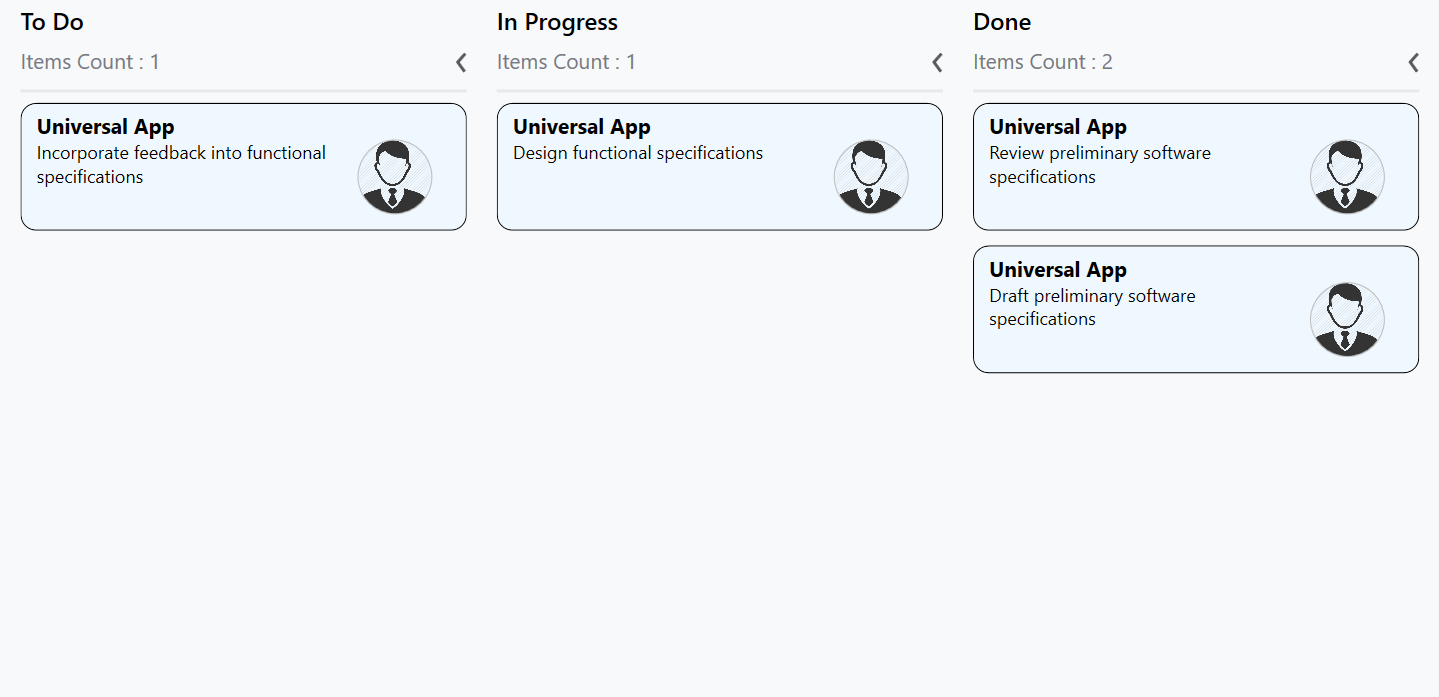
Cards Tooltip
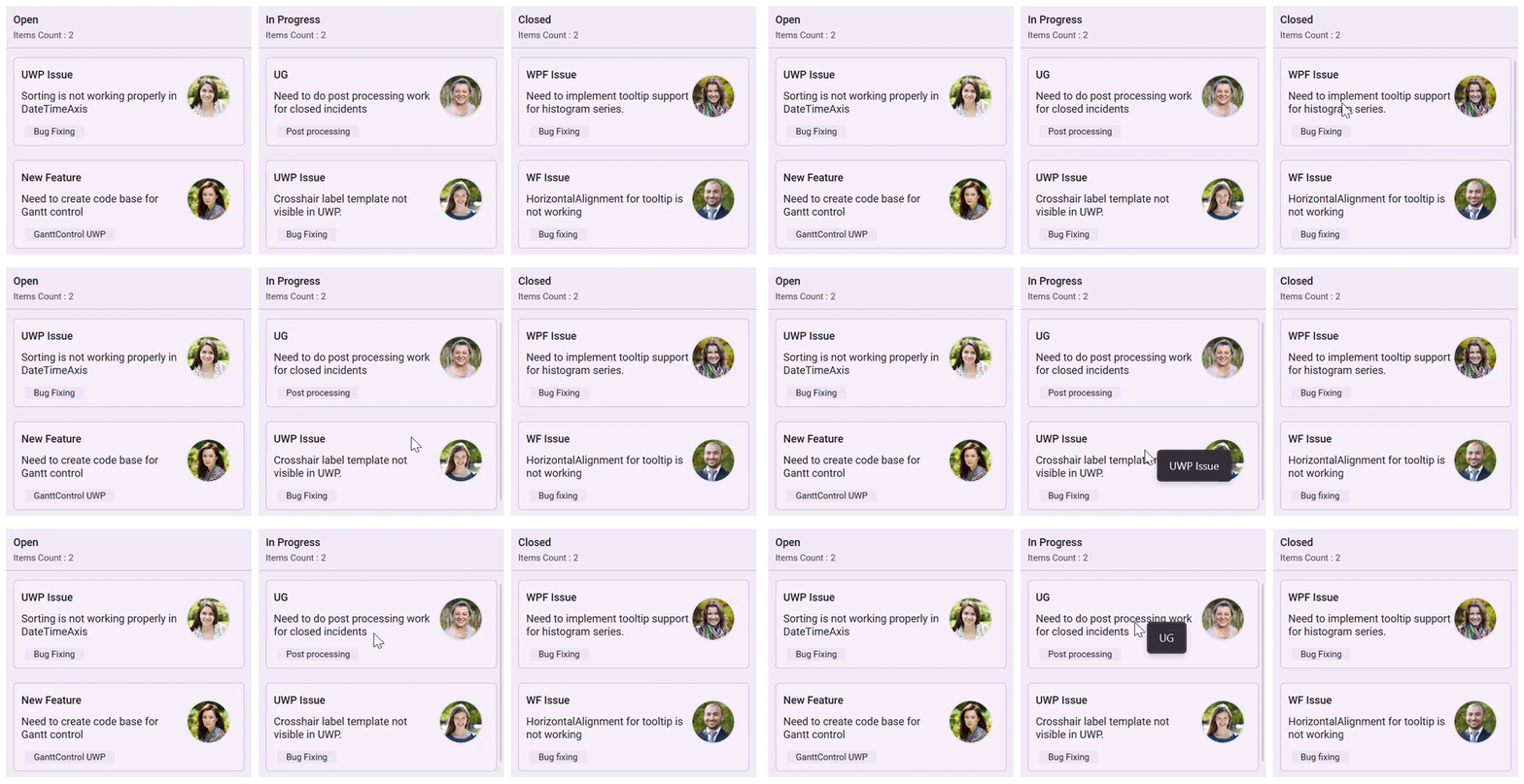
An interactive tooltip provides additional details about the cards when hovering the mouse over them.
Enable Tooltip for Cards
To enable the tooltip for the cards, use the IsToolTipEnabled property of SfKanban. By default, IsToolTipEnabled is set to false. To provide users with additional information or context about cards, set this property to true.
<kanban:SfKanban x:Name="kanban"
                 IsToolTipEnabled="True"
                 ItemsSource="{Binding Tasks}">
    <kanban:SfKanban.DataContext>
        <local:ViewModel />
    </kanban:SfKanban.DataContext>
</kanban:SfKanban>this.kanban.IsToolTipEnabled = true;using System.Collections.ObjectModel;
using Syncfusion.UI.Xaml.Kanban;
namespace GettingStarted
{
/// <summary>
/// Provides sample data for the SfKanban control.
/// </summary>
public class ViewModel
{
/// <summary>
/// Gets or sets the collection of <see cref="KanbanModel"/> objects representing tasks in various stages.
/// </summary>
public ObservableCollection<KanbanModel> Tasks { get; set; }
/// <summary>
/// Initializes a new instance of the <see cref="ViewModel"/> class.
/// </summary>
public ViewModel()
{
Tasks = new ObservableCollection<KanbanModel>();
KanbanModel task = new KanbanModel();
task.Title = "WPF Issue";
task.Description = "Sorting is not working properly in DateTimeAxis";
task.Category = "Open";
task.Tags = new string[] { "Bug Fixing" };
Tasks.Add(task);
task = new KanbanModel();
task.Title = "New Feature";
task.Description = "Need to create code base for Gantt control";
task.Category = "Open";
task.Tags = new string[] { "GanttControl" };
Tasks.Add(task);
task = new KanbanModel();
task.Title = "UG";
task.Description = "Need to do post processing work for closed incidents";
task.Category = "In Progress";
task.Tags = new string[] { "Post processing" };
Tasks.Add(task);
task = new KanbanModel();
task.Title = "WPF Issue";
task.Description = "Crosshair label template not visible in WPF.";
task.Category = "In Progress";
task.Tags = new string[] { "Bug Fixing" };
Tasks.Add(task);
task = new KanbanModel();
task.Title = "WPF Issue";
task.Description = "Need to implement tooltip support for histogram series.";
task.Category = "Closed";
task.Tags = new string[] { "Bug Fixing" };
Tasks.Add(task);
task = new KanbanModel();
task.Title = "WPF Issue";
task.Description = "HorizontalAlignment for tooltip is not working";
task.Category = "Closed";
task.Tags = new string[] { "Bug Fixing" };
Tasks.Add(task);
}
}
}
Customize Tooltip Appearance
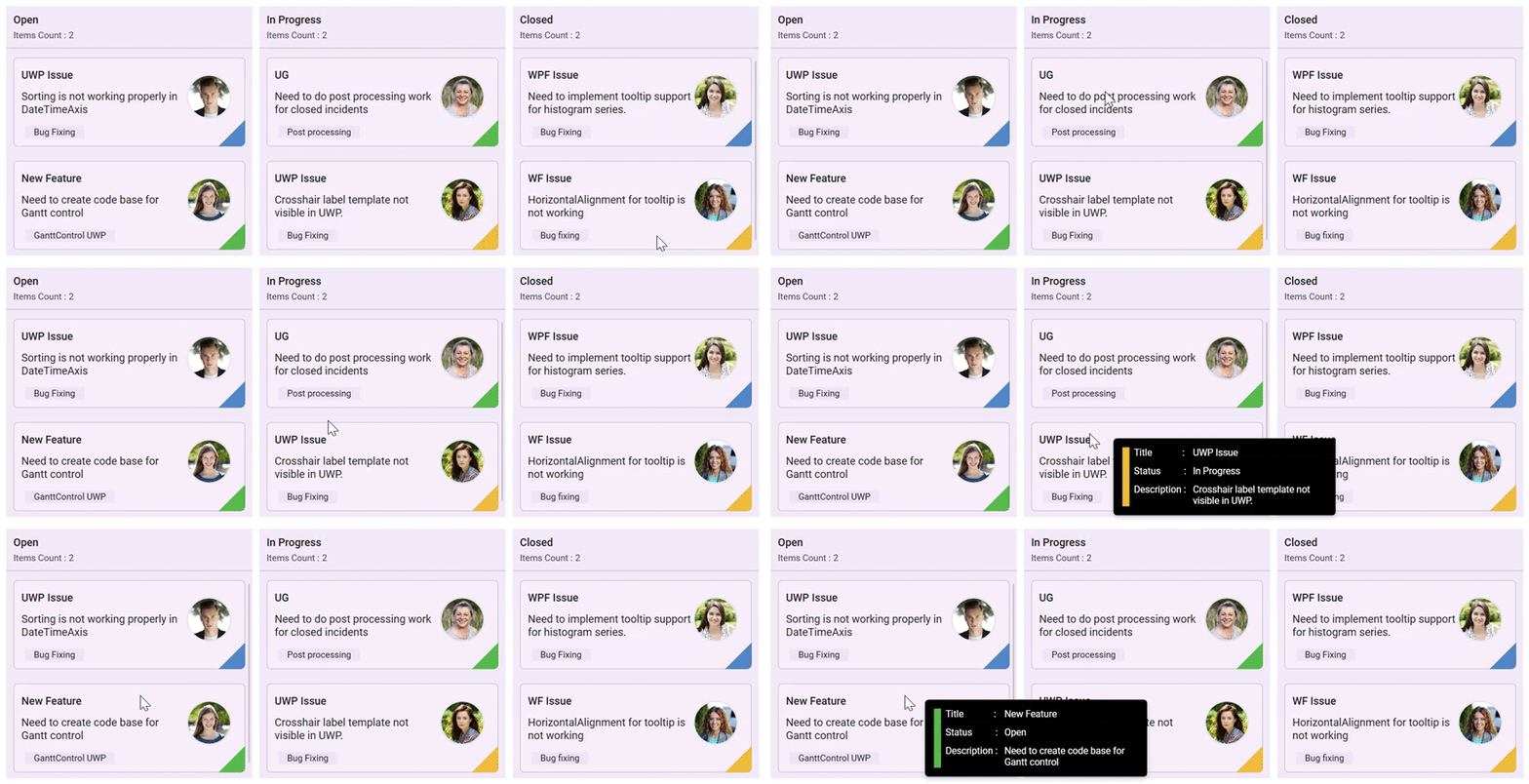
You can customize the tooltip appearance by using the ToolTipTemplate property of SfKanban.
The following code example shows the usage of DataTemplate:
<kanban:SfKanban x:Name="kanban"
                 IsToolTipEnabled="True"
                 ItemsSource="{Binding Tasks}"
                 ToolTipTemplate="{StaticResource KanbanToolTipTemplate}">
    <kanban:SfKanban.Resources>
        <DataTemplate x:Key="KanbanToolTipTemplate">
            <Border CornerRadius="4" Padding="10" Background="Black">
                <Grid>
                    <Grid.ColumnDefinitions>
                        <ColumnDefinition Width="Auto" />
                        <ColumnDefinition Width="*" />
                    </Grid.ColumnDefinitions>
                    <Rectangle Fill="DodgerBlue" Grid.Column="0" VerticalAlignment="Stretch"
                               HorizontalAlignment="Left" Width="8" Margin="0,0,5,0" />
                    <Grid Grid.Column="1">
                        <Grid.ColumnDefinitions>
                            <ColumnDefinition Width="Auto" />
                            <ColumnDefinition Width="*" />
                        </Grid.ColumnDefinitions>
                        <Grid.RowDefinitions>
                            <RowDefinition Height="Auto" />
                            <RowDefinition Height="Auto" />
                            <RowDefinition Height="Auto" />
                        </Grid.RowDefinitions>
                        <TextBlock Text="Title: " FontSize="10.5" Grid.Row="0" Grid.Column="0"
                                   Margin="0,0,0,8" Foreground="White" />
                        <TextBlock Text="{Binding Title}" Grid.Row="0" Grid.Column="1"
                                   FontSize="10.5" Margin="5,0,0,8" Foreground="White" />
                        <TextBlock Text="Status: " Margin="0,0,0,8" Grid.Row="1" Grid.Column="0"
                                   FontSize="10.5" Foreground="White" />
                        <TextBlock Text="{Binding Category}" Grid.Row="1" Grid.Column="1"
                                   FontSize="10.5" Margin="5,0,0,8" Foreground="White" />
                        <TextBlock Text="Description: " Grid.Row="2" Grid.Column="0"
                                   FontSize="10.5" Foreground="White" />
                        <TextBlock Text="{Binding Description}" Margin="5,0,0,0" Width="150"
                                   TextWrapping="Wrap" TextTrimming="CharacterEllipsis"
                                   FontSize="10.5" Grid.Row="2" Grid.Column="1" Foreground="White" />
                    </Grid>
                </Grid>
            </Border>
        </DataTemplate>
    </kanban:SfKanban.Resources>
    <kanban:SfKanban.DataContext>
        <local:ViewModel />
    </kanban:SfKanban.DataContext>
</kanban:SfKanban>this.kanban.IsToolTipEnabled = true;
this.kanban.ItemsSource = new ViewModel().Tasks;using System.Collections.ObjectModel;
using Syncfusion.UI.Xaml.Kanban;
namespace GettingStarted
{
/// <summary>
/// Provides sample data for the WPF Kanban Board control with custom tooltip styling.
/// </summary>
public class ViewModel
{
/// <summary>
/// Gets or sets the collection of <see cref="KanbanModel"/> objects representing tasks in various stages.
/// </summary>
public ObservableCollection<KanbanModel> Tasks { get; set; }
/// <summary>
/// Initializes a new instance of the <see cref="ViewModel"/> class.
/// </summary>
public ViewModel()
{
Tasks = new ObservableCollection<KanbanModel>();
KanbanModel task = new KanbanModel();
task.Title = "WPF Issue";
task.Description = "Sorting is not working properly in DateTimeAxis";
task.Category = "Open";
task.ColorKey = "#FF5187C6";
task.Tags = new string[] { "Bug Fixing" };
Tasks.Add(task);
task = new KanbanModel();
task.Title = "New Feature";
task.Description = "Need to create code base for Gantt control";
task.Category = "Open";
task.ColorKey = "#FF57B94C";
task.Tags = new string[] { "GanttControl" };
Tasks.Add(task);
task = new KanbanModel();
task.Title = "UG";
task.Description = "Need to do post processing work for closed incidents";
task.Category = "In Progress";
task.ColorKey = "#FF57B94C";
task.Tags = new string[] { "Post processing" };
Tasks.Add(task);
task = new KanbanModel();
task.Title = "WPF Issue";
task.Description = "Crosshair label template not visible in WPF.";
task.Category = "In Progress";
task.ColorKey = "#FFECB93C";
task.Tags = new string[] { "Bug Fixing" };
Tasks.Add(task);
task = new KanbanModel();
task.Title = "WPF Issue";
task.Description = "Need to implement tooltip support for histogram series.";
task.Category = "Closed";
task.ColorKey = "#FF5187C6";
task.Tags = new string[] { "Bug Fixing" };
Tasks.Add(task);
task = new KanbanModel();
task.Title = "WPF Issue";
task.Description = "HorizontalAlignment for tooltip is not working";
task.Category = "Closed";
task.ColorKey = "#FFECB93C";
task.Tags = new string[] { "Bug Fixing" };
Tasks.Add(task);
}
}
}
- The
ToolTipTemplateproperty will only be applicable whenIsToolTipEnabledis set totrue.