Localization Support for Syncfusion® WinUI Controls
18 Nov 20189 minutes to read
Localization is the process of making an application multilingual by formatting the content according to the languages. This involves configuring the application for a specific language. For example en-US is the language of English spoken in the United States, while en-GB is the language of English spoken in Great Britain. Syncfusion® WinUI controls can be localized by adding resource files for each language.
Changing application language
The application language can be changed by setting the desired language to the ApplicationLanguages.PrimaryLanguageOverride property in the constructor of the main window. Localization can be done while changing the application language by creating a .resw file.
public sealed partial class MainWindow : Window
    {
        public MainWindow()
        {
            Microsoft.Windows.Globalization.ApplicationLanguages.PrimaryLanguageOverride = "de";
            this.InitializeComponent();
        }
    }
For packaged deployments only
You can also use the Windows.Globalization.ApplicationLanguages.PrimaryLanguageOverride property. However, in unpackaged deployments, it may cause the app to crash.
public sealed partial class MainWindow : Window
    {
        public MainWindow()
        {
            Windows.Globalization.ApplicationLanguages.PrimaryLanguageOverride = "de";
            this.InitializeComponent();
        }
    }
We recommend setting the
ApplicationLanguages.PrimaryLanguageOverrideproperty before theInitializeComponentmethod call if you have added a .resw file to your project. Otherwise, it may cause the app to crash. The supported culture codes can be used as the language value (e.g.,defor German).
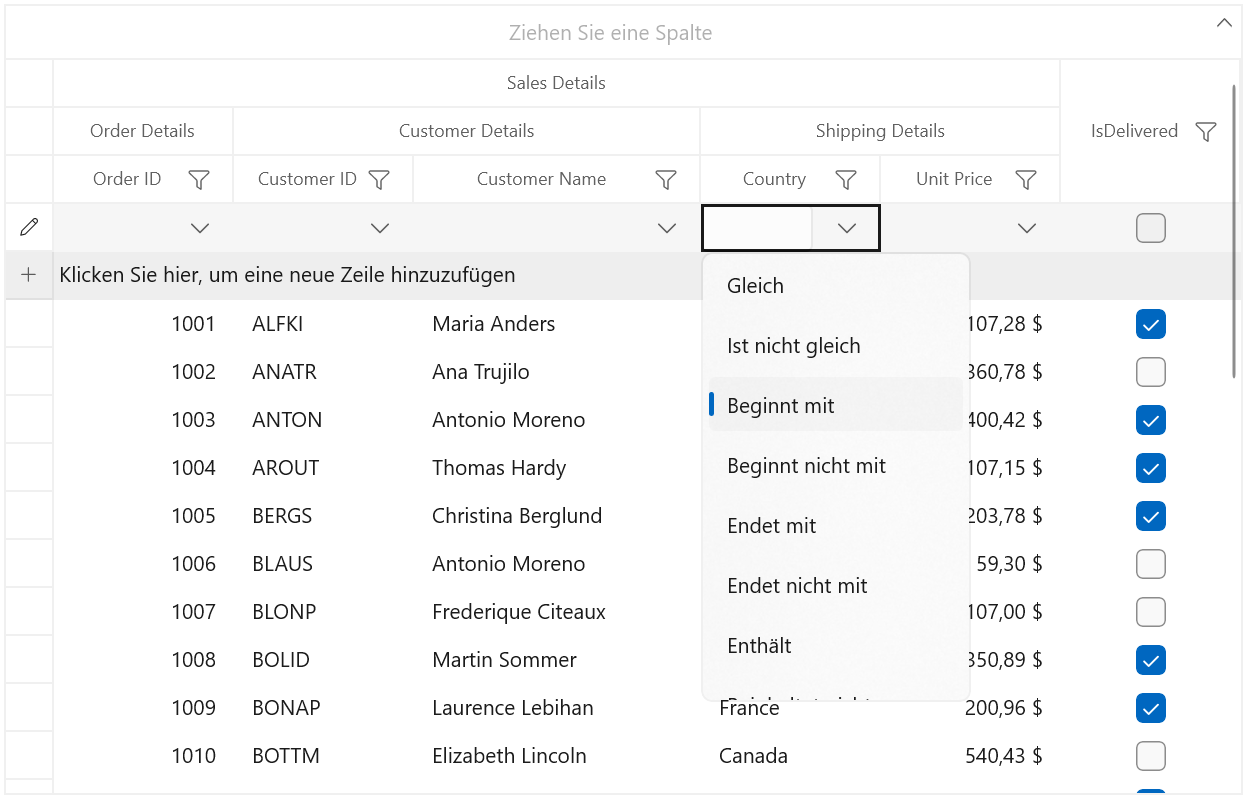
The following screenshot illustrates how the localization is applied to the datagrid based on the defined language to the ApplicationLanguages.PrimaryLanguageOverride property.
Creating .resw files
The following steps can be used to generate .resw files for any language:
The default resource files of all Syncfusion® WinUI libraries can be obtained from GitHub.
1) Right-click the project and add a new folder named Resources.
2) Add another folder named with the language name. For example, use de for German. Find the supported culture codes from here.
3) Add the default resource files in the following structure.
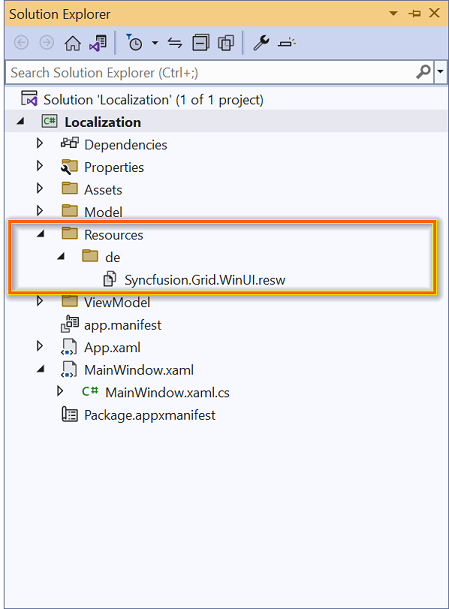
If the SfDataGrid control is used in the application, copy and paste the
Syncfusion.Grid.WinUI.resw(SfDataGrid is present in the Syncfusion.Grid.WinUI library) file into the Resources folder. These default files contain the key names and values of the default strings in the Syncfusion.Grid.WinUI library.
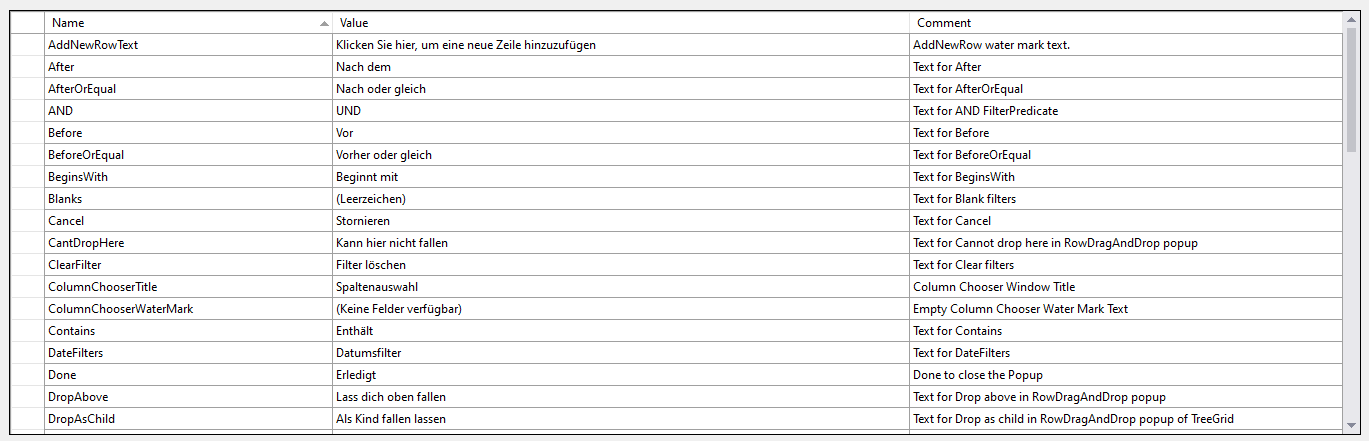
4) Now, the key names from default resource files can be defined and assigned values based on language.
Download demo from GitHub
Editing default language strings
The default string of any control can be changed by adding the default .resw files (from GitHub) to the Resources folder of the application. If the default string is added, Syncfusion® WinUI controls reads it from the .resw files of the application.
Localizing without using .resw files
You can localize the WinUI controls using the Provider property of the LocalizationProvider class.
To implement localization of Syncfusion WinUI controls without using .resw files, using a custom string, follow the steps below.
Implementation in sample:
The following procedure helps you localize WinUI controls using a string provider.
Step 1: Include the required namespace using Syncfusion.UI.Xaml.Core; at the beginning of the file. Refer to Syncfusion.UI.Xaml.Core for more information.
Step 2: Create a class that implements the ILocalizationProvider interface defined in the Syncfusion.UI.Xaml.Core namespace in the Syncfusion.Core.WinUI.dll.
Step 3: In the GetLocalizedString method, return a custom string value for a localizable key. If the same key name exists in two different assemblies, you can retrieve the specific assembly’s name along with the key to update the custom string for that key from the desired assembly by using the ResourceAssemblyName property of the LocalizationInfo parameter.
Step 4: Return null for the rest of the localizable keys that are not involved in the localization. These keys are loaded with a resource map if available; otherwise, they fall back to the default resource map.
Step 5: Assign the instance to the Provider property of the LocalizationProvider class, before the InitializeComponent call in the constructor of the application.
Registering the provider:
LocalizationProvider.Provider = new MyStringLoader();The following code example is a reference to assign a localization string to the DataGrid control in WinUI without using .resw files.
Implementing the provider:
using Syncfusion.UI.Xaml.Core;

public class MyStringLoader : ILocalizationProvider
{
    public string GetLocalizedString(LocalizationInfo info)
    {
        if (info.ResourceAssemblyName == "Syncfusion.Grid.WinUI" && info.ResourceName == "SortDateDescending")
        {
            return "CustomText";
        }

        switch (info.ResourceName)
        {
            case "AddNewRowText": // resource key from Syncfusion.Grid.WinUI assembly
                return "CustomText1";
            case "Automatic": // resource key from Syncfusion.Editors.WinUI assembly
                return "CustomText2";
            default:
                return null;
        }
    }
}public partial class App : Application
{
public App()
{
LocalizationProvider.Provider = new MyStringLoader();
this.InitializeComponent();
}
}Using
Provider(highest priority, overrides everything) - Uses your own implemented method for localization. Using aresource map(fallback option) - Uses your own created resource file. This file contains a table with keys values where we can set our own values.
Step 3: In a GetLocalizedString method, return Custom string value for a localizable key
If the same key name exists in two different assemblies, you can retrieve the specific assembly’s name along with the key to update the custom string for that key from the desired assembly by using ResourceAssemblyName
Step 4: Return null for the rest of the localizable keys that are not involved in the localization. These keys are loaded with a resource map if available, else it falls back to the default resource map.
Step 5: Assign the instance to the Provider property of the LocalizationProvider class, before the InitializeComponent call in the constructor of the application.
LocalizationProvider.Provider = new MyStringLoader();The following code example is a reference to assign Localization string to DataGrid Control in WinUI without using .resw
using Syncfusion.UI.Xaml.Core;

public class MyStringLoader : ILocalizationProvider
{
    public string GetLocalizedString(LocalizationInfo info)
    {
        if (info.ResourceAssemblyName == "Syncfusion.Grid.WinUI" && info.ResourceName == " SortDateDescending ")
        {
            return "CustomText";
        }

        switch (info.ResourceName)
        {
            case "AddNewRowText": // resource key from Syncfusion.Grid.WinUI assembly
                return "CustomText1";
            case "Automatic":   // resource key from Syncfusion.Editors.WinU assembly
                return "CustomText2";
            default:
                return null;
        }
    }
}public partial class App : Application
{
public App()
{
LocalizationProvider.Provider = new MyStringLoader();
this.InitializeComponent();
}
}Using
Provider(highest priority, overrides everything) - Uses your own implemented method for localization. Using aresource map(fallback option) - Uses your own created resource file. This file contains a table with keys values where we can set our own values.