Gradient Color Selection in WinUI Color Picker
18 Nov 201812 minutes to read
This section describes how to create gradient color brush, modify their colors and their properties available in Color Picker control.
What is a gradient color?
A gradient color paints an area with multiple colors that blend into each other along an axis. Color Picker now comes with Gradient tools which returns a brush of type Linear and Radial gradient colors. The offsets can be added or dropped dynamically and its position can be changed to produce different color combinations.
Select linear gradient brush programmatically
Linear Gradient color brush can be selected by the multiple colors and their location along the gradient axis using the GradientStop objects and StartPoint and EndPoint properties of LinearGradientBrush. Based on the StartPoint and EndPoint, the selected color brush will be combined in linear manner.
<editors:SfColorPicker x:Name="colorPicker">
    <editors:SfColorPicker.SelectedBrush>
        <LinearGradientBrush StartPoint="0,0" EndPoint="1,1">
            <GradientStop Color="Yellow" Offset="0.0" />
            <GradientStop Color="Red" Offset="0.25" />
            <GradientStop Color="Blue" Offset="0.75" />
            <GradientStop Color="LimeGreen" Offset="1.0" />
        </LinearGradientBrush>
    </editors:SfColorPicker.SelectedBrush>
</editors:SfColorPicker>
using Syncfusion.UI.Xaml.Editors;
using Microsoft.UI;
using Microsoft.UI.Xaml.Media;
using Windows.Foundation;
using Windows.UI;
//Creating the linear gradient brush
LinearGradientBrush linearGradient = new LinearGradientBrush();
linearGradient.StartPoint = new Point(0, 0);
linearGradient.EndPoint = new Point(1, 1);
linearGradient.GradientStops.Add(
new GradientStop() { Color = Colors.Yellow, Offset = 0.0 });
linearGradient.GradientStops.Add(
new GradientStop() { Color = Colors.Red, Offset = 0.25 });
linearGradient.GradientStops.Add(
new GradientStop() { Color = Colors.Blue, Offset = 0.75 });
linearGradient.GradientStops.Add(
new GradientStop() { Color = Colors.LimeGreen, Offset = 1.0 });
//Assigning a linear gradient brush to Color Picker
colorPicker.SelectedBrush = linearGradient;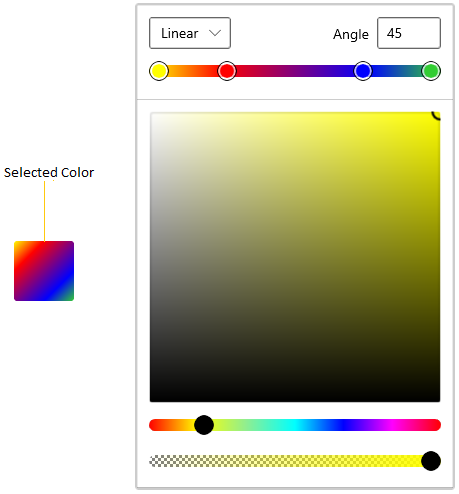
Download demo application from GitHub
Interactively select linear gradient brush
You can directly select a linear gradient color brush at runtime by creating multiple gradient stops and selecting a color for each stop. The created gradient stops are then combined to form a linear gradient color brush. You can enable the linear gradient mode by setting the BrushTypeOptions property value to LinearGradientBrush. The default value of the BrushTypeOptions property is All.
<editors:SfColorPicker BrushTypeOptions="LinearGradientBrush"
Name="colorPicker"/>colorPicker.BrushTypeOptions = BrushTypeOptions.LinearGradientBrush;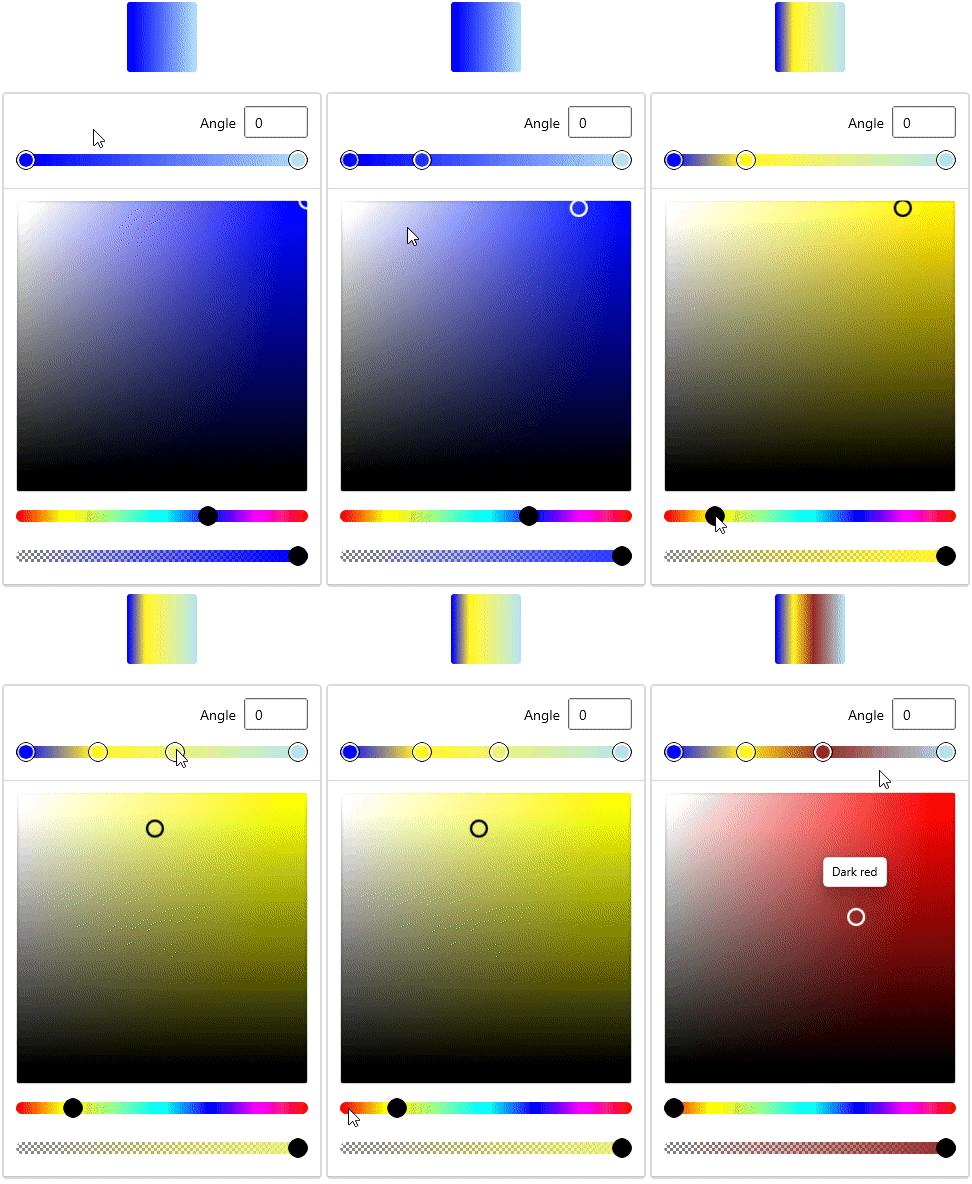
Download demo application from GitHub
Change angle of linear gradient brush
You can change the angle of the selected linear gradient color brush by entering a value in the Angle value editor, or programmatically by setting the Angle property of type double. The Angle value editor accepts values from 0 to 359. The default angle value is 0. The angle editor is shown only when the AxisInputOption property value is Simple.
<editors:SfColorPicker AxisInputOption="Simple"
                       BrushTypeOptions="LinearGradientBrush"
                       Name="colorPicker"/>
using Syncfusion.UI.Xaml.Editors;
colorPicker.AxisInputOption = AxisInputOption.Simple;
colorPicker.BrushTypeOptions = BrushTypeOptions.LinearGradientBrush;
Download demo application from GitHub
Change offset of linear gradient brush using value editor
You can change the offset of the selected linear gradient color brush by using the dedicated start- and end-point value editors. By default, the offset value editors are collapsed. To show them, set the AxisInputOption property value to Advanced.
<editors:SfColorPicker AxisInputOption="Advanced"
                       BrushTypeOptions="LinearGradientBrush"
                       Name="colorPicker"/>
using Syncfusion.UI.Xaml.Editors;
colorPicker.AxisInputOption = AxisInputOption.Advanced;
colorPicker.BrushTypeOptions = BrushTypeOptions.LinearGradientBrush;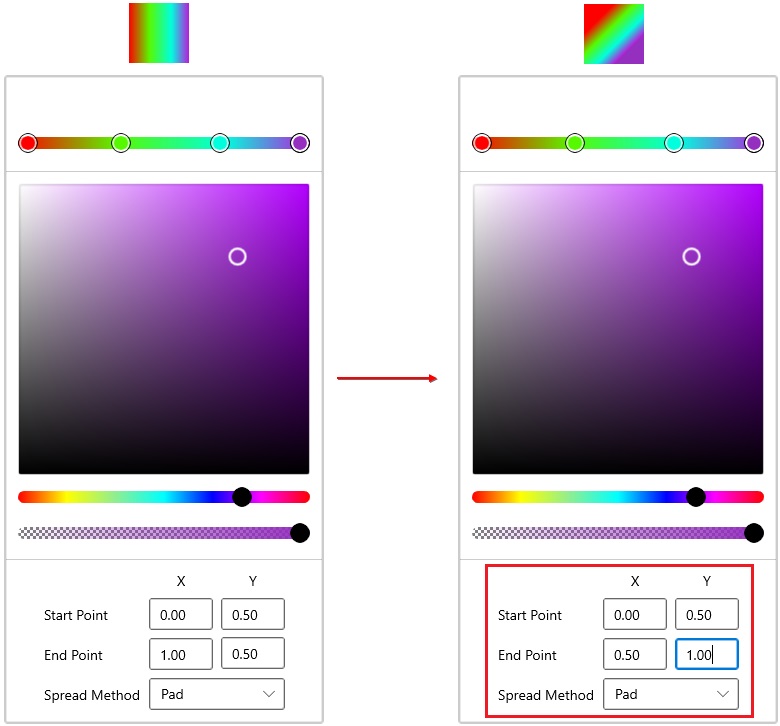
Download demo application from GitHub
Select radial gradient brush programmatically
Radial Gradient color brush is similar to Linear Gradient color brush, except for the axis defined by the circle. Based on the GradientOrigin, Center and radius point values, the selected gradient color brush are combined in a circle manner. You can programmatically select a radial gradient brush by using the RadialGradientBrush elements.
<editors:SfColorPicker x:Name="colorPicker">
    <editors:SfColorPicker.SelectedBrush>
        <RadialGradientBrush GradientOrigin="0.5,0.5"
                             Center="0.5,0.5"
                             RadiusX="0.5" RadiusY="0.5">
            <GradientStop Color="Yellow" Offset="0" />
            <GradientStop Color="Red" Offset="0.25" />
            <GradientStop Color="Blue" Offset="0.75" />
            <GradientStop Color="LimeGreen" Offset="1" />
        </RadialGradientBrush>
    </editors:SfColorPicker.SelectedBrush>
</editors:SfColorPicker>
using Syncfusion.UI.Xaml.Editors;
using Microsoft.UI;
using Microsoft.UI.Xaml.Media;
using Windows.Foundation;
using Windows.UI;
//Creating a radial gradient brush
RadialGradientBrush radialGradient = new RadialGradientBrush();
radialGradient.GradientOrigin = new Point(0.5, 0.5);
radialGradient.Center = new Point(0.5, 0.5);
radialGradient.RadiusX = 0.5;
radialGradient.RadiusY = 0.5;
radialGradient.GradientStops.Add(
new GradientStop() {Color=Colors.Yellow, Offset= 0.0 });
radialGradient.GradientStops.Add(
new GradientStop() {Color=Colors.Red, Offset = 0.25 });
radialGradient.GradientStops.Add(
new GradientStop() {Color=Colors.Blue, Offset = 0.75 });
radialGradient.GradientStops.Add(
new GradientStop() {Color=Colors.LimeGreen, Offset = 1.0 });
//Assigning a radial gradient brush to Color Picker
colorPicker.SelectedBrush = radialGradient;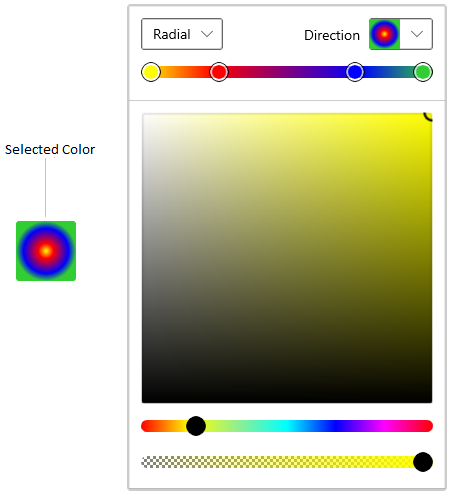
Download demo application from GitHub
Interactively select radial gradient brush
You can directly select a radial gradient color brush at runtime by creating multiple gradient stops and selecting a color for each stop. The created gradient stops are then combined to form a radial gradient color brush. You can enable the radial gradient mode by setting the BrushTypeOptions property value to RadialGradientBrush.
<editors:SfColorPicker BrushTypeOptions="RadialGradientBrush"
                       Name="colorPicker"/>
using Syncfusion.UI.Xaml.Editors;
colorPicker.BrushTypeOptions = BrushTypeOptions.RadialGradientBrush;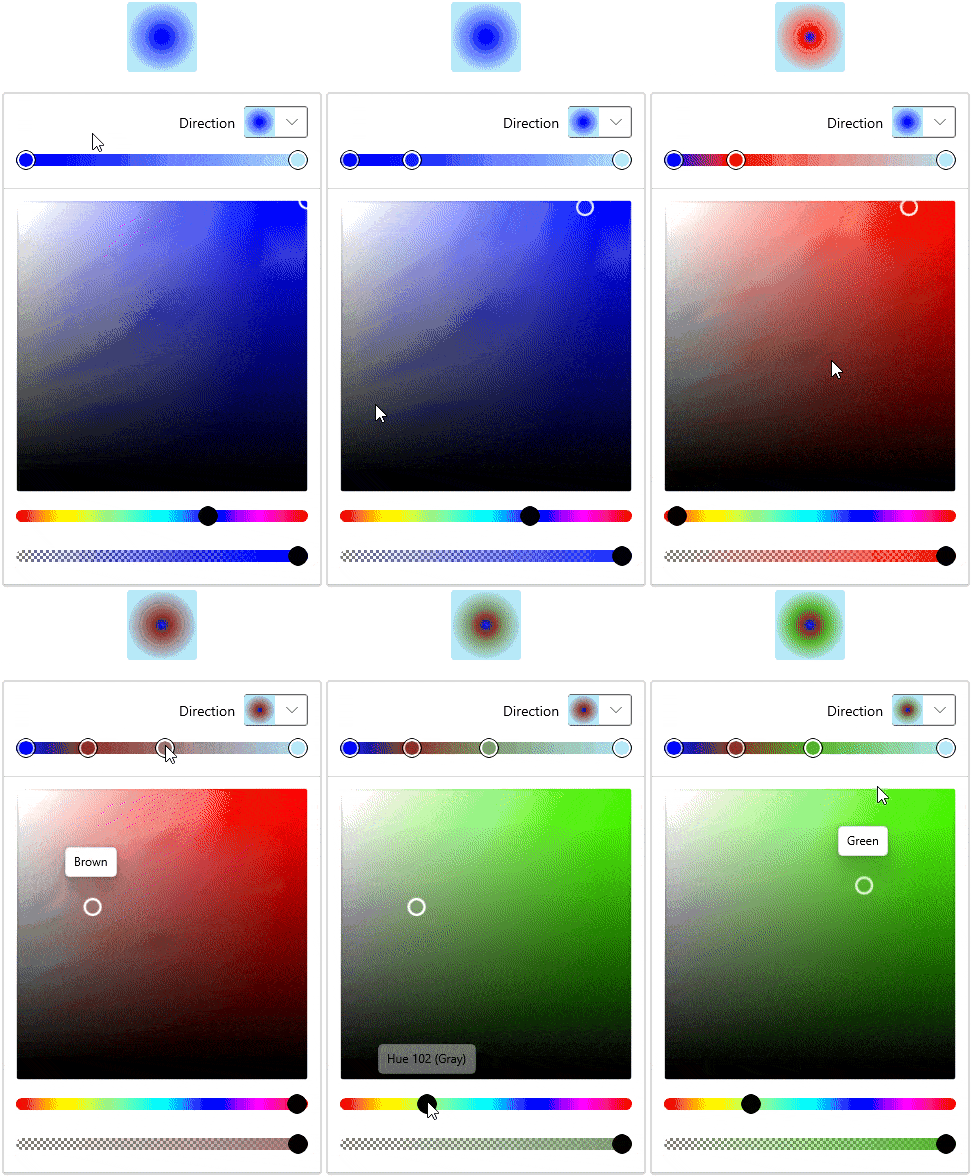
Download demo application from GitHub
Change direction of radial gradient brush
You can change the direction of the selected radial gradient color brush by selecting a direction from the drop-down list, or programmatically by setting the Direction property of type RadialGradientDirection. The supported values are TopLeft, TopRight, BottomLeft, and BottomRight. The direction option is shown only when the AxisInputOption property value is Simple.
<editors:SfColorPicker AxisInputOption="Simple"
                       BrushTypeOptions="RadialGradientBrush"
                       Name="colorPicker"/>
using Syncfusion.UI.Xaml.Editors;
colorPicker.AxisInputOption = AxisInputOption.Simple;
colorPicker.BrushTypeOptions = BrushTypeOptions.RadialGradientBrush;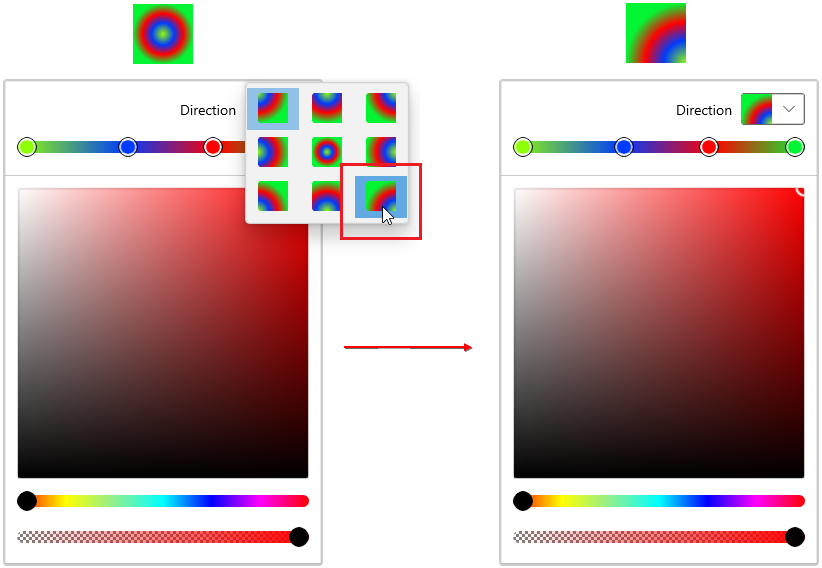
Download demo application from GitHub
Change offset of radial gradient brush using value editor
You can change the offset of the selected radial gradient color brush by using the dedicated center, origin, and radius value editors. To show the offset value editors, set the AxisInputOption property value to Advanced.
<editors:SfColorPicker AxisInputOption="Advanced"
                       BrushTypeOptions="RadialGradientBrush"
                       Name="colorPicker"/>
using Syncfusion.UI.Xaml.Editors;
colorPicker.AxisInputOption = AxisInputOption.Advanced;
colorPicker.BrushTypeOptions = BrushTypeOptions.RadialGradientBrush;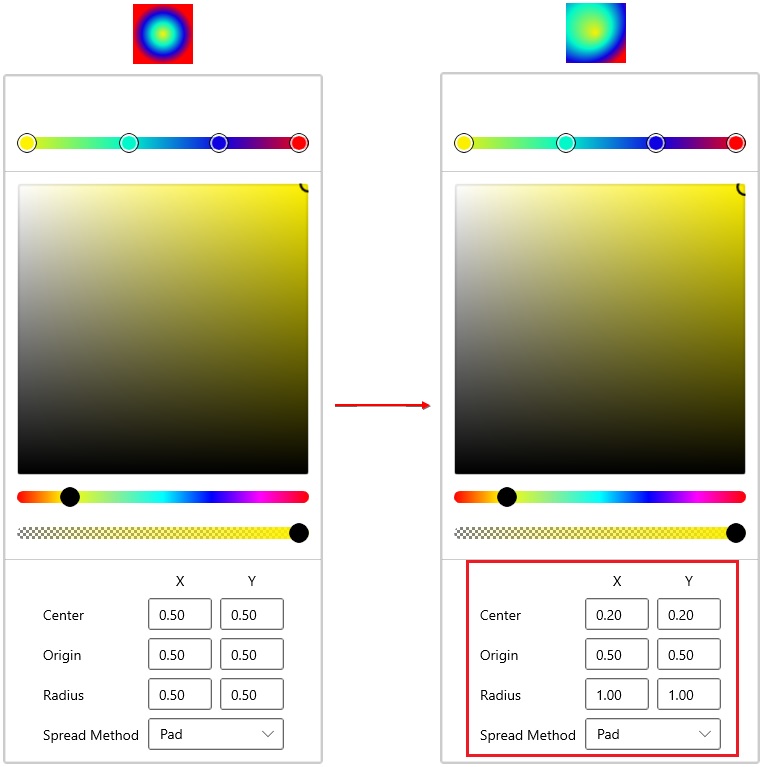
Download demo application from GitHub
Change opacity of gradient brush
You can change the opacity of the selected gradient color brush by using the dedicated slider in the Color Picker.
<editors:SfColorPicker BrushTypeOptions="LinearGradientBrush,RadialGradientBrush"
                       Name="colorPicker"/>
using Syncfusion.UI.Xaml.Editors;
SfColorPicker colorPicker = new SfColorPicker();
colorPicker.BrushTypeOptions = BrushTypeOptions.LinearGradientBrush | BrushTypeOptions.RadialGradientBrush;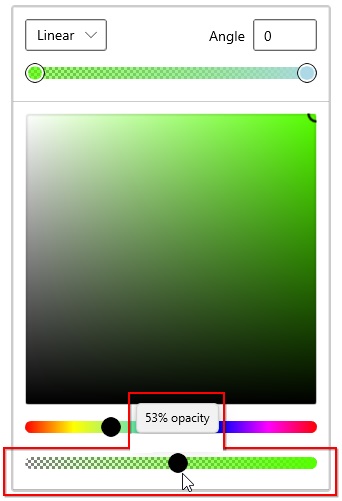
Download demo application from GitHub
Selected gradient brush changed notification
You will be notified when the selected gradient color brush changes in Color Picker by using the SelectedBrushChanged event. You can get the old and newly selected brush by using the OldBrush and NewBrush properties of the SelectedBrushChangedEventArgs class.
<editors:SfColorPicker BrushTypeOptions="SolidColorBrush,RadialGradientBrush"
                       SelectedBrushChanged="ColorPicker_SelectedBrushChanged"
                       Name="colorPicker"/>
using Syncfusion.UI.Xaml.Editors;
colorPicker.SelectedBrushChanged += ColorPicker_SelectedBrushChanged;
colorPicker.BrushTypeOptions = BrushTypeOptions.SolidColorBrush | BrushTypeOptions.RadialGradientBrush;You can handle the event as follows.
private void ColorPicker_SelectedBrushChanged(object sender, SelectedBrushChangedEventArgs args)
{
    var oldSelectedBrush = args.OldBrush;
    var newSelectedBrush = args.NewBrush;
}