Working with TimeSpanEdit in WPF TimeSpan Editor
18 Nov 201815 minutes to read
This section explains how to change the time value and time formats in the WPF TimeSpanEdit.
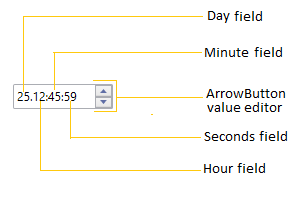
Day, hour and minute field navigation
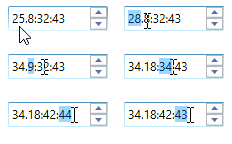
By default, the focus field will be navigated automatically after the value has been validated to the corresponding field. If you want to manually change the day, hour or minute values, before that you navigate to the respective field by using the mouse or move the Left-Right keys in the keyboard.
Increase or decrease the time fields with specific interval
If you want to increase or decrease the time span field values with specific interval, use the StepInterval property. Selected time span field will be increased or decreased based on StepInterval field value by pressing the Up-Down arrow keys, UpDown button in TimeSpanEdit or using mouse wheel. The default value of StepInterval property is {1.01:01:01}.
For example, if value is 1.1:1:10, seconds will increase or decrease in 10 seconds interval. Other fields will increase or decrease by 1 minute, hour, or day interval.
<Window
    . . .
    xmlns:syncfusion="http://schemas.syncfusion.com/wpf">
    <syncfusion:TimeSpanEdit StepInterval="1.1:1:10"
                         Value="25.08:33:10"
                         Name="timeSpanEdit" />
</Window>
using Syncfusion.Windows.Shared;
TimeSpanEdit timeSpanEdit = new TimeSpanEdit();
timeSpanEdit.StepInterval = new TimeSpan(1, 1, 1, 10);
timeSpanEdit.Value = new TimeSpan(25, 08, 33, 10);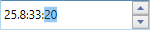
View Sample in GitHub
Change the time value
You can change the time value of TimeSpanEdit by programmatically and using mouse or key interactions.
Change time programmatically
You can set or change the selected time of the TimeSpanEdit programmatically by setting the value to the Value property.
<Window
    . . .
    xmlns:syncfusion="http://schemas.syncfusion.com/wpf">
    <syncfusion:TimeSpanEdit Value="10.11:32:43"
                         Name="timeSpanEdit" />
</Window>
using Syncfusion.Windows.Shared;
TimeSpanEdit timeSpanEdit = new TimeSpanEdit();
timeSpanEdit.Value = new TimeSpan(10, 11, 32, 43);
View Sample in GitHub
Change time using updown buttons
You can increase or decrease the selected time span field value based on the StepInterval value by pressing the Up or Down arrow buttons in the TimeSpanEdit. If you want to restrict the user from changing time by clicking the UpDown buttons, use the ShowArrowButtons property value as false. It will hide the Arrow buttons. The default value of ShowArrowButtons property is true.
<Window
    . . .
    xmlns:syncfusion="http://schemas.syncfusion.com/wpf">
    <syncfusion:TimeSpanEdit ShowArrowButtons="True"
                         Value="25.09:32:43"
                         Name="timeSpanEdit" />
</Window>
using Syncfusion.Windows.Shared;
TimeSpanEdit timeSpanEdit = new TimeSpanEdit();
timeSpanEdit.ShowArrowButtons = true;
timeSpanEdit.Value = new TimeSpan(25, 09, 32, 43);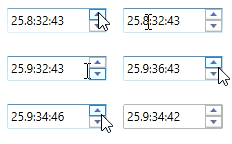
View Sample in GitHub
Change time on mouse wheel
You can increase or decrease the selected time span field value based on the StepInterval value by mouse scrolling over the TimeSpanEdit. If you want to restrict the user from changing time by using mouse scrolling, use the IncrementOnScrolling property value as false. The default value of IncrementOnScrolling property is true.
<Window
    . . .
    xmlns:syncfusion="http://schemas.syncfusion.com/wpf">
    <syncfusion:TimeSpanEdit IncrementOnScrolling="True"
                         Value="25.08:32:43"
                         Name="timeSpanEdit" />
</Window>
using Syncfusion.Windows.Shared;
TimeSpanEdit timeSpanEdit = new TimeSpanEdit();
timeSpanEdit.IncrementOnScrolling = true;
timeSpanEdit.Value = new TimeSpan(25, 08, 32, 43);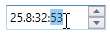
View Sample in GitHub
Change time on click and drag
You can increase or decrease the selected time span field value based on the StepInterval value by clicking and dragging the mouse on up or down, use the EnableExtendedScrolling property value as true. This is effective only when the control is in unfocused state. The default value of EnableExtendedScrolling property is false.
<Window
    . . .
    xmlns:syncfusion="http://schemas.syncfusion.com/wpf">
    <syncfusion:TimeSpanEdit EnableExtendedScrolling="True"
                         Value="25.08:33:10"
                         Name="timeSpanEdit" />
</Window>
using Syncfusion.Windows.Shared;
TimeSpanEdit timeSpanEdit = new TimeSpanEdit();
timeSpanEdit.EnableExtendedScrolling = true;
timeSpanEdit.Value = new TimeSpan(25, 08, 33, 10);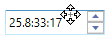
View Sample in GitHub
Change time using keyboard interaction
You can increase or decrease the selected time span field value based on the StepInterval value by pressing Up-Arrow and Down-Arrow keys in keyboard.
Setting null value
If you want to set null value for the TimeSpanEdit, use the AllowNull property value as true and Value property as null. If AllowNull property is false, then the default time is displayed.
<Window
    . . .
    xmlns:syncfusion="http://schemas.syncfusion.com/wpf">
    <syncfusion:TimeSpanEdit AllowNull="True"
                         Value="{x:Null}"
                         Name="timeSpanEdit" />
</Window>
using Syncfusion.Windows.Shared;
TimeSpanEdit timeSpanEdit = new TimeSpanEdit();
timeSpanEdit.AllowNull = true;
timeSpanEdit.Value = null;
View Sample in GitHub
Show watermark when value is null
If you want to display any watermark text instead of null value, use the NullString property to setting the watermark text. You can enable it by setting the AllowNull property as true and Value property as null. The default value of NullString property is string.Empty.
<Window
    . . .
    xmlns:syncfusion="http://schemas.syncfusion.com/wpf">
    <syncfusion:TimeSpanEdit NullString="Edit here..."
                         AllowNull="True"
                         Value="{x:Null}"
                         Name="timeSpanEdit" />
</Window>
using Syncfusion.Windows.Shared;
TimeSpanEdit timeSpanEdit = new TimeSpanEdit();
timeSpanEdit.NullString = "Edit here...";
timeSpanEdit.AllowNull = true;
timeSpanEdit.Value = null;
View Sample in GitHub
Change display format of time span
You can format each field to show what the numerals denote, i.e. days, hours, or minutes by using the Format property. The default value of Format is d.h:m:s. You can show only the days, hours or minutes values by using any one of the following respective fields to the Format property.
- d - It displays the days value.
- h - It displays the hours value.
- m - It displays the minutes value.
- s - It displays the seconds value.
<Window
    . . .
    xmlns:syncfusion="http://schemas.syncfusion.com/wpf">
    <syncfusion:TimeSpanEdit Format="d 'days' h 'hours' m 'minutes' s 'sec'"
                         Value="25.08:33:10"
                         Name="timeSpanEdit" />
</Window>
using Syncfusion.Windows.Shared;
TimeSpanEdit timeSpanEdit = new TimeSpanEdit();
timeSpanEdit.Format = "d 'days' h 'hours' m 'minutes' s 'sec'";
timeSpanEdit.Value = new TimeSpan(25, 08, 33, 10);
View Sample in GitHub
Display milliseconds
If you want to show the milliseconds in the time span, use the character z in the format string of the Format property.
- z - It displays the milliseconds value.
<Window
    . . .
    xmlns:syncfusion="http://schemas.syncfusion.com/wpf">
    <syncfusion:TimeSpanEdit Format=" d 'days' h 'hours' m 'minutes' s 'sec' z 'msec'"
                         Value="25.08:33:10.6"
                         Name="timeSpanEdit" />
</Window>
using Syncfusion.Windows.Shared;
TimeSpanEdit timeSpanEdit = new TimeSpanEdit();
timeSpanEdit.Format = @" d 'days' h 'hours' m 'minutes' s 'sec' z 'msec'";
timeSpanEdit.Value = new TimeSpan(25, 08, 33, 10, 6);
View Sample in GitHub
Value Changed Notification
The selected time span changed in TimeSpanEdit can be examined using ValueChanged event. The ValueChanged event contains the old and newly selected time span values in the OldValue and NewValue properties.
<Window
    . . .
    xmlns:syncfusion="http://schemas.syncfusion.com/wpf">
    <syncfusion:TimeSpanEdit ValueChanged="TimeSpanEdit_ValueChanged"
                         Name="timeSpanEdit" />
</Window>
using Syncfusion.Windows.Shared;
TimeSpanEdit timeSpanEdit = new TimeSpanEdit();
timeSpanEdit.ValueChanged += TimeSpanEdit_ValueChanged;You can handle this event as follows,
private void TimeSpanEdit_ValueChanged(DependencyObject d, DependencyPropertyChangedEventArgs e) {
    //Get old and new values
    var oldValue = e.OldValue;
    var newValue = e.NewValue;
}
ReadOnly support
If you want to restrict the inputs from the user, use the IsReadOnly property value as true. However, value can be changed programmatically in readonly mode and the user can still select text. The default value of IsReadOnly property is false.
<Window
    . . .
    xmlns:syncfusion="http://schemas.syncfusion.com/wpf">
    <syncfusion:TimeSpanEdit IsReadOnly="True"
                         Name="timeSpanEdit" />
</Window>
using Syncfusion.Windows.Shared;
TimeSpanEdit timeSpanEdit = new TimeSpanEdit();
timeSpanEdit.IsReadOnly = true;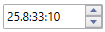
View Sample in GitHub
Restrict the time within minimum and maximum time span
The selecting time in TimeSpanEdit can be restricted within the maximum and minimum time span limits. Once the selected time has reached the minimum or maximum time span limits, the selected time does not exceed the limit. You can change the minimum and maximum time span limits by using the MinValue and MaxValue properties.
<Window
    . . .
    xmlns:syncfusion="http://schemas.syncfusion.com/wpf">
    <syncfusion:TimeSpanEdit MinValue="2.0:0:0"
                         MaxValue="10.0:0:0"
                         Value="5.2:25:52"
                         Name="timeSpanEdit" />
</Window>
using Syncfusion.Windows.Shared;
TimeSpanEdit timeSpanEdit = new TimeSpanEdit();
timeSpanEdit.MinValue = new TimeSpan(2, 0, 0, 0);
timeSpanEdit.MaxValue = new TimeSpan(10, 0, 0, 0);
timeSpanEdit.Value = new TimeSpan(5, 2, 25, 52);
View Sample in GitHub