Getting Started with Blazor Hybrid WinForms PDF Viewer
14 Aug 20268 minutes to read
This section explains how to add the Blazor SfPdfViewer to a WinForms Blazor Hybrid App using Visual Studio or Visual Studio Code. The result is a desktop (WinForms) application that hosts Blazor UI inside a BlazorWebView control.
Prerequisites
- System requirements for Blazor components
- .NET 8.0 SDK installed (required by the pinned
Microsoft.AspNetCore.Components.WebView.WindowsForms8.0.16 package). - Visual Studio 2022 version 17.8 or later with the .NET desktop development workload installed.
Create a new WinForms app in Visual Studio
- Open Visual Studio 2022.
- Go to File → New → Project….
- Choose the Windows Forms App (.NET) template (C#) and click Next.
- Set the project name to
WinFormsBlazorHybridApp(or any preferred name) and click Next. - From the Framework dropdown, select .NET 8.0 (Long Term Support) and click Create.
The app hosts Blazor components via BlazorWebView. For reference, see Microsoft Blazor tooling or the Syncfusion® Blazor Extension.
Install Blazor PDF Viewer NuGet packages
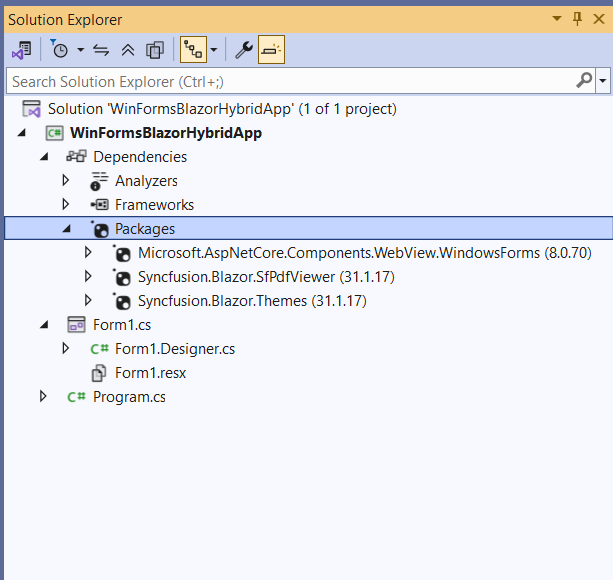
To add the Blazor PDF Viewer component, open the NuGet package manager in Visual Studio (Tools → NuGet Package Manager → Manage NuGet Packages for Solution), then install:
- Syncfusion.Blazor.SfPdfViewer
- Syncfusion.Blazor.Themes
- Microsoft.AspNetCore.Components.WebView.WindowsForms
Ensure the package
Microsoft.AspNetCore.Components.WebView.WindowsFormsis updated to version8.0.16so it is compatible with the .NET 8 target framework used by this tutorial.
Prerequisites
Create a new WinForms app in Visual Studio Code
Create a WinForms desktop project (not a WinForms Blazor Hybrid App) using the .NET CLI in Visual Studio Code. This WinForms project hosts Blazor UI through BlazorWebView. For guidance, see Microsoft templates or the Syncfusion® Blazor Extension.
dotnet new winforms -n WinFormsBlazorHybridAppInstall Blazor SfPdfViewer and Themes NuGet packages in the app
Install the required NuGet packages in the WinForms project that will host the Blazor UI.
- Press Ctrl+` to open the integrated terminal in Visual Studio Code.
- Ensure the current directory contains the WinForms project
.csprojfile. - Run the following commands to install Syncfusion.Blazor.SfPdfViewer, Syncfusion.Blazor.Themes, and Microsoft.AspNetCore.Components.WebView.WindowsForms. This adds the PDF Viewer, theme, and the BlazorWebView host control.
dotnet add package Syncfusion.Blazor.SfPdfViewer -v 35.1.37
dotnet add package Syncfusion.Blazor.Themes -v 35.1.37
dotnet add package Microsoft.AspNetCore.Components.WebView.WindowsForms
dotnet restore
- Syncfusion® Blazor components are available on nuget.org. See NuGet packages for package details.
- Ensure the package
Microsoft.AspNetCore.Components.WebView.WindowsFormsis updated to version8.0.16so it is compatible with the .NET 8 target framework used by this tutorial.
Configure the WinForms project
The WinForms project must target Windows, enable WinForms, and opt in to Razor components so that BlazorWebView and Syncfusion® Blazor components can be hosted. A complete WinFormsBlazorHybridApp.csproj looks like the following.
<Project Sdk="Microsoft.NET.Sdk.Razor">

    ....

</Project>
The
Microsoft.AspNetCore.Components.WebView.WindowsForms8.0.16 package requiresTargetFrameworkto benet8.0-windows(or anynet8.0-*TFM) andUseRazorComponentsto betrue.
Create the Component folder and _Imports.razor
- Right-click the project node in Solution Explorer and select Add → New Folder. Name it
Components. - Right-click the new
Componentsfolder and select Add → New Item → Razor Component. Name it_Imports.razor. - Add the required namespaces to the
_Imports.razorfile so they apply to every Razor component in this folder.
@using Microsoft.AspNetCore.Components.Web
@using Syncfusion.Blazor
@using Syncfusion.Blazor.SfPdfViewer
Create the wwwroot folder and index.html
- In Solution Explorer, right-click the project and select Add → New Folder. Name it
wwwroot. - Right-click the
wwwrootfolder and select Add → New Item → HTML Page. Name itindex.html. This file becomes the host page for the Blazor UI; it initializes the Blazor runtime and loads static assets such as themes and scripts.
<!DOCTYPE html>
<html>
<head>
    <meta charset="utf-8" />
    <meta name="viewport" content="width=device-width, initial-scale=1.0" />
    <title>WinForms Blazor Hybrid App</title>
    <base href="/" />
    <link href="_content/Syncfusion.Blazor.Themes/bootstrap5.css" rel="stylesheet" />
</head>
<body>
    <div id="app">Loading...</div>
    <script src="_framework/blazor.webview.js"></script>
    <script src="_content/Syncfusion.Blazor.SfPdfViewer/scripts/syncfusion-blazor-sfpdfviewer.min.js" type="text/javascript"></script>
</body>
</html>- In Solution Explorer, right-click
wwwroot/index.html, choose Properties, and set Build Action to Content and Copy to Output Directory to Copy if newer so the file is deployed next to the WinForms executable.
Ensure that the PDF Viewer static assets (themes and scripts) are loaded properly. If they are missing, the viewer UI will render without styling or scripting.
Register Syncfusion® Blazor services and the BlazorWebView
Add the following using directives to Form1.cs so the WinForms host can resolve Blazor types and the project’s Components namespace.
using Microsoft.AspNetCore.Components.WebView.WindowsForms;
using Microsoft.Extensions.DependencyInjection;
using Syncfusion.Blazor;
using WinFormsBlazorHybridApp.Components;
Register the Syncfusion® Blazor services and the BlazorWebView in Form1.cs so the WinForms window can host Blazor components.
ServiceCollection services = new ServiceCollection();
services.AddWindowsFormsBlazorWebView();
services.AddMemoryCache();
services.AddSyncfusionBlazor();
BlazorWebView blazorWebView = new BlazorWebView()
{
    HostPage = "wwwroot\\index.html",
    Services = services.BuildServiceProvider(),
    Dock = DockStyle.Fill
};
blazorWebView.RootComponents.Add<YourRazorFileName>("#app");
<!-- Replace 'YourRazorFileName' with the actual Razor component class (e.g., Main) in your project's namespace -->
this.Controls.Add(blazorWebView);
Replace
WinFormsBlazorHybridApp.Componentswith the actual root namespace of your project if it differs from the project name.
Add the Blazor PDF Viewer component
Create a Razor component inside the Components folder. In Solution Explorer, right-click Components, choose Add → New Item → Razor Component, and name it PdfViewer.razor.
@using Syncfusion.Blazor.SfPdfViewer

<SfPdfViewer2 DocumentPath="https://cdn.syncfusion.com/content/pdf/pdf-succinctly.pdf"
              Height="100%"
              Width="100%" />
- If the DocumentPath property is not set, the PDF Viewer renders without loading a document. Users can use the Open toolbar option to browse and open a PDF.
DocumentPathcan point to a remote URL (as shown), a relative URL to a file copied towwwroot, or a stream/byte array supplied programmatically. When loading a local file, ensure the file is configured to copy to the output directory.
Run the app
- Visual Studio: Press F5 (with debugging) or Ctrl+F5 (without debugging).
-
Visual Studio Code: From the terminal, run
dotnet runin the project folder.
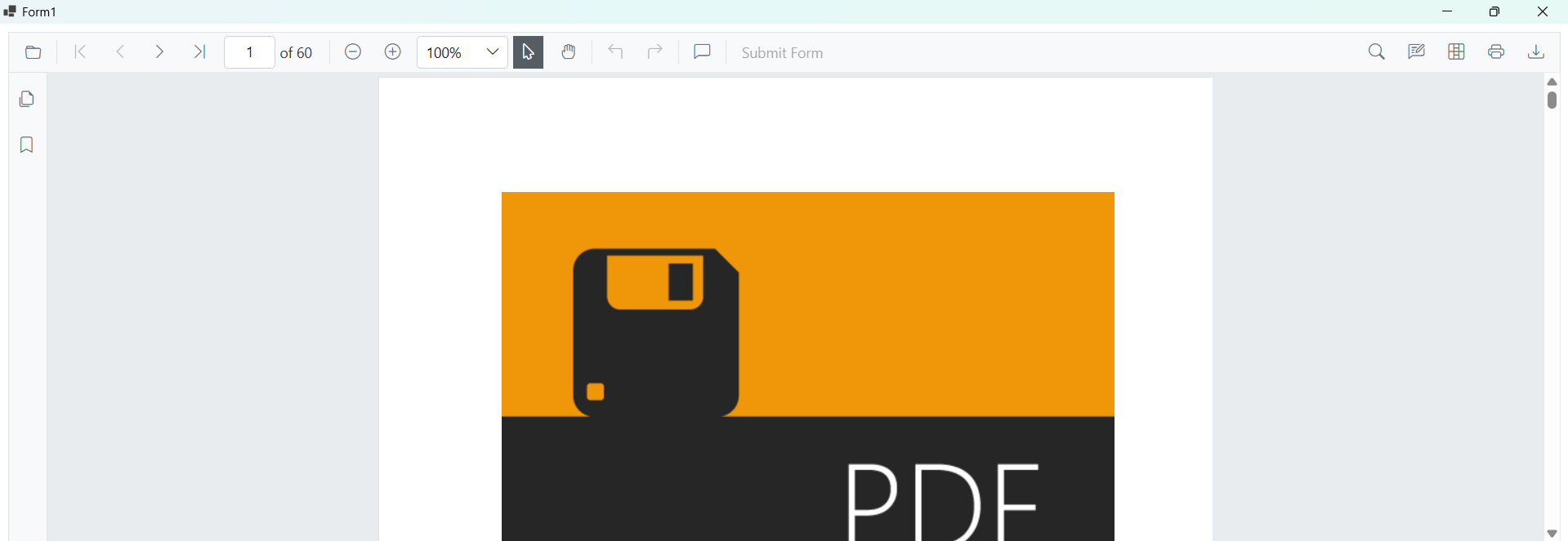
The Blazor PDF Viewer renders inside the WinForms window.
View the sample on GitHub. Looking for the full Blazor PDF Viewer component overview, features, pricing, and documentation? Visit the Blazor PDF Viewer page.
See also
- Getting Started with Blazor PDF Viewer Component in Blazor WASM App
- Getting Started with Blazor PDF Viewer Component in Blazor Web App
- Getting Started with Blazor PDF Viewer Component in WPF Blazor Hybrid App
-
Getting Started with Blazor PDF Viewer Component in MAUI Blazor App
- Processing Large Files Without Increasing Maximum Message Size in SfPdfViewer Component