Blazor DataGrid in a standalone Blazor Server app using .NET CLI
18 Nov 201824 minutes to read
This article provides step-by-step instructions to build a standalone Blazor Server app with Blazor DataGrid using the .NET CLI. The guidance aligns with .NET 8/9 Blazor Server project standards.
Manually creating a project
This section explains how to manually create a Blazor Server app using the CLI.
Prerequisites
Install the latest .NET SDK for .NET 8/9. To verify installed SDKs, run:
dotnet --list-sdksTo check the current default .NET SDK version installed on a system, run the following command in a terminal or command prompt:
dotnet --versionCreate a standalone Blazor Server side project using .NET Core CLI
To create a new standalone Blazor Server application using the .NET CLI, run the following command:
dotnet new blazorserver -o BlazorApp
cd BlazorApp
This command creates a new standalone Blazor Server app and places it in a directory named BlazorApp within the current working location. For more details, refer to the Create a Blazor app and dotnet new CLI documentation.
NOTE
If multiple SDK versions are installed and a specific target framework (for example, net8.0/net9.0) is required, add the -f flag with the dotnet new blazorserver command. Refer to the dotnet new options for available flags.
Install Blazor DataGrid and Themes NuGet in the app
To add the Syncfusion.Blazor.Grid NuGet package to the application, use the following command in the command prompt (Windows) or terminal (Linux/macOS). For more details, refer to Install and manage packages using the dotnet CLI.
dotnet add package Syncfusion.Blazor.Grid --version 33.2.3
dotnet add package Syncfusion.Blazor.Themes --version 33.2.3
dotnet restore
NOTE
Syncfusion® Blazor components are available on nuget.org. Refer to the NuGet packages topic for the list of available packages and component details. If a project requires a Syncfusion license key, see the licensing topic to register it at startup.
Register Syncfusion® Blazor service
- Import namespaces:
Open the ~/_Imports.razor file and add the following namespaces:
@using Syncfusion.Blazor
@using Syncfusion.Blazor.Grids- Register the Syncfusion® service:
In the ~/Program.cs file, register the Syncfusion® Blazor service as shown below:
using Microsoft.AspNetCore.Components;
using Microsoft.AspNetCore.Components.Web;
using Syncfusion.Blazor;

var builder = WebApplication.CreateBuilder(args);

// Add services to the container.
builder.Services.AddRazorPages();
builder.Services.AddServerSideBlazor();
builder.Services.AddSyncfusionBlazor();

var app = builder.Build();
....
Add stylesheet and script resources
The theme stylesheet and script can be accessed from NuGet through Static Web Assets. Reference the stylesheet and script in the <head> section of the main layout page as shown below:
- For .NET 8 and .NET 9 Blazor Server apps, include them in the ~/Pages/_Host.cshtml file.
<head>
    ....
    <link href="_content/Syncfusion.Blazor.Themes/bootstrap5.css" rel="stylesheet" />
</head>

<body>
    ....
    <script src="_content/Syncfusion.Blazor.Core/scripts/syncfusion-blazor.min.js" type="text/javascript"></script>
</body>
NOTE
Review the Blazor Themes topic to learn various methods (Static Web Assets, CDN, and CRG) for referencing themes in a Blazor application. Also, see Adding Script Reference for approaches to add script references.
Add Blazor DataGrid
Add the Blazor DataGrid in the ~/Pages/Index.razor file.
@using Syncfusion.Blazor.Grids

<SfGrid DataSource="@Orders"></SfGrid>

@code {
    public List<OrderData> Orders { get; set; }

    protected override void OnInitialized()
    {
        Orders = OrderData.GetAllRecords();
    }
}
public class OrderData
{
public static List<OrderData> Orders = new List<OrderData>();
public OrderData()
{
}
public OrderData( int? OrderID, string CustomerID)
{
this.OrderID = OrderID;
this.CustomerID = CustomerID;
}
public static List<OrderData> GetAllRecords()
{
if (Orders.Count() == 0)
{
int code = 10;
for (int i = 1; i < 2; i++)
{
Orders.Add(new OrderData(1, "ALFKI"));
Orders.Add(new OrderData(2, "ALFKI"));
Orders.Add(new OrderData(3, "ANANTR"));
Orders.Add(new OrderData(4, "ANANTR"));
Orders.Add(new OrderData(5, "ALFKI"));
code += 5;
}
}
return Orders;
}
public int? OrderID { get; set; }
public string CustomerID { get; set; }
}- To build and run the Blazor Server app, use the following command in the terminal or command prompt:
dotnet run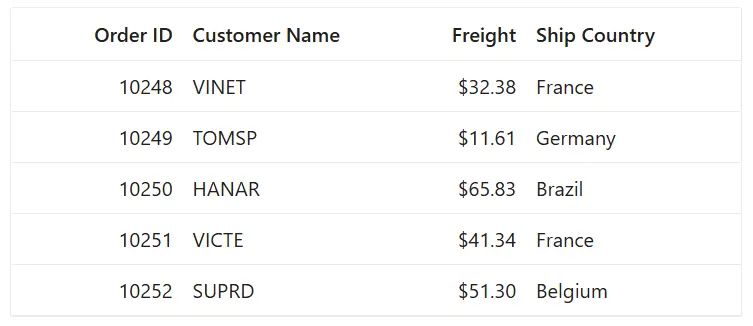
Defining row data
To bind data for the Blazor DataGrid, assign a List<OrderData> (or any collection that implements IEnumerable<OrderData>) to the DataSource property. The list data source can also be provided as an instance of the DataManager. The data source is typically assigned in the OnInitialized lifecycle method of the page.
@using Syncfusion.Blazor.Grids

<SfGrid DataSource="@Orders"></SfGrid>

@code {
    public List<OrderData> Orders { get; set; }

    protected override void OnInitialized()
    {
        Orders = OrderData.GetAllRecords();
    }
}
public class OrderData
{
public static List<OrderData> Orders = new List<OrderData>();
public OrderData()
{
}
public OrderData( int? OrderID, string CustomerID, DateTime? OrderDate, double? Freight)
{
this.OrderID = OrderID;
this.CustomerID = CustomerID;
this.OrderDate = OrderDate;
this.Freight = Freight;
}
public static List<OrderData> GetAllRecords()
{
if (Orders.Count() == 0)
{
int code = 10;
for (int i = 1; i < 2; i++)
{
Orders.Add(new OrderData(10248, "VINET",new DateTime(1996,07,07), 32.38));
Orders.Add(new OrderData(10249, "TOMSP", new DateTime(1996, 07, 07), 92.38));
Orders.Add(new OrderData(10250, "HANAR", new DateTime(1996, 07, 07), 62.77));
Orders.Add(new OrderData(10251, "VICTE", new DateTime(1996, 07, 07), 12.38));
Orders.Add(new OrderData(10252, "SUPRD", new DateTime(1996, 07, 07), 82.38));
Orders.Add(new OrderData(10253, "CHOPS", new DateTime(1996, 07, 07), 31.31));
Orders.Add(new OrderData(10254, "RICSU", new DateTime(1996, 07, 07), 22.37));
Orders.Add(new OrderData(10255, "WELLI", new DateTime(1996, 07, 07), 44.34));
Orders.Add(new OrderData(10256, "RICSU", new DateTime(1996, 07, 07), 31.33));
code += 5;
}
}
return Orders;
}
public int? OrderID { get; set; }
public string CustomerID { get; set; }
public DateTime? OrderDate { get; set; }
public double? Freight { get; set; }
}Defining columns
Columns are automatically generated when the column declaration is empty or undefined during initialization of the Blazor DataGrid.
The Grid also supports defining columns using GridColumns. In GridColumn, several properties are available to customize column behavior.
Here are the key properties used in the example below:
-
Field : Binds the column to a property in the data model.
-
HeaderText : Sets the displayed column title.
-
TextAlign : Controls the horizontal alignment of cell text. By default, text is left-aligned; set this to
TextAlign.Rightto right-align. -
Format : Applies standard or custom formatting to numeric and date values.
-
Type : Specifies the column data type.
-
Width: Sets the column width.
@using Syncfusion.Blazor.Grids

<SfGrid DataSource="@Orders">
    <GridColumns>
        <GridColumn Field=@nameof(OrderData.OrderID) HeaderText="Order ID" TextAlign="Syncfusion.Blazor.Grids.TextAlign.Right" Width="120"></GridColumn>
        <GridColumn Field=@nameof(OrderData.CustomerID) HeaderText="Customer ID" Width="150"></GridColumn>
        <GridColumn Field=@nameof(OrderData.Freight) HeaderText="Freight" Format="C2" TextAlign="Syncfusion.Blazor.Grids.TextAlign.Right" Width="120"></GridColumn>
        <GridColumn Field=@nameof(OrderData.OrderDate) HeaderText="Order Date" Format="d" Type="Syncfusion.Blazor.Grids.ColumnType.Date" TextAlign="Syncfusion.Blazor.Grids.TextAlign.Right" Width="130"></GridColumn>
    </GridColumns>
</SfGrid>

@code {
   private SfGrid<OrderData> Grid;
    public List<OrderData> Orders { get; set; }

    protected override void OnInitialized()
    {
        Orders = OrderData.GetAllRecords();
    }
}
public class OrderData
{
public static List<OrderData> Orders = new List<OrderData>();
public OrderData()
{
}
public OrderData( int? OrderID, string CustomerID, DateTime? OrderDate, double? Freight)
{
this.OrderID = OrderID;
this.CustomerID = CustomerID;
this.OrderDate = OrderDate;
this.Freight = Freight;
}
public static List<OrderData> GetAllRecords()
{
if (Orders.Count() == 0)
{
int code = 10;
for (int i = 1; i < 2; i++)
{
Orders.Add(new OrderData(10248, "VINET",new DateTime(1996,07,07), 32.38));
Orders.Add(new OrderData(10249, "TOMSP", new DateTime(1996, 07, 07), 92.38));
Orders.Add(new OrderData(10250, "HANAR", new DateTime(1996, 07, 07), 62.77));
Orders.Add(new OrderData(10251, "VICTE", new DateTime(1996, 07, 07), 12.38));
Orders.Add(new OrderData(10252, "SUPRD", new DateTime(1996, 07, 07), 82.38));
Orders.Add(new OrderData(10253, "CHOPS", new DateTime(1996, 07, 07), 31.31));
Orders.Add(new OrderData(10254, "RICSU", new DateTime(1996, 07, 07), 22.37));
Orders.Add(new OrderData(10255, "WELLI", new DateTime(1996, 07, 07), 44.34));
Orders.Add(new OrderData(10256, "RICSU", new DateTime(1996, 07, 07), 31.33));
code += 5;
}
}
return Orders;
}
public int? OrderID { get; set; }
public string CustomerID { get; set; }
public DateTime? OrderDate { get; set; }
public double? Freight { get; set; }
}Enable paging
The Blazor DataGrid can display records in a paged format. To enable paging, set the AllowPaging property to true. Customize the pager using the GridPageSettings.
@using Syncfusion.Blazor.Grids

<SfGrid DataSource="@Orders" AllowPaging="true">
     <GridPageSettings PageSize="5"></GridPageSettings>
    <GridColumns>
        <GridColumn Field=@nameof(OrderData.OrderID) HeaderText="Order ID" TextAlign="Syncfusion.Blazor.Grids.TextAlign.Right" Width="120"></GridColumn>
        <GridColumn Field=@nameof(OrderData.CustomerID) HeaderText="Customer ID" Width="150"></GridColumn>
        <GridColumn Field=@nameof(OrderData.Freight) HeaderText="Freight" Format="C2" TextAlign="Syncfusion.Blazor.Grids.TextAlign.Right" Width="120"></GridColumn>
        <GridColumn Field=@nameof(OrderData.OrderDate) HeaderText="Order Date" Format="d" Type="Syncfusion.Blazor.Grids.ColumnType.Date" TextAlign="Syncfusion.Blazor.Grids.TextAlign.Right" Width="130"></GridColumn>
    </GridColumns>
</SfGrid>

@code {
    public List<OrderData> Orders { get; set; }

    protected override void OnInitialized()
    {
        Orders = OrderData.GetAllRecords();
    }
}
public class OrderData
{
public static List<OrderData> Orders = new List<OrderData>();
public OrderData()
{
}
public OrderData( int? OrderID, string CustomerID, DateTime? OrderDate, double? Freight)
{
this.OrderID = OrderID;
this.CustomerID = CustomerID;
this.OrderDate = OrderDate;
this.Freight = Freight;
}
public static List<OrderData> GetAllRecords()
{
if (Orders.Count() == 0)
{
int code = 10;
for (int i = 1; i < 2; i++)
{
Orders.Add(new OrderData(10248, "VINET",new DateTime(1996,07,07), 32.38));
Orders.Add(new OrderData(10249, "TOMSP", new DateTime(1996, 07, 07), 92.38));
Orders.Add(new OrderData(10250, "HANAR", new DateTime(1996, 07, 07), 62.77));
Orders.Add(new OrderData(10251, "VICTE", new DateTime(1996, 07, 07), 12.38));
Orders.Add(new OrderData(10252, "SUPRD", new DateTime(1996, 07, 07), 82.38));
Orders.Add(new OrderData(10253, "CHOPS", new DateTime(1996, 07, 07), 31.31));
Orders.Add(new OrderData(10254, "RICSU", new DateTime(1996, 07, 07), 22.37));
Orders.Add(new OrderData(10255, "WELLI", new DateTime(1996, 07, 07), 44.34));
Orders.Add(new OrderData(10256, "RICSU", new DateTime(1996, 07, 07), 31.33));
code += 5;
}
}
return Orders;
}
public int? OrderID { get; set; }
public string CustomerID { get; set; }
public DateTime? OrderDate { get; set; }
public double? Freight { get; set; }
}Enable sorting
The Blazor DataGrid can sort records in ascending or descending order. To enable sorting, set the AllowSorting property to true. Customize sorting using the GridSortSettings.
@using Syncfusion.Blazor.Grids

<SfGrid DataSource="@Orders" AllowSorting="true">
    <GridColumns>
        <GridColumn Field=@nameof(OrderData.OrderID) HeaderText="Order ID" TextAlign="Syncfusion.Blazor.Grids.TextAlign.Right" Width="120"></GridColumn>
        <GridColumn Field=@nameof(OrderData.CustomerID) HeaderText="Customer ID" Width="150"></GridColumn>
        <GridColumn Field=@nameof(OrderData.Freight) HeaderText="Freight" Format="C2" TextAlign="Syncfusion.Blazor.Grids.TextAlign.Right" Width="120"></GridColumn>
        <GridColumn Field=@nameof(OrderData.OrderDate) HeaderText="Order Date" Format="d" Type="Syncfusion.Blazor.Grids.ColumnType.Date" TextAlign="Syncfusion.Blazor.Grids.TextAlign.Right" Width="130"></GridColumn>
    </GridColumns>
</SfGrid>

@code {
    public List<OrderData> Orders { get; set; }

    protected override void OnInitialized()
    {
        Orders = OrderData.GetAllRecords();
    }
}
public class OrderData
{
public static List<OrderData> Orders = new List<OrderData>();
public OrderData()
{
}
public OrderData( int? OrderID, string CustomerID, DateTime? OrderDate, double? Freight)
{
this.OrderID = OrderID;
this.CustomerID = CustomerID;
this.OrderDate = OrderDate;
this.Freight = Freight;
}
public static List<OrderData> GetAllRecords()
{
if (Orders.Count() == 0)
{
int code = 10;
for (int i = 1; i < 2; i++)
{
Orders.Add(new OrderData(10248, "VINET",new DateTime(1996,07,07), 32.38));
Orders.Add(new OrderData(10249, "TOMSP", new DateTime(1996, 07, 07), 92.38));
Orders.Add(new OrderData(10250, "HANAR", new DateTime(1996, 07, 07), 62.77));
Orders.Add(new OrderData(10251, "VICTE", new DateTime(1996, 07, 07), 12.38));
Orders.Add(new OrderData(10252, "SUPRD", new DateTime(1996, 07, 07), 82.38));
Orders.Add(new OrderData(10253, "CHOPS", new DateTime(1996, 07, 07), 31.31));
Orders.Add(new OrderData(10254, "RICSU", new DateTime(1996, 07, 07), 22.37));
Orders.Add(new OrderData(10255, "WELLI", new DateTime(1996, 07, 07), 44.34));
Orders.Add(new OrderData(10256, "RICSU", new DateTime(1996, 07, 07), 31.33));
code += 5;
}
}
return Orders;
}
public int? OrderID { get; set; }
public string CustomerID { get; set; }
public DateTime? OrderDate { get; set; }
public double? Freight { get; set; }
}Enable filtering
The Blazor DataGrid can filter records to display only those that meet specific criteria. To enable filtering, set the AllowFiltering property to true. Customize filtering behavior using the GridFilterSettings.
@using Syncfusion.Blazor.Grids

<SfGrid DataSource="@Orders" AllowFiltering="true">
    <GridColumns>
        <GridColumn Field=@nameof(OrderData.OrderID) HeaderText="Order ID" TextAlign="Syncfusion.Blazor.Grids.TextAlign.Right" Width="120"></GridColumn>
        <GridColumn Field=@nameof(OrderData.CustomerID) HeaderText="Customer ID" Width="150"></GridColumn>
        <GridColumn Field=@nameof(OrderData.Freight) HeaderText="Freight" Format="C2" TextAlign="Syncfusion.Blazor.Grids.TextAlign.Right" Width="120"></GridColumn>
        <GridColumn Field=@nameof(OrderData.OrderDate) HeaderText="Order Date" Format="d" Type="Syncfusion.Blazor.Grids.ColumnType.Date" TextAlign="Syncfusion.Blazor.Grids.TextAlign.Right" Width="130"></GridColumn>
    </GridColumns>
</SfGrid>

@code {
    public List<OrderData> Orders { get; set; }

    protected override void OnInitialized()
    {
        Orders = OrderData.GetAllRecords();
    }
}
public class OrderData
{
public static List<OrderData> Orders = new List<OrderData>();
public OrderData()
{
}
public OrderData( int? OrderID, string CustomerID, DateTime? OrderDate, double? Freight)
{
this.OrderID = OrderID;
this.CustomerID = CustomerID;
this.OrderDate = OrderDate;
this.Freight = Freight;
}
public static List<OrderData> GetAllRecords()
{
if (Orders.Count() == 0)
{
int code = 10;
for (int i = 1; i < 2; i++)
{
Orders.Add(new OrderData(10248, "VINET",new DateTime(1996,07,07), 32.38));
Orders.Add(new OrderData(10249, "TOMSP", new DateTime(1996, 07, 07), 92.38));
Orders.Add(new OrderData(10250, "HANAR", new DateTime(1996, 07, 07), 62.77));
Orders.Add(new OrderData(10251, "VICTE", new DateTime(1996, 07, 07), 12.38));
Orders.Add(new OrderData(10252, "SUPRD", new DateTime(1996, 07, 07), 82.38));
Orders.Add(new OrderData(10253, "CHOPS", new DateTime(1996, 07, 07), 31.31));
Orders.Add(new OrderData(10254, "RICSU", new DateTime(1996, 07, 07), 22.37));
Orders.Add(new OrderData(10255, "WELLI", new DateTime(1996, 07, 07), 44.34));
Orders.Add(new OrderData(10256, "RICSU", new DateTime(1996, 07, 07), 31.33));
code += 5;
}
}
return Orders;
}
public int? OrderID { get; set; }
public string CustomerID { get; set; }
public DateTime? OrderDate { get; set; }
public double? Freight { get; set; }
}Enable grouping
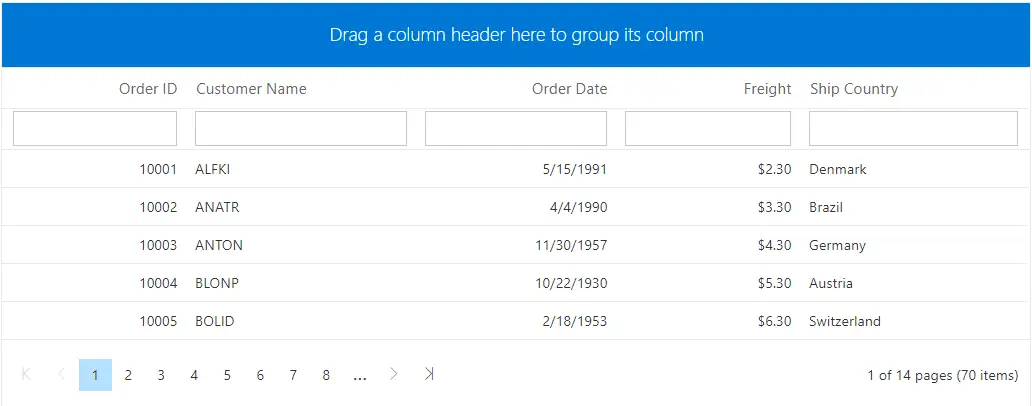
The Blazor DataGrid can group records by one or more columns. To enable grouping, set the AllowGrouping property to true. Customize grouping behavior using the GridGroupSettings.
@using Syncfusion.Blazor.Grids

<SfGrid DataSource="@Orders" AllowGrouping="true">
    <GridColumns>
        <GridColumn Field=@nameof(OrderData.OrderID) HeaderText="Order ID" TextAlign="Syncfusion.Blazor.Grids.TextAlign.Right" Width="120"></GridColumn>
        <GridColumn Field=@nameof(OrderData.CustomerID) HeaderText="Customer ID" Width="150"></GridColumn>
        <GridColumn Field=@nameof(OrderData.Freight) HeaderText="Freight" Format="C2" TextAlign="Syncfusion.Blazor.Grids.TextAlign.Right" Width="120"></GridColumn>
        <GridColumn Field=@nameof(OrderData.OrderDate) HeaderText="Order Date" Format="d" Type="Syncfusion.Blazor.Grids.ColumnType.Date" TextAlign="Syncfusion.Blazor.Grids.TextAlign.Right" Width="130"></GridColumn>
    </GridColumns>
</SfGrid>

@code {
    public List<OrderData> Orders { get; set; }

    protected override void OnInitialized()
    {
        Orders = OrderData.GetAllRecords();
    }
}
public class OrderData
{
public static List<OrderData> Orders = new List<OrderData>();
public OrderData()
{
}
public OrderData( int? OrderID, string CustomerID, DateTime? OrderDate, double? Freight)
{
this.OrderID = OrderID;
this.CustomerID = CustomerID;
this.OrderDate = OrderDate;
this.Freight = Freight;
}
public static List<OrderData> GetAllRecords()
{
if (Orders.Count() == 0)
{
int code = 10;
for (int i = 1; i < 2; i++)
{
Orders.Add(new OrderData(10248, "VINET",new DateTime(1996,07,07), 32.38));
Orders.Add(new OrderData(10249, "TOMSP", new DateTime(1996, 07, 07), 92.38));
Orders.Add(new OrderData(10250, "HANAR", new DateTime(1996, 07, 07), 62.77));
Orders.Add(new OrderData(10251, "VICTE", new DateTime(1996, 07, 07), 12.38));
Orders.Add(new OrderData(10252, "SUPRD", new DateTime(1996, 07, 07), 82.38));
Orders.Add(new OrderData(10253, "CHOPS", new DateTime(1996, 07, 07), 31.31));
Orders.Add(new OrderData(10254, "RICSU", new DateTime(1996, 07, 07), 22.37));
Orders.Add(new OrderData(10255, "WELLI", new DateTime(1996, 07, 07), 44.34));
Orders.Add(new OrderData(10256, "RICSU", new DateTime(1996, 07, 07), 31.33));
code += 5;
}
}
return Orders;
}
public int? OrderID { get; set; }
public string CustomerID { get; set; }
public DateTime? OrderDate { get; set; }
public double? Freight { get; set; }
}
Find the sample in this GitHub location.