Legend in .NET MAUI Circular Chart
18 Nov 201820 minutes to read
The Legend provides a list of data points, helping to identify the corresponding data points in the chart. This guide explains how to define and customize the legend in the circular chart.
Prerequisite: Ensure that the required NuGet package is installed, the necessary namespaces are imported, and the SfCircularChart control is properly configured in your application. For detailed setup and configuration instructions, refer to the Getting Started guide.
Defining the legend
To define the legend in the chart, initialize the ChartLegend class and assign it to the Legend property.
<chart:SfCircularChart>
    <chart:SfCircularChart.Legend>
        <chart:ChartLegend/>
    </chart:SfCircularChart.Legend>
    <!-- code omitted for brevity -->
</chart:SfCircularChart>
SfCircularChart chart = new SfCircularChart();
chart.Legend = new ChartLegend();
// code omitted for brevity
this.Content = chart;Legend visibility
The visibility of the chart legend can be controlled using the IsVisible property. By default, the IsVisible property is set to true.
<chart:SfCircularChart>
    <chart:SfCircularChart.Legend>
        <chart:ChartLegend IsVisible="True"/>
    </chart:SfCircularChart.Legend>
    <!-- code omitted for brevity -->
</chart:SfCircularChart>
SfCircularChart chart = new SfCircularChart();
chart.Legend = new ChartLegend()
{
IsVisible = true
};
// code omitted for brevity
this.Content = chart;Legend item visibility
The visibility of individual legend items for specific series can be controlled using the IsVisibleOnLegend property of the series. The default value for IsVisibleOnLegend is true.
<chart:SfCircularChart>
    <chart:SfCircularChart.Legend>
        <chart:ChartLegend/>
    </chart:SfCircularChart.Legend>

    <chart:PieSeries ItemsSource="{Binding Data}"
                     XBindingPath="XValue"
                     IsVisibleOnLegend="True"
                     YBindingPath="YValue"/>
</chart:SfCircularChart>
SfCircularChart chart = new SfCircularChart();
chart.Legend = new ChartLegend();
PieSeries series = new PieSeries()
{
ItemsSource = (new ViewModel()).Data,
XBindingPath = "XValue",
IsVisibleOnLegend = true,
YBindingPath = "YValue",
};
chart.Series.Add(series);
this.Content = chart;Customizing labels
The appearance of the legend label can be customized using the LabelStyle property of the ChartLegendLabelStyle class:
-
TextColor, of typeColor, specifies the color of the label. -
FontFamily, of typestring, specifies the font family for the legend label. -
FontAttributes, of typeFontAttributes, specifies the font style for the legend label. -
FontSize, of typedouble, specifies the font size for the legend label. -
Margin, of typeThickness, specifies the margin size of labels.
<chart:SfCircularChart>
    <chart:SfCircularChart.Legend>
        <chart:ChartLegend>
            <chart:ChartLegend.LabelStyle>
                <chart:ChartLegendLabelStyle TextColor="Blue" Margin="5" FontSize="18" FontAttributes="Bold" FontFamily="PlaywriteAR-Regular"/>
            </chart:ChartLegend.LabelStyle>
        </chart:ChartLegend>
    </chart:SfCircularChart.Legend>
    <!-- code omitted for brevity -->
</chart:SfCircularChart>
SfCircularChart chart = new SfCircularChart();
chart.Legend = new ChartLegend();
ChartLegendLabelStyle labelStyle = new ChartLegendLabelStyle()
{
TextColor = Colors.Blue,
FontSize = 18,
FontAttributes = FontAttributes.Bold,
Margin = 5,
FontFamily = "PlaywriteAR-Regular"
};
chart.Legend.LabelStyle = labelStyle;
// code omitted for brevity
this.Content = chart;
Legend icon
To specify the legend icon based on the associated series type, use the LegendIcon property and set the icon type using the ChartLegendIconType enum values. The default value of the LegendIcon property is Circle.
The ChartLegendIconType enum provides the following values:
-
Circle- Displays a circular legend icon (default). -
Rectangle- Displays a rectangular legend icon. -
Diamond- Displays a diamond-shaped legend icon. -
Triangle- Displays a triangular legend icon. -
Cross- Displays a cross-shaped legend icon. -
Pentagon- Displays a pentagon-shaped legend icon. -
Hexagon- Displays a hexagon-shaped legend icon. -
SeriesType- Displays a legend icon based on the associated series type.
<chart:SfCircularChart>
    <chart:SfCircularChart.Legend>
       <chart:ChartLegend/>
    </chart:SfCircularChart.Legend>

    <chart:PieSeries ItemsSource="{Binding Data}"
                     XBindingPath="XValue"
                     YBindingPath="YValue"
                     LegendIcon = "Diamond"/>
</chart:SfCircularChart>
SfCircularChart chart = new SfCircularChart();
chart.Legend = new ChartLegend();
PieSeries pieSeries = new PieSeries()
{
ItemsSource = (new ViewModel()).Data,
XBindingPath = "XValue",
YBindingPath = "YValue",
LegendIcon = ChartLegendIconType.Diamond,
};
// code omitted for brevity
chart.Series.Add(pieSeries);
this.Content = chart;Placement
The legend can be positioned to the left, right, top, or bottom of the chart area using the Placement property in the ChartLegend class. The default placement is Top.
The Placement property uses the LegendPlacement enum, which provides the following values:
-
Top- Positions the legend at the top of the chart area (default). -
Bottom- Positions the legend at the bottom of the chart area. -
Left- Positions the legend to the left of the chart area. -
Right- Positions the legend to the right of the chart area.
<chart:SfCircularChart>
    <chart:SfCircularChart.Legend>
        <chart:ChartLegend Placement="Bottom">
        </chart:ChartLegend>
    </chart:SfCircularChart.Legend>
    <!-- code omitted for brevity -->
</chart:SfCircularChart>
SfCircularChart chart = new SfCircularChart();
chart.Legend = new ChartLegend()
{
Placement = LegendPlacement.Bottom
};
// code omitted for brevity
this.Content = chart;Legend Title
The legend title can be displayed above the legend items using the Title property in the ChartLegend class. The Title property accepts either a string or a custom View.
Legend title as String
<chart:SfCircularChart>
    <chart:SfCircularChart.Legend>
        <chart:ChartLegend Title="Browsers" Placement="Bottom" />
    </chart:SfCircularChart.Legend>
</chart:SfCircularChart>
SfCircularChart chart = new SfCircularChart();
//code omitted for brevity
chart.Legend = new ChartLegend()
{
Title="Browsers",
Placement = LegendPlacement.Bottom
};
this.Content = chart;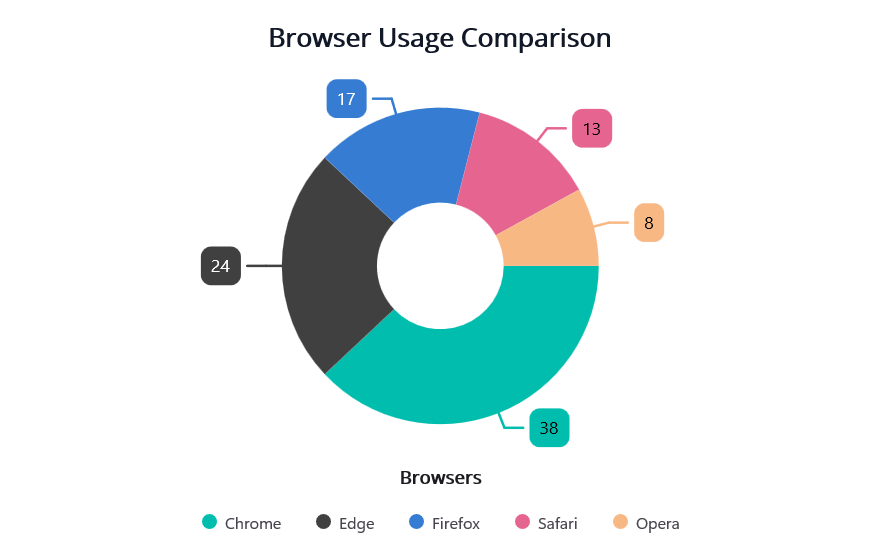
Legend title as Custom view
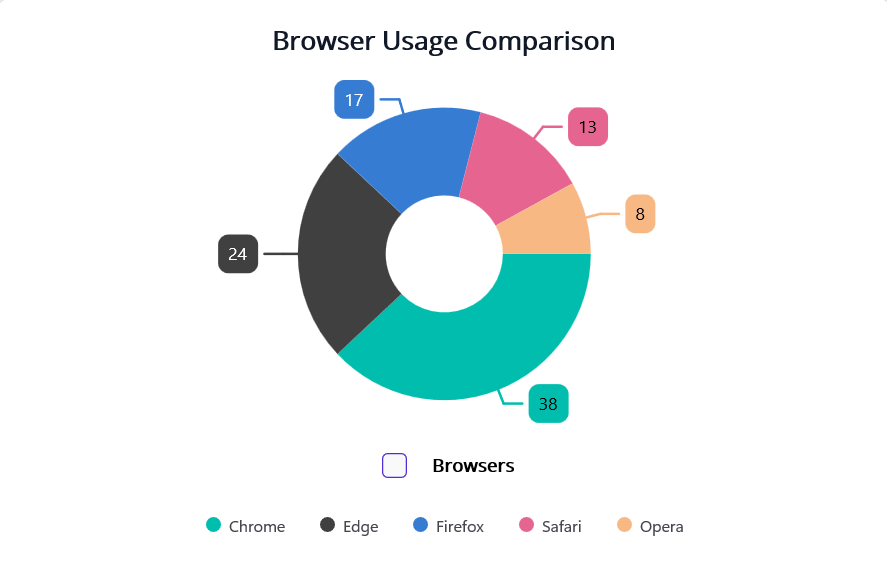
A custom View can be assigned to the Title property to display customized content, such as a layout containing a CheckBox and label, as the legend header.
<chart:SfCircularChart.Legend>
    <chart:ChartLegend Placement="Bottom">
        <chart:ChartLegend.Title>
            <HorizontalStackLayout Spacing="2">
                <CheckBox VerticalOptions="Center"/>
                <Label Text="Browsers"
                       FontSize="14"
                       FontAttributes="Bold"
                       VerticalOptions="Center"/>
            </HorizontalStackLayout>
        </chart:ChartLegend.Title>
    </chart:ChartLegend>
</chart:SfCircularChart.Legend>chart.Legend = new ChartLegend()
{
Placement = LegendPlacement.Bottom,
Title = new HorizontalStackLayout()
{
Spacing = 2,
Children =
{
new CheckBox()
{
VerticalOptions = LayoutOptions.Center
},
new Label()
{
Text = "Browsers",
FontSize = 14,
FontAttributes = FontAttributes.Bold,
VerticalOptions = LayoutOptions.Center
}
}
}
};
Floating legend
The floating legend feature allows you to position the legend inside the chart area based on its defined placement. When IsFloating is set to true, the legend will start from the specified Placement (such as Top, Bottom, Left, or Right) and then move according to the offset values, enabling precise control over the legend’s location.
-
OffsetX: Specifies the horizontal distance (in px) from the defined placement position. A negative value moves the legend to the left. The default value is
0. -
OffsetY: Specifies the vertical distance (in px) from the defined placement position. A negative value moves the legend upward. The default value is
0.
<chart:SfCircularChart>
    <chart:SfCircularChart.Legend>
        <chart:ChartLegend Placement="Right" IsFloating="True" OffsetX="-480" OffsetY="10"/>
    </chart:SfCircularChart.Legend>
</chart:SfCircularChart>
SfCircularChart chart = new SfCircularChart();
chart.Legend = new ChartLegend()
{
Placement = LegendPlacement.Right,
IsFloating = true,
OffsetX = -480,
OffsetY = 10
};
// code omitted for brevity
this.Content = chart;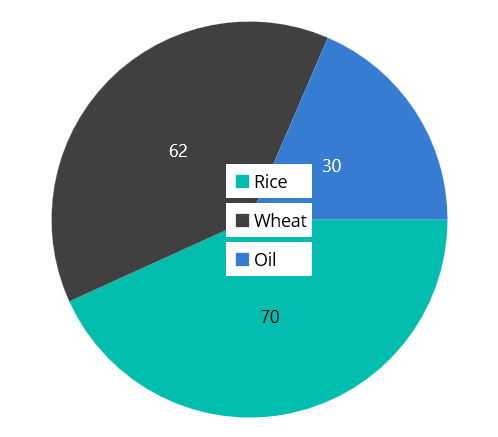
Toggle the series visibility
The visibility of circular series data points can be controlled by tapping the legend item using the ToggleSeriesVisibility property. The default value of ToggleSeriesVisibility is false.
<chart:SfCircularChart>
    <chart:SfCircularChart.Legend>
        <chart:ChartLegend
            ToggleSeriesVisibility="True">
        </chart:ChartLegend>
    </chart:SfCircularChart.Legend>
    <!-- code omitted for brevity -->
</chart:SfCircularChart>
SfCircularChart chart = new SfCircularChart();
chart.Legend = new ChartLegend()
{
ToggleSeriesVisibility = true
};
// code omitted for brevity
this.Content = chart;Legend maximum size request
To set the maximum size request for the legend view, override the GetMaximumSizeCoefficient protected method in the ChartLegend class. The value should be a double between 0 and 1, representing the maximum size coefficient for the legend view relative to the chart area (not the desired size for the legend items layout).
Using this property requires creating a custom subclass of
ChartLegendand overriding theGetMaximumSizeCoefficientmethod.
<chart:SfCircularChart >
    <chart:SfCircularChart.Legend>
        <chart:LegendExt/>
    </chart:SfCircularChart.Legend>
    <!-- code omitted for brevity -->
</chart:SfCircularChart>
public class LegendExt : ChartLegend
{
protected override double GetMaximumSizeCoefficient()
{
return 0.7;
}
}
SfCircularChart chart = new SfCircularChart();
chart.Legend = new LegendExt();
// code omitted for brevity
this.Content = chart;Items layout
The ItemsLayout property is used to customize the arrangement and position of each legend item. The default value is null. This property accepts any layout type.
For more details about the layout alignment refer to this article.
<chart:SfCircularChart>
    <chart:SfCircularChart.Legend>
        <chart:ChartLegend>
            <chart:ChartLegend.ItemsLayout>
                <FlexLayout Wrap="Wrap"
                            WidthRequest="400">
                </FlexLayout>
            </chart:ChartLegend.ItemsLayout>
        </chart:ChartLegend>
    </chart:SfCircularChart.Legend>
    <!-- code omitted for brevity -->
</chart:SfCircularChart>
SfCircularChart chart = new SfCircularChart();
// code omitted for brevity
ChartLegend legend = new ChartLegend();
legend.ItemsLayout = new FlexLayout()
{
Wrap = FlexWrap.Wrap,
WidthRequest = 400
};
chart.Legend = legend;
this.Content = chart;Item template
The ChartLegend supports customizing the appearance of legend items using the ItemTemplate property. The default value of ItemTemplate is null.
The BindingContext of the template is the corresponding underlying legend item provided in the ChartLegendItem class. The following bindable properties are available on the legend item:
IconBrush,Text,Item, andIndex.
<chart:SfCircularChart>
    <chart:SfCircularChart.Resources>
        <DataTemplate x:Key="legendTemplate">
            <HorizontalStackLayout>
                <Rectangle HeightRequest="12"
                           WidthRequest="12" Margin="3"
                           Background="{Binding IconBrush}"/>
                <Label Text="{Binding Text}"
                       Margin="3"/>
            </HorizontalStackLayout>
        </DataTemplate>
    </chart:SfCircularChart.Resources>

    <chart:SfCircularChart.Legend>
        <chart:ChartLegend ItemTemplate="{StaticResource legendTemplate}">
        </chart:ChartLegend>
    </chart:SfCircularChart.Legend>
    <!-- code omitted for brevity -->
</chart:SfCircularChart>
SfCircularChart chart = new SfCircularChart();
ChartLegend legend = new ChartLegend();
legend.ItemTemplate = chart.Resources["legendTemplate"] as DataTemplate;
// code omitted for brevity
chart.Legend = legend;
this.Content = chart;
Events
LegendItemCreated event
The LegendItemCreated event is triggered when the chart legend item is created. The argument contains the LegendItem object. The following properties are available in the LegendItem class:
-
Text, of typestring, specifies the text of the label. -
TextColor, of typeColor, specifies the color of the label. -
FontFamily, of typestring, specifies the font family for the legend label. -
FontAttributes, of typeFontAttributes, specifies the font style for the legend label. -
FontSize, of typedouble, specifies the font size for the legend label. -
TextMargin, of typeThickness, specifies the margin size of labels. -
IconBrush, of typeBrush, specifies the color of the legend icon. -
IconType, of typeChartLegendIconType, specifies the icon type for the legend icon. -
IconHeight, of typedouble, specifies the height of the legend icon. -
IconWidth, of typedouble, specifies the width of the legend icon. -
IsToggled, of typebool, specifies the toggle visibility of the legend. -
DisableBrush, of typeBrush, specifies the color of the legend when toggled. -
Index, of typeint, specifies the index position of the legend. -
Item, of typeobject, specifies the corresponding series for the legend item.
<chart:SfCircularChart>
    <chart:SfCircularChart.Legend>
        <chart:ChartLegend LegendItemCreated="ChartLegend_LegendItemCreated"/>
    </chart:SfCircularChart.Legend>
    <!-- code omitted for brevity -->
</chart:SfCircularChart>
SfCircularChart chart = new SfCircularChart();
ChartLegend legend = new ChartLegend();
legend.LegendItemCreated += ChartLegend_LegendItemCreated;
this.Content = chart;
private void ChartLegend_LegendItemCreated(object sender, LegendItemEventArgs e)
{
if (e.LegendItem != null)
{
e.LegendItem.TextColor = Colors.Red;
}
}Limitations
- Do not add items explicitly.
- When using BindableLayouts, do not bind ItemsSource explicitly.
- For better UX, arrange items vertically for left and right dock positions, and horizontally for top and bottom dock positions.
- If the layout’s measured size is larger than the MaximumHeightRequest, scrolling will be enabled.
- If MaximumHeightRequest is set to 1 and the chart’s available size is smaller than the layout’s measured size, the series may not have enough space to draw properly.