Chips Types in .NET MAUI Chips
18 Nov 201824 minutes to read
SfChipGroup supports four ChipType values that determine how users interact with the Chips. Use the table below to choose the type that matches your scenario.
| ChipType | Use when |
|---|---|
Input |
Users add and remove chips at runtime; an embedded InputView (such as an Entry) lets users type a new chip’s text. |
Choice |
Users select a single chip from a group; selecting another chip deselects the previous one. |
Filter |
Users select one or more chips; a check mark (selection indicator) marks the selected chips. |
Action |
Each chip acts like a button; the Command is invoked when a chip is clicked. |
Prerequisites
Before using the SfChip, ensure the following NuGet package is installed in your .NET MAUI project:
Syncfusion.Maui.Core
For a step-by-step setup, refer to the Getting Started documentation.
Input
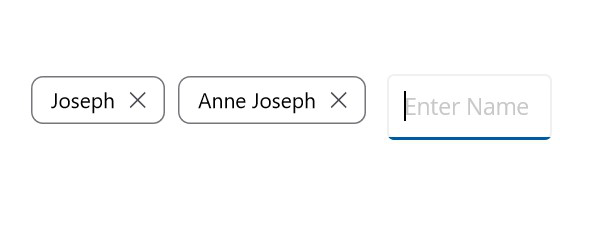
The Input ChipType arranges the .NET MAUI Chips in a layout, enables a close button for each chip, and provides an embedded InputView (an Entry in the example below) where users can type the text for a new chip.
<chip:SfChipGroup ItemsSource="{Binding Employees}"
                  DisplayMemberPath="Name"
                  ChipType="Input">
    <chip:SfChipGroup.InputView>
        <Entry x:Name="entry"
               VerticalOptions="Center"
               HeightRequest="40"
               FontSize="15"
               WidthRequest="110"
               Completed="OnEntryCompleted" />
    </chip:SfChipGroup.InputView>
</chip:SfChipGroup>
var entry = new Entry
{
VerticalOptions = LayoutOptions.Center,
FontSize = 15,
WidthRequest = 110,
HeightRequest = 40
};
entry.Completed += OnEntryCompleted;
SfChipGroup chipGroup = new SfChipGroup()
{
InputView = entry,
DisplayMemberPath = "Name",
ChipType = SfChipsType.Input,
};
chipGroup.SetBinding(SfChipGroup.ItemsSourceProperty, "Employees");
this.Content = chipGroup;public class Employee
{
public string Name { get; set; }
}
public class EmployeeViewModel : INotifyPropertyChanged
{
private ObservableCollection<Employee> employees;
public event PropertyChangedEventHandler PropertyChanged;
public ObservableCollection<Employee> Employees
{
get => employees;
set
{
employees = value;
OnPropertyChanged();
}
}
public EmployeeViewModel()
{
Employees = new ObservableCollection<Employee>
{
new Employee { Name = "Joseph" },
new Employee { Name = "Anne Joseph" },
new Employee { Name = "Andrew Fuller" },
new Employee { Name = "Emilio Alvaro" },
new Employee { Name = "Janet Leverling" }
};
}
public void OnPropertyChanged([CallerMemberName] string name = null) =>
PropertyChanged?.Invoke(this, new PropertyChangedEventArgs(name));
}The Entry’s Completed event can be handled in C# as follows:
private void OnEntryCompleted(object sender, EventArgs e)
{
    if (sender is not Entry entry) return;
    if (BindingContext is not EmployeeViewModel viewModel) return;

    var name = entry.Text;
    if (!string.IsNullOrWhiteSpace(name))
    {
        viewModel.Employees.Add(new Employee { Name = name });
    }
    entry.Text = string.Empty;
}
The following image illustrates the Input ChipType:
Choice
The Choice ChipType allows users to select a single chip from a group. Selecting a chip automatically deselects the previously selected chip. The visual treatment for the selected state is set via the Selected visual state in the VisualStateManager.
<chip:SfChipGroup x:Name="sfChipGroup"
                  ItemsSource="{Binding Employees}"
                  DisplayMemberPath="Name"
                  HeightRequest="50"
                  ChipType="Choice">
    <VisualStateManager.VisualStateGroups>
        <VisualStateGroup x:Name="CommonStates">
            <VisualState x:Name="Normal">
                <VisualState.Setters>
                    <Setter Property="ChipTextColor"
                            Value="Black" />
                    <Setter Property="ChipBackground"
                            Value="White" />
                </VisualState.Setters>
            </VisualState>
            <VisualState x:Name="Selected">
                <VisualState.Setters>
                    <Setter Property="ChipTextColor"
                            Value="White" />
                    <Setter Property="ChipBackground"
                            Value="#512dcd" />
                </VisualState.Setters>
            </VisualState>
        </VisualStateGroup>
    </VisualStateManager.VisualStateGroups>
</chip:SfChipGroup>
BindingContext = new EmployeeViewModel();
SfChipGroup sfChipGroup = new SfChipGroup
{
DisplayMemberPath = "Name",
HeightRequest = 50,
ChipType = SfChipsType.Choice
};
sfChipGroup.SetBinding(SfChipGroup.ItemsSourceProperty, "Employees");
var visualStateGroupList = new VisualStateGroupList();
var commonStateGroup = new VisualStateGroup();
var normalState = new VisualState { Name = "Normal" };
normalState.Setters.Add(new Setter { Property = SfChipGroup.ChipTextColorProperty, Value = Colors.Black });
normalState.Setters.Add(new Setter { Property = SfChipGroup.ChipBackgroundProperty, Value = Colors.White });
var selectedState = new VisualState { Name = "Selected" };
selectedState.Setters.Add(new Setter { Property = SfChipGroup.ChipTextColorProperty, Value = Colors.White });
selectedState.Setters.Add(new Setter { Property = SfChipGroup.ChipBackgroundProperty, Value = Color.FromArgb("#512dcd") });
commonStateGroup.States.Add(normalState);
commonStateGroup.States.Add(selectedState);
visualStateGroupList.Add(commonStateGroup);
VisualStateManager.SetVisualStateGroups(sfChipGroup, visualStateGroupList);
this.Content = sfChipGroup;public class Employee
{
public string Name { get; set; }
}
public class EmployeeViewModel : INotifyPropertyChanged
{
private ObservableCollection<Employee> employees;
public event PropertyChangedEventHandler PropertyChanged;
public ObservableCollection<Employee> Employees
{
get => employees;
set
{
employees = value;
OnPropertyChanged();
}
}
public EmployeeViewModel()
{
Employees = new ObservableCollection<Employee>
{
new Employee { Name = "Joseph" },
new Employee { Name = "Anne Joseph" },
new Employee { Name = "Andrew Fuller" },
new Employee { Name = "Emilio Alvaro" },
new Employee { Name = "Janet Leverling" }
};
}
public void OnPropertyChanged([CallerMemberName] string name = null) =>
PropertyChanged?.Invoke(this, new PropertyChangedEventArgs(name));
}The following image illustrates the Choice ChipType:

ChoiceMode
The ChoiceMode property controls selection behavior for the Choice ChipType. The following values are available:
| ChoiceMode | Behavior |
|---|---|
Single |
At least one chip must be selected; the selected chip cannot be deselected by the user. |
SingleOrNone |
At most one chip is selected; the user can deselect the selected chip, leaving the group with no selection. |
<chip:SfChipGroup ChipType="Choice"
                  HeightRequest="50"
                  ChoiceMode="SingleOrNone">
    <chip:SfChip Text="Extra Small" />
    <chip:SfChip Text="Small" />
    <chip:SfChip Text="Medium" />
    <chip:SfChip Text="Large" />
    <chip:SfChip Text="Extra Large" />
</chip:SfChipGroup>
SfChipGroup chipGroup = new SfChipGroup
{
ChipType = SfChipsType.Choice,
HeightRequest = 50,
ChoiceMode = ChoiceMode.SingleOrNone
};
chipGroup.Items.Add(new SfChip { Text = "Extra Small" });
chipGroup.Items.Add(new SfChip { Text = "Small" });
chipGroup.Items.Add(new SfChip { Text = "Medium" });
chipGroup.Items.Add(new SfChip { Text = "Large" });
chipGroup.Items.Add(new SfChip { Text = "Extra Large" });
this.Content = chipGroup;Filter
The Filter ChipType allows users to select one or more chips in a group. Selected chips are indicated by a check mark (the selection indicator). The indicator color can be customized using the SelectionIndicatorColor property. The currently selected chips are exposed through the SelectedItem and SelectedItems properties, and selection changes are notified through the SelectionChanging and SelectionChanged events.
<chip:SfChipGroup x:Name="sfChipGroup"
                  ItemsSource="{Binding Employees}"
                  HeightRequest="50"
                  SelectionIndicatorColor="White"
                  ChipType="Filter"
                  DisplayMemberPath="Name">
    <VisualStateManager.VisualStateGroups>
        <VisualStateGroup x:Name="CommonStates">
            <VisualState x:Name="Normal">
                <VisualState.Setters>
                    <Setter Property="ChipTextColor"
                            Value="Black" />
                    <Setter Property="ChipBackground"
                            Value="White" />
                </VisualState.Setters>
            </VisualState>
            <VisualState x:Name="Selected">
                <VisualState.Setters>
                    <Setter Property="ChipTextColor"
                            Value="White" />
                    <Setter Property="ChipBackground"
                            Value="#512dcd" />
                </VisualState.Setters>
            </VisualState>
        </VisualStateGroup>
    </VisualStateManager.VisualStateGroups>
</chip:SfChipGroup>
BindingContext = new EmployeeViewModel();
SfChipGroup sfChipGroup = new SfChipGroup
{
DisplayMemberPath = "Name",
SelectionIndicatorColor = Colors.White,
HeightRequest = 50,
ChipType = SfChipsType.Filter
};
sfChipGroup.SetBinding(SfChipGroup.ItemsSourceProperty, "Employees");
var visualStateGroupList = new VisualStateGroupList();
var commonStateGroup = new VisualStateGroup();
var normalState = new VisualState { Name = "Normal" };
normalState.Setters.Add(new Setter { Property = SfChipGroup.ChipTextColorProperty, Value = Colors.Black });
normalState.Setters.Add(new Setter { Property = SfChipGroup.ChipBackgroundProperty, Value = Colors.White });
var selectedState = new VisualState { Name = "Selected" };
selectedState.Setters.Add(new Setter { Property = SfChipGroup.ChipTextColorProperty, Value = Colors.White });
selectedState.Setters.Add(new Setter { Property = SfChipGroup.ChipBackgroundProperty, Value = Color.FromArgb("#512dcd") });
commonStateGroup.States.Add(normalState);
commonStateGroup.States.Add(selectedState);
visualStateGroupList.Add(commonStateGroup);
VisualStateManager.SetVisualStateGroups(sfChipGroup, visualStateGroupList);
this.Content = sfChipGroup;public class Employee
{
public string Name { get; set; }
}
public class EmployeeViewModel : INotifyPropertyChanged
{
private ObservableCollection<Employee> employees;
public event PropertyChangedEventHandler PropertyChanged;
public ObservableCollection<Employee> Employees
{
get => employees;
set
{
employees = value;
OnPropertyChanged();
}
}
public EmployeeViewModel()
{
Employees = new ObservableCollection<Employee>
{
new Employee { Name = "Joseph" },
new Employee { Name = "Anne Joseph" },
new Employee { Name = "Andrew Fuller" },
new Employee { Name = "Emilio Alvaro" },
new Employee { Name = "Janet Leverling" }
};
}
public void OnPropertyChanged([CallerMemberName] string name = null) =>
PropertyChanged?.Invoke(this, new PropertyChangedEventArgs(name));
}Action
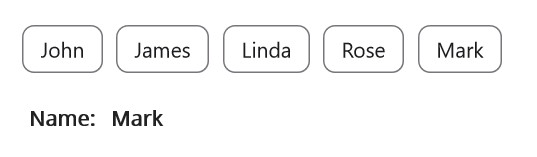
The Action ChipType of Chip Group executes the Command when the user clicks a chip. The command only fires for the Action ChipType. You can pass a CommandParameter to the Command to provide context to the handler (for example, the clicked Person).
<VerticalStackLayout>
    <chip:SfChipGroup Command="{Binding ActionCommand}"
                      ItemsSource="{Binding Employees}"
                      DisplayMemberPath="Name"
                      CloseButtonColor="Black"
                      ChipType="Action" />
    <HorizontalStackLayout Margin="0,60,0,0"
                           Spacing="10">
        <Label Text="Name:"
               FontAttributes="Bold"
               FontSize="14" />
        <Label Text="{Binding Result}"
               FontAttributes="Bold"
               FontSize="14" />
    </HorizontalStackLayout>
</VerticalStackLayout>
var viewModel = new ChipsViewModel();
BindingContext = viewModel;
var chipGroup = new SfChipGroup
{
ChipType = SfChipsType.Action,
DisplayMemberPath = nameof(Person.Name),
CloseButtonColor = Colors.Black,
ItemsSource = viewModel.Employees
};
chipGroup.SetBinding(
SfChipGroup.CommandProperty,
nameof(ChipsViewModel.ActionCommand));
var titleLabel = new Label
{
Text = "Name:",
FontAttributes = FontAttributes.Bold,
FontSize = 14
};
var resultLabel = new Label
{
FontAttributes = FontAttributes.Bold,
FontSize = 14
};
resultLabel.SetBinding(
Label.TextProperty,
nameof(ChipsViewModel.Result));
var resultLayout = new HorizontalStackLayout
{
Margin = new Thickness(0, 60, 0, 0),
Spacing = 10,
Children =
{
titleLabel,
resultLabel
}
};
Content = new VerticalStackLayout
{
Children =
{
chipGroup,
resultLayout
}
};public class Person
{
public string Name { get; set; }
}
public class ChipsViewModel : INotifyPropertyChanged
{
private string result;
public ICommand ActionCommand { get; }
public ObservableCollection<Person> Employees { get; }
public string Result
{
get => result;
set
{
result = value;
OnPropertyChanged();
}
}
public ChipsViewModel()
{
ActionCommand = new Command(HandleAction);
Employees = new ObservableCollection<Person>
{
new Person { Name = "John" },
new Person { Name = "James" },
new Person { Name = "Linda" },
new Person { Name = "Rose" },
new Person { Name = "Mark" }
};
}
private void HandleAction(object obj)
{
if (obj is Person person)
{
Result = person.Name;
}
}
public event PropertyChangedEventHandler PropertyChanged;
public void OnPropertyChanged([CallerMemberName] string name = null) =>
PropertyChanged?.Invoke(this, new PropertyChangedEventArgs(name));
}The following image illustrates the Action ChipType: