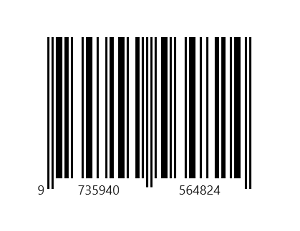
One-Dimensional Symbology in .NET MAUI Barcode Generator
18 Nov 201818 minutes to read
The one-dimensional .NET MAUI Barcode Generator represents the data by varying the widths and spacings of the parallel lines. These barcode types are also known as linear barcode types. The Syncfusion® .NET MAUI barcode generator supports the following one-dimensional barcode types:
Prerequisite: Ensure that the required NuGet package is installed, the necessary namespaces are imported, and the Barcode Generator control is properly configured in your application. For detailed setup and configuration instructions, refer to the Getting Started guide.
All one-dimensional symbologies support the
Moduleproperty, which defines the size of the smallest bar line of the barcode. By default,Moduleis not set; the smallest bar line size is automatically calculated based on the available size and the total number of bars for the provided input value.
Codabar
-
Codabaris a discrete numeric symbology that is used in libraries, blood banks and a variety of other information processing applications. - Encodes only numeric characters and some special characters such as dash (-), colon (:), slash (/), and plus (+).
- Each character has three bars and four spaces.
- Uses the characters A, B, C, and D as start and stop characters.
<barcode:SfBarcodeGenerator Value="123456789"
                            ShowText="True"
                            HeightRequest="150">
    <barcode:SfBarcodeGenerator.Symbology>
        <barcode:Codabar Module="2" />
    </barcode:SfBarcodeGenerator.Symbology>
</barcode:SfBarcodeGenerator>
SfBarcodeGenerator barcode = new SfBarcodeGenerator();
barcode.HeightRequest = 150;
barcode.Value = "123456789";
barcode.Symbology = new Codabar() { Module = 2 };
barcode.ShowText = true;
this.Content = barcode;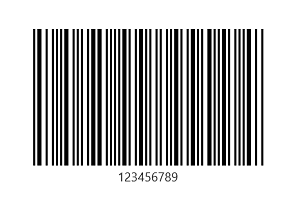
Code39
Code39 is a discrete, variable-length symbology that encodes alphanumeric characters into a series of bars. Each barcode begins and ends with special start and stop characters. Code39 is self-checking; a check digit is not usually required for common use. For applications requiring high accuracy, a checksum digit may be added.
- Allows character set of digits (0-9), upper case alphabets (A-Z), and symbols like space, minus (-), plus (+), period (.), dollar sign ($), slash (/), and percent (%).
- Each character is encoded with five bars and four spaces where three are wide and six are narrow.
<barcode:SfBarcodeGenerator Value="CODE39"
                            ShowText="True"
                            HeightRequest="150">
    <barcode:SfBarcodeGenerator.Symbology>
        <barcode:Code39 Module="2" />
    </barcode:SfBarcodeGenerator.Symbology>
</barcode:SfBarcodeGenerator>
SfBarcodeGenerator barcode = new SfBarcodeGenerator();
barcode.HeightRequest = 150;
barcode.Value = "CODE39";
barcode.Symbology = new Code39() { Module = 2 };
barcode.ShowText = true;
this.Content = barcode;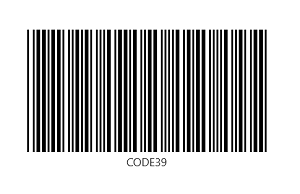
The EnableCheckSum property of Code39 barcode allows you to add the check digit along with the input value. The default value of the EnableCheckSum property is true.
<barcode:SfBarcodeGenerator Value="CODE39"
                            ShowText="True"
                            HeightRequest="150">
    <barcode:SfBarcodeGenerator.Symbology>
        <barcode:Code39 Module="2" EnableCheckSum="False" />
    </barcode:SfBarcodeGenerator.Symbology>
</barcode:SfBarcodeGenerator>
SfBarcodeGenerator barcode = new SfBarcodeGenerator();
barcode.HeightRequest = 150;
barcode.Value = "CODE39";
barcode.Symbology = new Code39() { Module = 2, EnableCheckSum = false };
barcode.ShowText = true;
this.Content = barcode;Code39Extended
-
Code39Extendedsymbology is an extended version of Code39 that supports the full 128-character ASCII set. So, it encodes lower case alphabets (a-z) as well as special characters.
<barcode:SfBarcodeGenerator Value="051091"
                            ShowText="True"
                            HeightRequest="150">
    <barcode:SfBarcodeGenerator.Symbology>
        <barcode:Code39Extended Module="2" />
    </barcode:SfBarcodeGenerator.Symbology>
</barcode:SfBarcodeGenerator>
SfBarcodeGenerator barcode = new SfBarcodeGenerator();
barcode.HeightRequest = 150;
barcode.Value = "051091";
barcode.Symbology = new Code39Extended() { Module = 2 };
barcode.ShowText = true;
this.Content = barcode;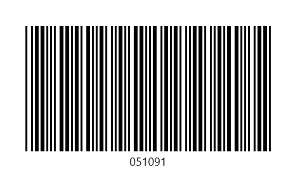
As with Code39, Code39Extended supports the EnableCheckSum property inherited from the Code39 base type.
Code93
Code93 is designed to complement and enhance Code39. It represents the complete ASCII character set by using a combination of 2 characters. It is a continuous, variable-length symbology that produces a denser code.
- Encodes character set of upper case alphabets (A-Z), digits (0-9), and special characters such as asterisk (*), dash (-), dollar ($), percent (%), space, dot (.), slash (/), plus (+), and so on.
- The asterisk (*) is not a true encoding character, but it is the start and stop symbol for
Code93symbology.
<barcode:SfBarcodeGenerator Value="01234567"
                            ShowText="True"
                            HeightRequest="150">
    <barcode:SfBarcodeGenerator.Symbology>
        <barcode:Code93 Module="2" />
    </barcode:SfBarcodeGenerator.Symbology>
</barcode:SfBarcodeGenerator>
SfBarcodeGenerator barcode = new SfBarcodeGenerator();
barcode.HeightRequest = 150;
barcode.Value = "01234567";
barcode.Symbology = new Code93() { Module = 2 };
barcode.ShowText = true;
this.Content = barcode;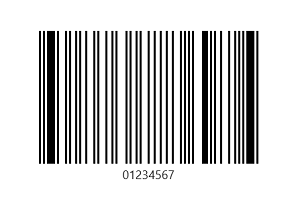
Code128
Code128 is a highly efficient, high-density linear barcode symbology that allows the encoding of alphanumeric data. It is capable of encoding full ASCII character sets and extended character sets. This symbology contains the checksum digit for verification and the barcode can also be verified character-by-character for the parity of each data byte.
The Code128 symbology encodes the input symbols supported by Code128A, Code128B, Code128C. The default symbology type of barcode generator is Code128.
Code128 special characters
The last seven characters of Code Sets A and B (character values 96 - 102) and the last three characters of Code Set C (character values 100 - 102) are special non-data characters with no ASCII character equivalents that have a particular significance to the barcode reading device.
<barcode:SfBarcodeGenerator Value="CODE128"
                            ShowText="True"
                            HeightRequest="150">
    <barcode:SfBarcodeGenerator.Symbology>
            <barcode:Code128 Module="2" />
    </barcode:SfBarcodeGenerator.Symbology>
</barcode:SfBarcodeGenerator>
SfBarcodeGenerator barcode = new SfBarcodeGenerator();
barcode.HeightRequest = 150;
barcode.Value = "CODE128";
barcode.Symbology = new Code128() { Module = 2 };
barcode.ShowText = true;
this.Content = barcode;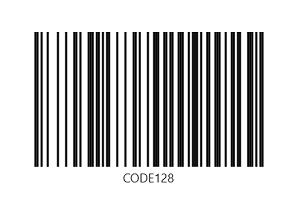
Code128A
Code128A (or Code Set A) includes all the standard upper case U.S. alphanumeric keyboard characters and punctuation characters, as well as the control characters (characters with ASCII values from 0 to 95 inclusive) and seven special characters.
<barcode:SfBarcodeGenerator Value="CODE128A"
                            ShowText="True"
                            HeightRequest="150">
    <barcode:SfBarcodeGenerator.Symbology>
        <barcode:Code128A Module="2" />
    </barcode:SfBarcodeGenerator.Symbology>
</barcode:SfBarcodeGenerator>
SfBarcodeGenerator barcode = new SfBarcodeGenerator();
barcode.HeightRequest = 150;
barcode.Value = "CODE128A";
barcode.Symbology = new Code128A() { Module = 2 };
barcode.ShowText = true;
this.Content = barcode;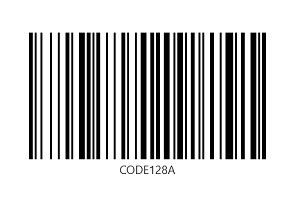
Code128B
Code128B (or Code Set B) includes all the standard upper case alphanumeric keyboard characters and punctuation characters, as well as the lower case alphabetic characters (characters with ASCII values from 32 to 127 inclusive) and seven special characters.
<barcode:SfBarcodeGenerator Value="CODE128B"
                            ShowText="True"
                            HeightRequest="150">
    <barcode:SfBarcodeGenerator.Symbology>
        <barcode:Code128B Module="2" />
    </barcode:SfBarcodeGenerator.Symbology>
</barcode:SfBarcodeGenerator>
SfBarcodeGenerator barcode = new SfBarcodeGenerator();
barcode.HeightRequest = 150;
barcode.Value = "CODE128B";
barcode.Symbology = new Code128B() { Module = 2 };
barcode.ShowText = true;
this.Content = barcode;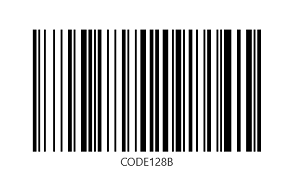
Code128C
Code128C (or Code Set C) includes a set of 100 digit pairs from 00 to 99 inclusive, as well as three special characters. This allows numeric data to be encoded as two data digits per symbol character, effectively twice the density of standard data.
<barcode:SfBarcodeGenerator Value="1234567890"
                            ShowText="True"
                            HeightRequest="150">
    <barcode:SfBarcodeGenerator.Symbology>
        <barcode:Code128C Module="2" />
    </barcode:SfBarcodeGenerator.Symbology>
</barcode:SfBarcodeGenerator>
SfBarcodeGenerator barcode = new SfBarcodeGenerator();
barcode.HeightRequest = 150;
barcode.Value = "1234567890";
barcode.Symbology = new Code128C() { Module = 2 };
barcode.ShowText = true;
this.Content = barcode;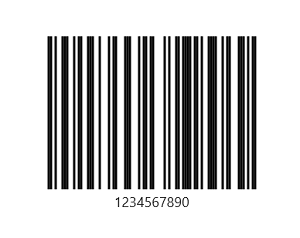
UPCA
UPC-A symbology supports only numeric characters. It encodes 11 digits of provided numeric input (0 to 9) along with a check digit at its end, for a total of 12 digits of input data. If you give 11 numeric inputs, the check digit should automatically calculate at the end, and if you give 12 numeric inputs, the last digit should be check digit, otherwise the input will be rejected.
- This type is mainly used for worldwide retail.
<barcode:SfBarcodeGenerator Value="72527273070"
                            ShowText="True"
                            HeightRequest="150">
    <barcode:SfBarcodeGenerator.Symbology>
        <barcode:UPCA Module="2" />
    </barcode:SfBarcodeGenerator.Symbology>
</barcode:SfBarcodeGenerator>
SfBarcodeGenerator barcode = new SfBarcodeGenerator();
barcode.HeightRequest = 150;
barcode.Value = "72527273070";
barcode.Symbology = new UPCA() { Module = 2 };
barcode.ShowText = true;
this.Content = barcode;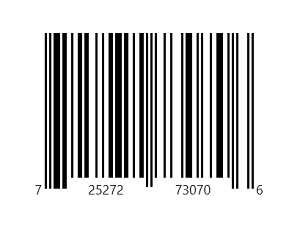
UPCE
Like UPC-A, the UPC-E symbology supports only numeric characters. It is a zero-suppressed version of the UPC-A symbology where it uses only 6 digits of product code and does not use the middle guard. By default, the number system (0) will be added at the front and the check digit at the end, along with 6 digits of the input product code.
- This type is mainly used on products with very small packaging details.
<barcode:SfBarcodeGenerator Value="310194"
                            ShowText="True"
                            HeightRequest="150">
    <barcode:SfBarcodeGenerator.Symbology>
        <barcode:UPCE Module="2" />
    </barcode:SfBarcodeGenerator.Symbology>
</barcode:SfBarcodeGenerator>
SfBarcodeGenerator barcode = new SfBarcodeGenerator();
barcode.HeightRequest = 150;
barcode.Value = "310194";
barcode.Symbology = new UPCE() { Module = 2 };
barcode.ShowText = true;
this.Content = barcode;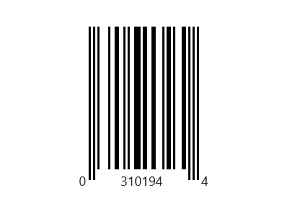
EAN8
EAN8 is equivalent to the UPCE for small packaging details. It is shorter than the EAN13 barcode and it is longer than UPCE.
Like EAN13 and UPCE, it encodes 7 digits of numeric data with the check digit at its end.
<barcode:SfBarcodeGenerator Value="11223344"
                            ShowText="True"
                            HeightRequest="150">
    <barcode:SfBarcodeGenerator.Symbology>
        <barcode:EAN8 Module="2" />
    </barcode:SfBarcodeGenerator.Symbology>
</barcode:SfBarcodeGenerator>
SfBarcodeGenerator barcode = new SfBarcodeGenerator();
barcode.HeightRequest = 150;
barcode.Value = "11223344";
barcode.Symbology = new EAN8() { Module = 2 };
barcode.ShowText = true;
this.Content = barcode;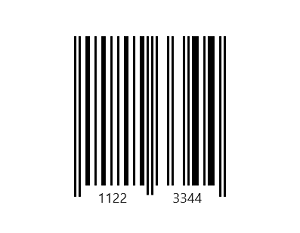
EAN13
The EAN-13 standard is based on the UPC-A standard. Like UPC-A, it supports only numeric characters. It encodes 12 digits of input data with the check digit at its end.
- The difference between
UPCAandEAN13is that the number system used inEAN13is a 2-digit number ranging from 00 to 99, whereas the number system used inUPCAis a single digit ranging from 0 to 9.
<barcode:SfBarcodeGenerator Value="9735940564824"
                            ShowText="True"
                            HeightRequest="150">
    <barcode:SfBarcodeGenerator.Symbology>
        <barcode:EAN13 Module="2" />
    </barcode:SfBarcodeGenerator.Symbology>
</barcode:SfBarcodeGenerator>
SfBarcodeGenerator barcode = new SfBarcodeGenerator();
barcode.HeightRequest = 150;
barcode.Value = "9735940564824";
barcode.Symbology = new EAN13() { Module = 2 };
barcode.ShowText = true;
this.Content = barcode;