Custom Range in WinUI Slider
18 Nov 20183 minutes to read
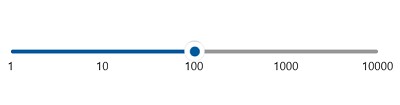
The SfSlider allows you to define a custom scale range by extending the control based on your business logic.
Overriding GenerateVisibleLabels, ValueToFactor and FactorToValue
Override the following methods of the SfSlider to define a custom scale range:
-
GenerateVisibleLabels– Generates the visible labels for the custom scale range. -
ValueToFactor– Converts the custom value to a factor (between 0 and 1) used to position the thumb. -
FactorToValue– Converts the factor (between 0 and 1) back to the custom value.
<local:LogarithmicSlider Minimum="1"
                         Maximum="10000"
                         Value="100"
                         ShowLabels="True" />
public class LogarithmicSlider : SfSlider
{
int labelsCount;
public override List<SliderLabelInfo> GenerateVisibleLabels()
{
List<SliderLabelInfo> labelInfos = new List<SliderLabelInfo>();
int minimum = (int)LogBase(this.Minimum, 10);
int maximum = (int)LogBase(this.Maximum, 10);
for (int i = minimum; i <= maximum; i++)
{
double value = Math.Floor(Math.Pow(10, i)); // logBase value is 10
SliderLabelInfo label = new SliderLabelInfo()
{
Value = value,
Text = value.ToString()
};
labelInfos.Add(label);
}
labelsCount = labelInfos.Count;
return labelInfos;
}
private double LogBase(double value, int baseValue)
{
return Math.Log(value) / Math.Log(baseValue);
}
public override double ValueToFactor(double value)
{
return LogBase(value, 10) / (labelsCount - 1);
}
public override double FactorToValue(double factor)
{
return Math.Pow(10, factor * (labelsCount - 1));
}
}In XAML, declare the
localnamespace pointing to the assembly that contains theLogarithmicSliderclass (for example,xmlns:local="using:SliderGettingStartedDesktop").