Legend in WinUI Circular Chart
18 Nov 201814 minutes to read
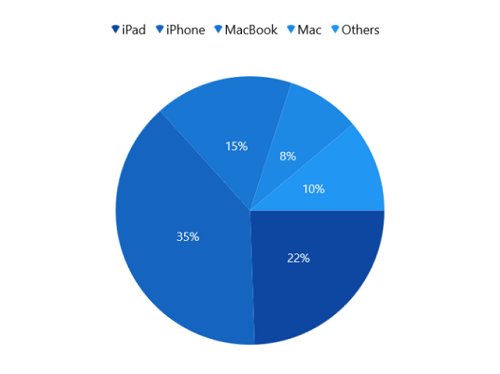
The legend contains a list of series data points in the chart. The information provided in each legend item helps to identify the corresponding data series in the chart.
<chart:SfCircularChart.Legend>
    <chart:ChartLegend/>
</chart:SfCircularChart.Legend>
SfCircularChart chart = new SfCircularChart();
chart.Legend = new ChartLegend();The x-value of the data points in the circular chart will be the legend items’
Label.
Title
The circular chart provides support to add any UIElement as a title for the legend. The Header property of ChartLegend is used to define the title for the legend, as shown in the following code example.
<chart:SfCircularChart>

    <!-- Configure additional chart elements -->
    <chart:SfCircularChart.Legend>
        <chart:ChartLegend>
            <chart:ChartLegend.Header>
                <TextBlock
                    Text="Products"
                    HorizontalAlignment="Center"
                    FontWeight="Bold"
                    Foreground="Blue"/>
            </chart:ChartLegend.Header>
        </chart:ChartLegend>
    </chart:SfCircularChart.Legend>
</chart:SfCircularChart>
SfCircularChart chart = new SfCircularChart();
ChartLegend legend = new ChartLegend();
TextBlock textBlock = new TextBlock()
{
Text = "Products",
HorizontalTextAlignment = TextAlignment.Center,
Foreground = new SolidColorBrush(Colors.Blue),
FontWeight = FontWeights.Bold,
};
legend.Header = textBlock;
chart.Legend = legend;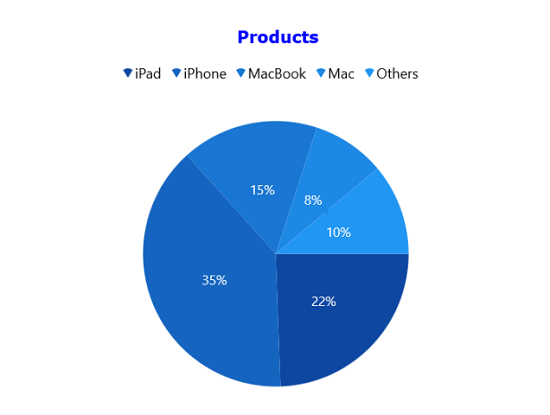
Icon
The legend icon represents a symbol associated with each legend item. The LegendIcon property of the series is used to set the icon type for the legend item. By default, the legend icon is SeriesType.
<chart:SfCircularChart>

    <!-- Configure additional chart elements -->
    <chart:SfCircularChart.Legend>
        <chart:ChartLegend/>
    </chart:SfCircularChart.Legend>

    <chart:SfCircularChart.Series>
        <chart:PieSeries
            LegendIcon="Rectangle"
            ItemsSource="{Binding Data}"
            XBindingPath="Product"
            YBindingPath="SalesRate">
        </chart:PieSeries>
    </chart:SfCircularChart.Series>

</chart:SfCircularChart>
SfCircularChart chart = new SfCircularChart();
// Configure additional chart elements
chart.Legend = new ChartLegend();
PieSeries series = new PieSeries();
series.LegendIcon = ChartLegendIcon.Rectangle;
chart.Series.Add(series);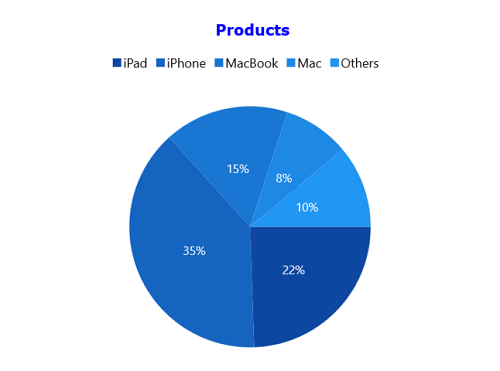
The appearance of the legend icon can be customized using the following properties.
- IconWidth - Gets or sets the double value that represents the legend icon(s) width.
- IconHeight - Gets or sets the double value that represents the legend icon(s) height.
- IconVisibility - Gets or sets the visibility of the legend icon.
<chart:SfCircularChart>

    <!-- Configure additional chart elements -->
    <chart:SfCircularChart.Legend>
        <chart:ChartLegend
            IconWidth="10"
            IconHeight="5"
            IconVisibility="Visible">
        </chart:ChartLegend>
    </chart:SfCircularChart.Legend>
</chart:SfCircularChart>
SfCircularChart chart = new SfCircularChart();
// Configure additional chart elements
chart.Legend = new ChartLegend()
{
IconWidth = 10,
IconHeight = 5,
IconVisibility = Visibility.Visible,
};Custom legend icon
The circular chart provides support to add a custom icon for the legend using the LegendIconTemplate property of the series, as in the following example.
SfCircularChart chart = new SfCircularChart();

// The 'iconTemplate' resource is defined in XAML Resources and referenced here.
PieSeries series = new PieSeries();
series.LegendIconTemplate = grid.Resources["iconTemplate"] as DataTemplate;

// Configure additional chart elements
chart.Series.Add(series);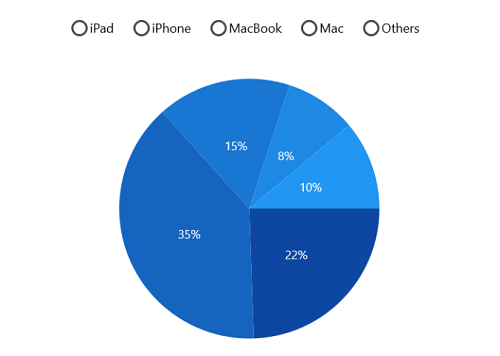
Item spacing
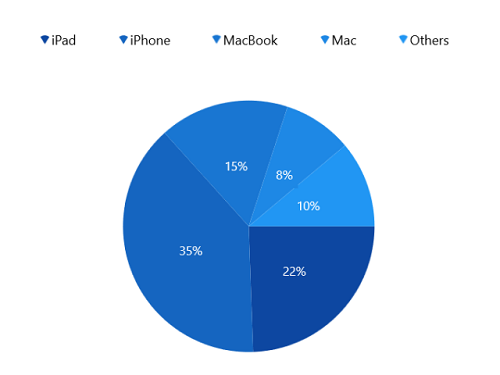
The ItemMargin property of the ChartLegend is used to provide spacing between each legend item.
<chart:SfCircularChart>

    <!-- Configure additional chart elements -->
    <chart:SfCircularChart.Legend>
        <chart:ChartLegend ItemMargin="10"/>
    </chart:SfCircularChart.Legend>
</chart:SfCircularChart>
SfCircularChart chart = new SfCircularChart();
// Configure additional chart elements
chart.Legend = new ChartLegend()
{
ItemMargin = new Thickness(10)
};
Checkbox for Legend
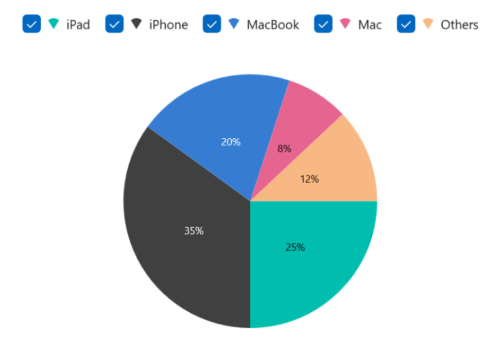
The circular chart provides support to enable the checkbox for each legend item to show or collapse the associated data points. By default, the value of the CheckBoxVisibility property is Collapsed.
<chart:SfCircularChart>

    <!-- Configure additional chart elements -->
    <chart:SfCircularChart.Legend>
        <chart:ChartLegend CheckBoxVisibility="Visible"/>
    </chart:SfCircularChart.Legend>
</chart:SfCircularChart>
SfCircularChart chart = new SfCircularChart();
// Configure additional chart elements
chart.Legend = new ChartLegend()
{
CheckBoxVisibility = Visibility.Visible
};
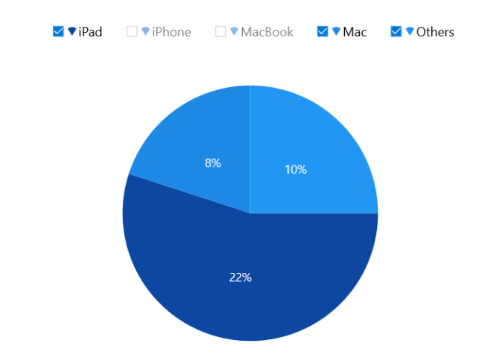
The data point can be collapsed by unchecking the checkbox, as shown below:
Toggle series visibility
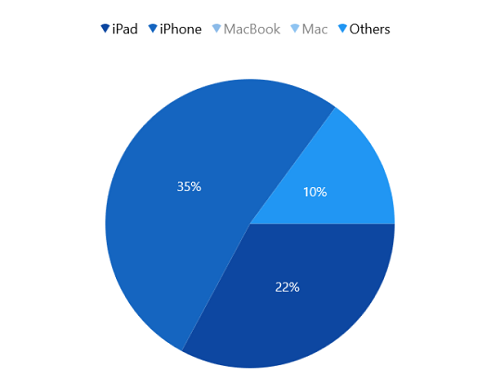
The visibility of the segment can be controlled by tapping the legend item by enabling the ToggleSeriesVisibility property. By default, the value of the ToggleSeriesVisibility property is False.
<chart:SfCircularChart>

    <!-- Configure additional chart elements -->
    <chart:SfCircularChart.Legend>
        <chart:ChartLegend ToggleSeriesVisibility="True"/>
    </chart:SfCircularChart.Legend>
</chart:SfCircularChart>
SfCircularChart chart = new SfCircularChart();
// Configure additional chart elements
chart.Legend = new ChartLegend()
{
ToggleSeriesVisibility = true
};
Placement
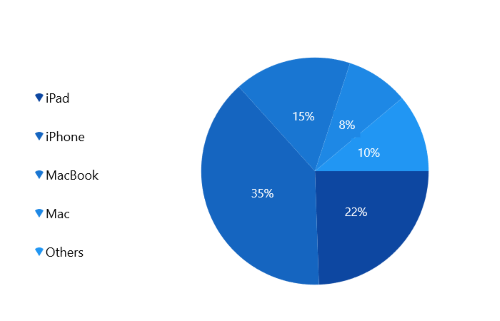
Legends can be docked left, right, top, or bottom around the chart area using the Placement property. By default, the chart legend is docked at the top of the chart as mentioned earlier.
To display the legend at the left, set the Placement as Left, as in the following code sample.
<chart:SfCircularChart>

    <!-- Configure additional chart elements -->
    <chart:SfCircularChart.Legend>
        <chart:ChartLegend ItemMargin="10" Placement="Left"/>
    </chart:SfCircularChart.Legend>
</chart:SfCircularChart>
SfCircularChart chart = new SfCircularChart();
// Configure additional chart elements
chart.Legend = new ChartLegend()
{
ItemMargin = new Thickness(10),
Placement = LegendPlacement.Left
};
Background Customization
The legend background appearance can be customized by using the following properties.
- BorderThickness - Used to change the stroke width of the legend.
- BorderBrush - Used to change the stroke color of the legend.
- Background - Used to change the background color of the legend.
- CornerRadius - Used to change the corner radius of the legend.
<chart:SfCircularChart>

    <!-- Configure additional chart elements -->
    <chart:SfCircularChart.Legend>
        <chart:ChartLegend
            Background="Gray"
            BorderBrush="Black"
            BorderThickness="1"
            CornerRadius="5">
        </chart:ChartLegend>
    </chart:SfCircularChart.Legend>
</chart:SfCircularChart>
SfCircularChart chart = new SfCircularChart();
// Configure additional chart elements
chart.Legend = new ChartLegend()
{
Background = new SolidColorBrush(Colors.Gray),
BorderBrush = new SolidColorBrush(Colors.Black),
BorderThickness = new Thickness(1),
CornerRadius = new CornerRadius(5)
};Template
Customize each legend item by using the ItemTemplate property in ChartLegend, as in the following code snippet:
<chart:SfCircularChart x:Name="chart">
    <chart:SfCircularChart.Resources>
        <DataTemplate x:Key="labelTemplate" x:DataType="chart:LegendItem">
            <StackPanel Margin="10" Orientation="Vertical">
                <Ellipse
                    Height="15"
                    Width="15"
                    Fill="{Binding IconBrush}"
                    Stroke="#4a4a4a"
                    StrokeThickness="2"/>
                <TextBlock
                    HorizontalAlignment="Center"
                    FontSize="12"
                    Foreground="Black"
                    FontWeight="SemiBold"
                    Text="{Binding Item._XAxesData}"/>
            </StackPanel>
        </DataTemplate>
    </chart:SfCircularChart.Resources>

    <!-- Configure additional chart elements -->
    <chart:SfCircularChart.Legend>
        <chart:ChartLegend ItemTemplate="{StaticResource labelTemplate}"/>
    </chart:SfCircularChart.Legend>

</chart:SfCircularChart>
SfCircularChart chart = new SfCircularChart();
// The 'itemTemplate' resource is defined in XAML Resources and referenced here.
chart.Legend = new ChartLegend()
{
ItemTemplate = grid.Resources["itemTemplate"] as DataTemplate
};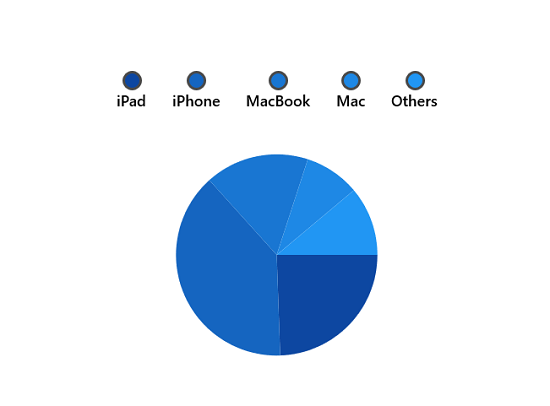
The Item can be used to access the data linked to the associated model class. The binding context for ChartLegend
ItemTemplateis LegendItem, which provides the necessary data for the legend labels.