UI Builder Skill with Angular DOCX Editor
27 Aug 20268 minutes to read
Syncfusion® Angular UI Builder Skill is an AI-powered agent skill that accelerates Angular DOCX Editor development by transforming natural-language UI requirements into production-ready code using Syncfusion® Angular components.
Integrated with your AI-powered IDE, it leverages deep knowledge of Angular DOCX Editor and other Angular components to deliver accurate and ready-to-use code.
By combining intelligent code generation with best practices, accessibility standards, and design-system consistency, Angular UI Builder helps you rapidly build scalable Document editing applications and user interfaces without leaving your development workflow.
Prerequisites
Before installing Angular UI Builder Skill with DOCX Editor, ensure the following:
- Install APM (Agent Package Manager)
- Node.js version ≥ 18 (required)
- Angular application (existing or new); see Quick Start
- A supported AI agent or IDE that integrates with the Skills (VS Code, Cursor, Syncfusion® Code Studio, etc.)
- Active Syncfusion® license (any of the following):
Key Benefits
AI-Driven UI Generation
- Transforms prompts into fully developed Angular components rather than just partial code snippets.
- Automatically selects appropriate Syncfusion® components and features
- Produces structured, maintainable code
Component Usage & API Accuracy
- Uses correct Syncfusion® component APIs
- Injects required feature modules (paging, sorting, filtering, etc.)
- Avoids unsupported or deprecated patterns
Patterns & Best Practices
- Recommended component composition and state management
- Event handling aligned with Angular standards
- Secure and scalable coding patterns
Accessibility & Responsiveness
- WCAG 2.1 AA–aligned output
- Semantic HTML with ARIA support
Design-System Integration
- Supports Tailwind, Bootstrap, Material, or custom themes
- Ensures consistent Syncfusion® styling and theme usage
Installation
Before installing Angular UI Builder Skill with DOCX Editor, ensure that APM (Agent Package Manager) is installed and available in your environment.
Verify APM Installation
Run the following command to confirm APM is installed:
apm --versionInstall the Syncfusion® Angular UI Builder Skill with DOCX Editor package using APM
Use the APM CLI to install the Angular UI Builder Skill with DOCX Editor for your preferred environment:
apm install syncfusion/angular-ui-builder -t copilotapm install syncfusion/angular-ui-builder -t cursorapm install syncfusion/angular-ui-builder -t codexapm install syncfusion/angular-ui-builder -t claudeAfter installation, the following artifacts are added to your project for the GitHub Copilot target:
-
.agent/skills/– contains the skill files -
.github/agents/– contains the agent configuration
Refer to the documentation for details about supported deployment targets.
For Syncfusion® Code Studio, use the Copilot command above to install the Angular UI Builder.
How the Syncfusion® Angular UI Builder Skill Works with DOCX Editor
- Intent Analysis: Parse the user’s prompt to identify component types and high-level layout intent.
- Project Detection: Automatically detects project framework, package manager, existing themes, and DOCX Editor configuration.
- Component Mapping: Map intent to Syncfusion® DOCX Editor and Angular components, including required modules.
-
Theming & Design System
Load required theming guidelines and confirm key design choices:- CSS framework (Tailwind, Bootstrap, Material, or Greenfield(custom theme)). If no themes detected in the existing project, Greenfield and Syncfusion Tailwind3 theme are shown as the default option, which can be used as is or changed based on preference.
- Syncfusion theme (Tailwind3, Bootstrap5, Material3, fluent2)
- Light and Dark Mode
- Core design basics (colors, spacing, typography, responsiveness, accessibility)
- Code Generation: Produce TypeScript Angular components with DOCX Editor integration, props interfaces, and CSS/styling scaffolding.
- Dependency Management: Recommend or install required Syncfusion® packages and peer dependencies.
- Validation: Run accessibility and basic security checks, request confirmation for changes.
- Code Insertion: Create files or patch existing files following project structure and conventions.
Key enforcement points:
- Adds correct theme and CSS imports for chosen Syncfusion® themes
- Injects only the feature modules required by generated components
- Generates semantic HTML with ARIA attributes and keyboard support
- Avoids unsupported or deprecated API usages for Syncfusion® components
The assistant handles most stages automatically and may request confirmation where required.
Using the AI Assistant
After installing Angular UI Builder Skill with DOCX Editor and APM, the relevant agent and skill files are added to your project under:
-
.agent/skills/(skill files) -
.github/agents/(Angular UI builder agent configuration, based on the selected target)
To start using the skill:
- Open your supported IDE.
- In the chat panel, select the
syncfusion-angular-ui-builderagent from the Agent dropdown.
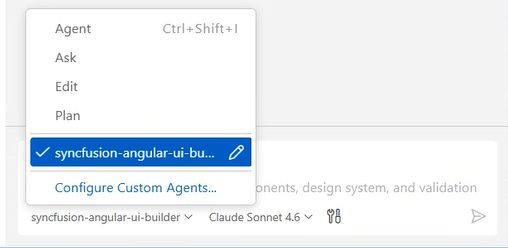
- Start prompting the agent with a clear description of your UI requirements.
For Syncfusion® Code Studio, if the UI Builder agent is not shown, ensure that the agent location is configured to use it in the chat, and refer to the documentation to configure the agent location properly.
Example Prompts:
Build a new Angular application with DOCX Editor - Include a sidebar panel on the right side that displays a list of toolbar options with checkboxes for New, Open, Undo and Redo. Add a button at the bottom of the panel labeled “Apply Changes”. When users select or deselect the checkboxes and click the button, the toolbar at the top of the DOCX Editor should dynamically show or hide the corresponding items in real time, providing a customizable editing experience similar to advanced DOCX Editors.
Build a new Angular application with the Syncfusion DOCX Editor. Include a toggle switch button at the top-left corner to control track changes. The editor should support real-time change tracking, and the toggle must properly enable or disable this feature.
Generated code follows best practices with accessible, semantic HTML, strong TypeScript typing, and built-in security measures such as input validation and avoidance of embedded secrets.
Best Practices
Follow these guidelines to get the most out of UI Builder and ensure high-quality production-ready results:
- Stay consistent: Maintain consistent file organization, naming conventions, and coding standards throughout your project.
- Use advanced AI models: For best results, use Claude Sonnet 4.6 or higher capability models to produce better code quality and more accurate implementations.
- Review all content and assets before production: Replace any placeholder images or icons (e.g., stock images or emoji sets) with your brand assets. Also validate the logic, security, and compatibility with your existing code before deployment.
Troubleshooting
-
APM installation failure: Refer to this documentation
-
Skills not loading: Ensure the .agent/ and .github/agents/ folders exist in your project and that the skill was installed successfully using APM. Verify that the correct agent is selected from the Agent dropdown in your IDE.
-
Component not rendering: Retry generation using the specific component skill to resolve the issue, and ensure required Syncfusion® packages and themes are properly configured.
-
Syncfusion license banner appears: Use the licensing skill to correctly register and validate your Syncfusion® license key in the application.
FAQ
Which agents/IDEs are supported?
Any Skills-compatible agent that reads local skill files (Code Studio, VS Code, Cursor, etc.).
Are skills loaded automatically?
Yes. Supported agents automatically load relevant skills based on your query.
Can I customize the generated styles?
Yes. The skill supports choosing Tailwind, Bootstrap, Material, or a custom theme; generated components include clear integration points for style adjustments.
Does it modify files automatically?
The skill proposes changes and requires confirmation for insertion; automatic dependency installation may be offered depending on agent permissions.