Create Word document in Azure Functions v4
13 Aug 202616 minutes to read
Syncfusion® DocIO is a .NET Core Word library used to create, read, edit and convert Word documents programmatically without Microsoft Word or interop dependencies. Using this library, you can create a Word document in Azure Functions v4.
Prerequisites
- Visual Studio 2022 with the Azure Development workload installed.
- An active Azure subscription.
- The Azure Functions Core Tools for local debugging.
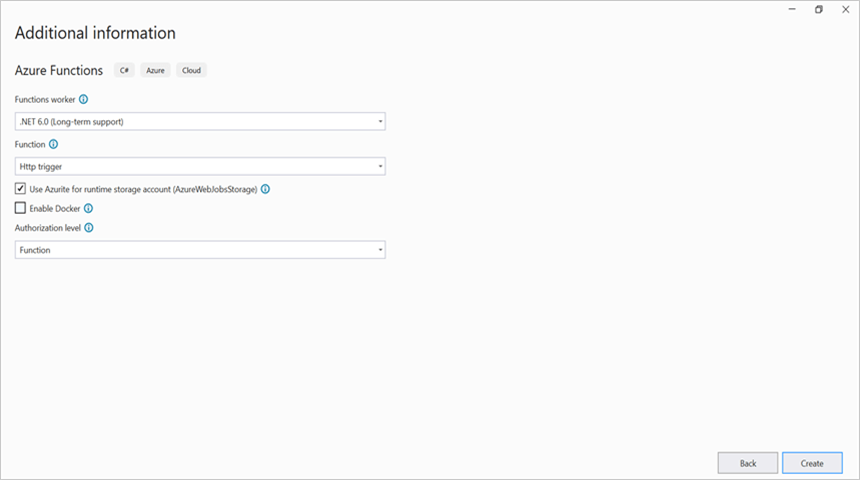
- The example uses the Azure Functions .NET 8 isolated worker model. When you create the project, select .NET 8.0 (Long Term Support) and Isolated as the worker model.
Steps to create a Word document in Azure Functions v4
Step 1: Create a new Azure Functions project.
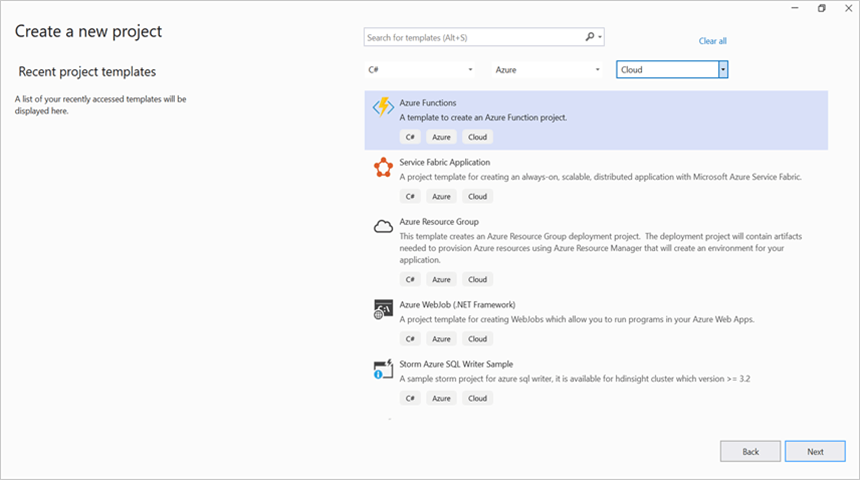
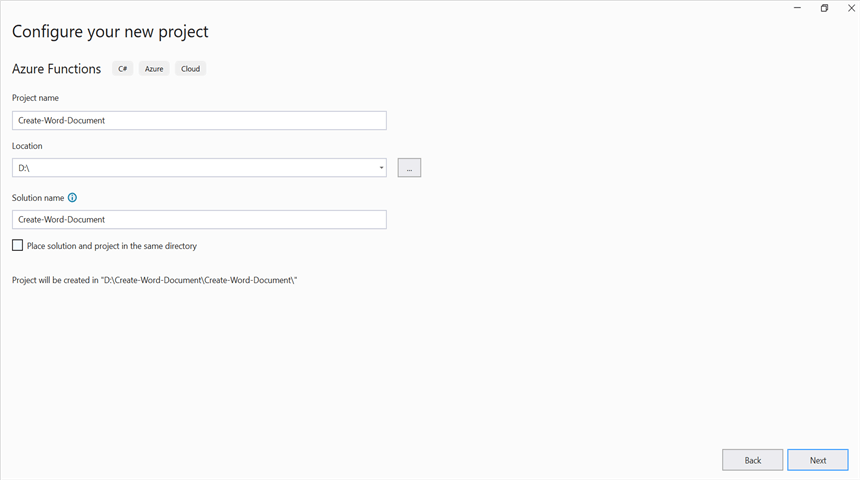
Step 2: Create a project name and select the location.
Step 3: Select the function worker as .NET 8.0 (Long Term Support) and the Isolated worker model.
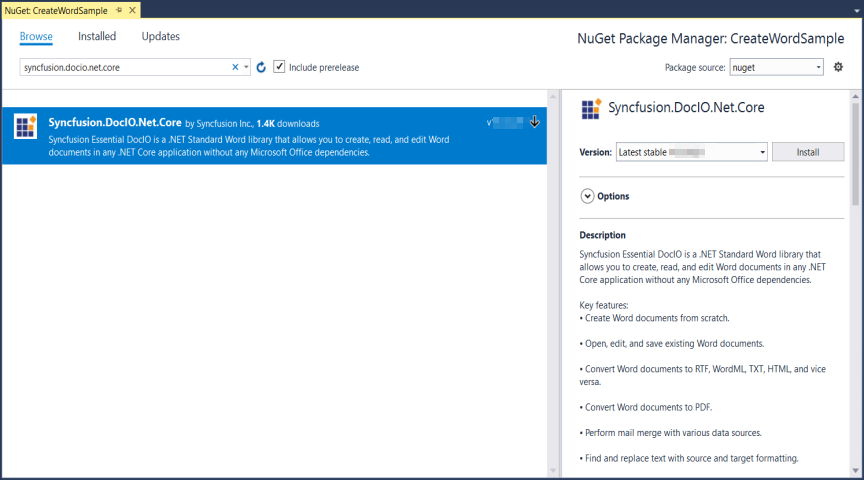
Step 4: Install the Syncfusion.DocIO.Net.Core NuGet package as a reference to your project from NuGet.org.
Starting with v16.2.0.x, if you reference Syncfusion® assemblies from the trial setup or from the NuGet feed, you must add a reference to the Syncfusion.Licensing assembly and include a valid license key in your application.
Install the Syncfusion.Licensing NuGet package and register the license key during application startup.
Syncfusion.Licensing.SyncfusionLicenseProvider.RegisterLicense("YOUR_LICENSE_KEY");For more information about generating and registering a license key, refer to the Syncfusion® licensing documentation.
Step 5: Include the following namespaces in the Function1.cs file.
using System;
using System.IO;
using System.Net;
using System.Net.Http;
using System.Net.Http.Headers;
using System.Reflection;
using Syncfusion.DocIO;
using Syncfusion.DocIO.DLS;
Step 6: Add the following code snippet in the Run method of the Function1 class to create a Word document in Azure Functions and return the resulting Word document to the client. The full method signature is shown below; the [Function] and [HttpTrigger] attributes define the HTTP trigger that the function responds to.
// Creating a new document.
WordDocument document = new WordDocument();
//Adding a new section to the document.
WSection section = document.AddSection() as WSection;
//Set Margin of the section
section.PageSetup.Margins.All = 72;
//Set page size of the section
section.PageSetup.PageSize = new Syncfusion.Drawing.SizeF(612, 792);

//Create Paragraph styles
WParagraphStyle style = document.AddParagraphStyle("Normal") as WParagraphStyle;
style.CharacterFormat.FontName = "Calibri";
style.CharacterFormat.FontSize = 11f;
style.ParagraphFormat.BeforeSpacing = 0;
style.ParagraphFormat.AfterSpacing = 8;
style.ParagraphFormat.LineSpacing = 13.8f;

style = document.AddParagraphStyle("Heading 1") as WParagraphStyle;
style.ApplyBaseStyle("Normal");
style.CharacterFormat.FontName = "Calibri Light";
style.CharacterFormat.FontSize = 16f;
style.CharacterFormat.TextColor = Syncfusion.Drawing.Color.FromArgb(46, 116, 181);
style.ParagraphFormat.BeforeSpacing = 12;
style.ParagraphFormat.AfterSpacing = 0;
style.ParagraphFormat.Keep = true;
style.ParagraphFormat.KeepFollow = true;
style.ParagraphFormat.OutlineLevel = OutlineLevel.Level1;

IWParagraph paragraph = section.HeadersFooters.Header.AddParagraph();
// Gets the image stream.
var assembly = Assembly.GetExecutingAssembly();
var stream = assembly.GetManifestResourceStream("Create_Word_Document.Data.AdventureCycle.jpg");
IWPicture picture = paragraph.AppendPicture(stream);
picture.TextWrappingStyle = TextWrappingStyle.InFrontOfText;
picture.VerticalOrigin = VerticalOrigin.Margin;
picture.VerticalPosition = -45;
picture.HorizontalOrigin = HorizontalOrigin.Column;
picture.HorizontalPosition = 263.5f;
picture.WidthScale = 20;
picture.HeightScale = 15;

paragraph.ApplyStyle("Normal");
paragraph.ParagraphFormat.HorizontalAlignment = HorizontalAlignment.Left;
WTextRange textRange = paragraph.AppendText("Adventure Works Cycles") as WTextRange;
textRange.CharacterFormat.FontSize = 12f;
textRange.CharacterFormat.FontName = "Calibri";
textRange.CharacterFormat.TextColor = Syncfusion.Drawing.Color.Red;

//Appends paragraph.
paragraph = section.AddParagraph();
paragraph.ApplyStyle("Heading 1");
paragraph.ParagraphFormat.HorizontalAlignment = HorizontalAlignment.Center;
textRange = paragraph.AppendText("Adventure Works Cycles") as WTextRange;
textRange.CharacterFormat.FontSize = 18f;
textRange.CharacterFormat.FontName = "Calibri";

//Appends paragraph.
paragraph = section.AddParagraph();
paragraph.ParagraphFormat.FirstLineIndent = 36;
paragraph.BreakCharacterFormat.FontSize = 12f;
textRange = paragraph.AppendText("Adventure Works Cycles, the fictitious company on which the AdventureWorks sample databases are based, is a large, multinational manufacturing company. The company manufactures and sells metal and composite bicycles to North American, European and Asian commercial markets. While its base operation is in Bothell, Washington with 290 employees, several regional sales teams are located throughout their market base.") as WTextRange;
textRange.CharacterFormat.FontSize = 12f;

//Appends paragraph.
paragraph = section.AddParagraph();
paragraph.ParagraphFormat.FirstLineIndent = 36;
paragraph.BreakCharacterFormat.FontSize = 12f;
textRange = paragraph.AppendText("In 2000, AdventureWorks Cycles bought a small manufacturing plant, Importadores Neptuno, located in Mexico. Importadores Neptuno manufactures several critical subcomponents for the AdventureWorks Cycles product line. These subcomponents are shipped to the Bothell location for final product assembly. In 2001, Importadores Neptuno, became the sole manufacturer and distributor of the touring bicycle product group.") as WTextRange;
textRange.CharacterFormat.FontSize = 12f;

paragraph = section.AddParagraph();
paragraph.ApplyStyle("Heading 1");
paragraph.ParagraphFormat.HorizontalAlignment = HorizontalAlignment.Left;
textRange = paragraph.AppendText("Product Overview") as WTextRange;
textRange.CharacterFormat.FontSize = 16f;
textRange.CharacterFormat.FontName = "Calibri";

//Appends table.
IWTable table = section.AddTable();
table.ResetCells(3, 2);
table.TableFormat.Borders.BorderType = BorderStyle.None;
table.TableFormat.IsAutoResized = true;
//Appends paragraph.
paragraph = table[0, 0].AddParagraph();
paragraph.ParagraphFormat.AfterSpacing = 0;
paragraph.BreakCharacterFormat.FontSize = 12f;
//Appends picture to the paragraph.
var assembly1 = Assembly.GetExecutingAssembly();
using (var stream1 = assembly1.GetManifestResourceStream("Create_Word_Document.Data.Mountain-200.jpg"))
picture = paragraph.AppendPicture(stream1);
picture.TextWrappingStyle = TextWrappingStyle.TopAndBottom;
picture.VerticalOrigin = VerticalOrigin.Paragraph;
picture.VerticalPosition = 4.5f;
picture.HorizontalOrigin = HorizontalOrigin.Column;
picture.HorizontalPosition = -2.15f;
picture.WidthScale = 79;
picture.HeightScale = 79;

//Appends paragraph.
paragraph = table[0, 1].AddParagraph();
paragraph.ApplyStyle("Heading 1");
paragraph.ParagraphFormat.AfterSpacing = 0;
paragraph.ParagraphFormat.LineSpacing = 12f;
paragraph.AppendText("Mountain-200");
//Appends paragraph.
paragraph = table[0, 1].AddParagraph();
paragraph.ParagraphFormat.AfterSpacing = 0;
paragraph.ParagraphFormat.LineSpacing = 12f;
paragraph.BreakCharacterFormat.FontSize = 12f;
paragraph.BreakCharacterFormat.FontName = "Times New Roman";
textRange = paragraph.AppendText("Product No: BK-M68B-38\r") as WTextRange;
textRange.CharacterFormat.FontSize = 12f;
textRange.CharacterFormat.FontName = "Times New Roman";
textRange = paragraph.AppendText("Size: 38\r") as WTextRange;
textRange.CharacterFormat.FontSize = 12f;
textRange.CharacterFormat.FontName = "Times New Roman";
textRange = paragraph.AppendText("Weight: 25\r") as WTextRange;
textRange.CharacterFormat.FontSize = 12f;
textRange.CharacterFormat.FontName = "Times New Roman";
textRange = paragraph.AppendText("Price: $2,294.99\r") as WTextRange;
textRange.CharacterFormat.FontSize = 12f;
textRange.CharacterFormat.FontName = "Times New Roman";
//Appends paragraph.
paragraph = table[0, 1].AddParagraph();
paragraph.ParagraphFormat.AfterSpacing = 0;
paragraph.ParagraphFormat.LineSpacing = 12f;
paragraph.BreakCharacterFormat.FontSize = 12f;

//Appends paragraph.
paragraph = table[1, 0].AddParagraph();
paragraph.ApplyStyle("Heading 1");
paragraph.ParagraphFormat.AfterSpacing = 0;
paragraph.ParagraphFormat.LineSpacing = 12f;
paragraph.AppendText("Mountain-300 ");
//Appends paragraph.
paragraph = table[1, 0].AddParagraph();
paragraph.ParagraphFormat.AfterSpacing = 0;
paragraph.ParagraphFormat.LineSpacing = 12f;
paragraph.BreakCharacterFormat.FontSize = 12f;
paragraph.BreakCharacterFormat.FontName = "Times New Roman";
textRange = paragraph.AppendText("Product No: BK-M47B-38\r") as WTextRange;
textRange.CharacterFormat.FontSize = 12f;
textRange.CharacterFormat.FontName = "Times New Roman";
textRange = paragraph.AppendText("Size: 35\r") as WTextRange;
textRange.CharacterFormat.FontSize = 12f;
textRange.CharacterFormat.FontName = "Times New Roman";
textRange = paragraph.AppendText("Weight: 22\r") as WTextRange;
textRange.CharacterFormat.FontSize = 12f;
textRange.CharacterFormat.FontName = "Times New Roman";
textRange = paragraph.AppendText("Price: $1,079.99\r") as WTextRange;
textRange.CharacterFormat.FontSize = 12f;
textRange.CharacterFormat.FontName = "Times New Roman";
//Appends paragraph.
paragraph = table[1, 0].AddParagraph();
paragraph.ParagraphFormat.AfterSpacing = 0;
paragraph.ParagraphFormat.LineSpacing = 12f;
paragraph.BreakCharacterFormat.FontSize = 12f;

//Appends paragraph.
paragraph = table[1, 1].AddParagraph();
paragraph.ApplyStyle("Heading 1");
paragraph.ParagraphFormat.LineSpacing = 12f;
//Appends picture to the paragraph.
var assembly2 = Assembly.GetExecutingAssembly();
using (var stream2 = assembly2.GetManifestResourceStream("Create_Word_Document.Data.Mountain-300.jpg"))
picture = paragraph.AppendPicture(stream2);
picture.TextWrappingStyle = TextWrappingStyle.TopAndBottom;
picture.VerticalOrigin = VerticalOrigin.Paragraph;
picture.VerticalPosition = 8.2f;
picture.HorizontalOrigin = HorizontalOrigin.Column;
picture.HorizontalPosition = -14.95f;
picture.WidthScale = 75;
picture.HeightScale = 75;

//Appends paragraph.
paragraph = table[2, 0].AddParagraph();
paragraph.ApplyStyle("Heading 1");
paragraph.ParagraphFormat.LineSpacing = 12f;
//Appends picture to the paragraph.
var assembly3 = Assembly.GetExecutingAssembly();
using (var stream3 = assembly3.GetManifestResourceStream("Create_Word_Document.Data.Road-550-W.jpg"))
picture = paragraph.AppendPicture(stream3);
picture.TextWrappingStyle = TextWrappingStyle.TopAndBottom;
picture.VerticalOrigin = VerticalOrigin.Paragraph;
picture.VerticalPosition = 3.75f;
picture.HorizontalOrigin = HorizontalOrigin.Column;
picture.HorizontalPosition = -5f;
picture.WidthScale = 92;
picture.HeightScale = 92;

//Appends paragraph.
paragraph = table[2, 1].AddParagraph();
paragraph.ApplyStyle("Heading 1");
paragraph.ParagraphFormat.AfterSpacing = 0;
paragraph.ParagraphFormat.LineSpacing = 12f;
paragraph.AppendText("Road-150 ");
//Appends paragraph.
paragraph = table[2, 1].AddParagraph();
paragraph.ParagraphFormat.AfterSpacing = 0;
paragraph.ParagraphFormat.LineSpacing = 12f;
paragraph.BreakCharacterFormat.FontSize = 12f;
paragraph.BreakCharacterFormat.FontName = "Times New Roman";
textRange = paragraph.AppendText("Product No: BK-R93R-44\r") as WTextRange;
textRange.CharacterFormat.FontSize = 12f;
textRange.CharacterFormat.FontName = "Times New Roman";
textRange = paragraph.AppendText("Size: 44\r") as WTextRange;
textRange.CharacterFormat.FontSize = 12f;
textRange.CharacterFormat.FontName = "Times New Roman";
textRange = paragraph.AppendText("Weight: 14\r") as WTextRange;
textRange.CharacterFormat.FontSize = 12f;
textRange.CharacterFormat.FontName = "Times New Roman";
textRange = paragraph.AppendText("Price: $3,578.27\r") as WTextRange;
textRange.CharacterFormat.FontSize = 12f;
textRange.CharacterFormat.FontName = "Times New Roman";
//Appends paragraph.
section.AddParagraph();

MemoryStream memoryStream = new MemoryStream();
//Saves the Word document file.
document.Save(memoryStream, FormatType.Docx);
//Create the response to return.
HttpResponseMessage response = new HttpResponseMessage(HttpStatusCode.OK);
//Set the Word document saved stream as content of response.
response.Content = new ByteArrayContent(memoryStream.ToArray());
//Set the contentDisposition as attachment.
response.Content.Headers.ContentDisposition = new ContentDispositionHeaderValue("attachment")
{
    FileName = "Sample.docx"
};
//Set the content type as Word document mime type.
response.Content.Headers.ContentType = new System.Net.Http.Headers.MediaTypeHeaderValue("application/docx");
//Return the response with output Word document stream.
return response;
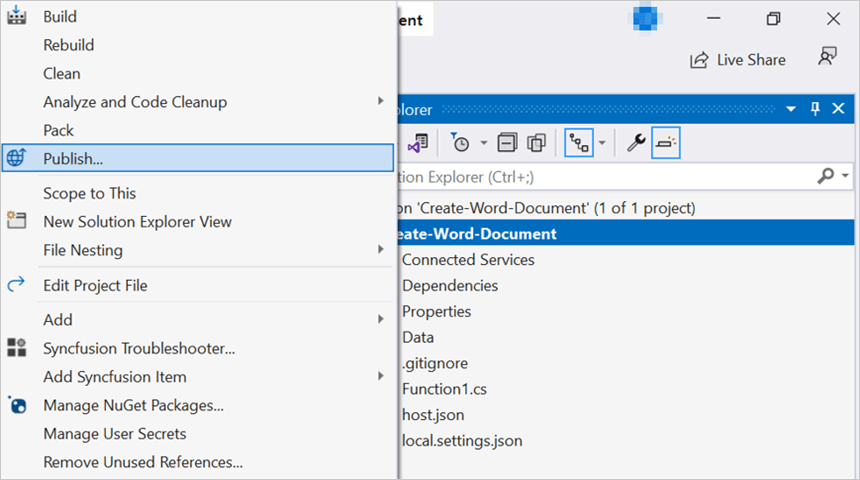
Step 7: Right-click the project and select Publish. Then, create a new profile in the Publish window.
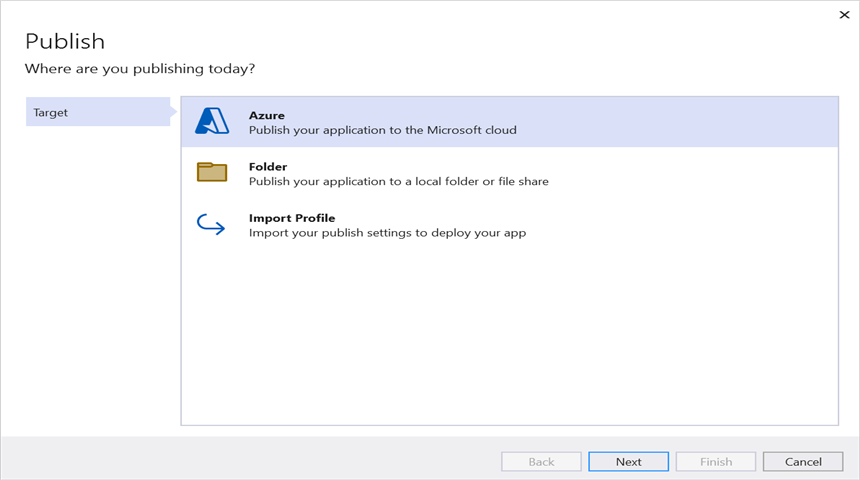
Step 8: Select the target as Azure and click the Next button.
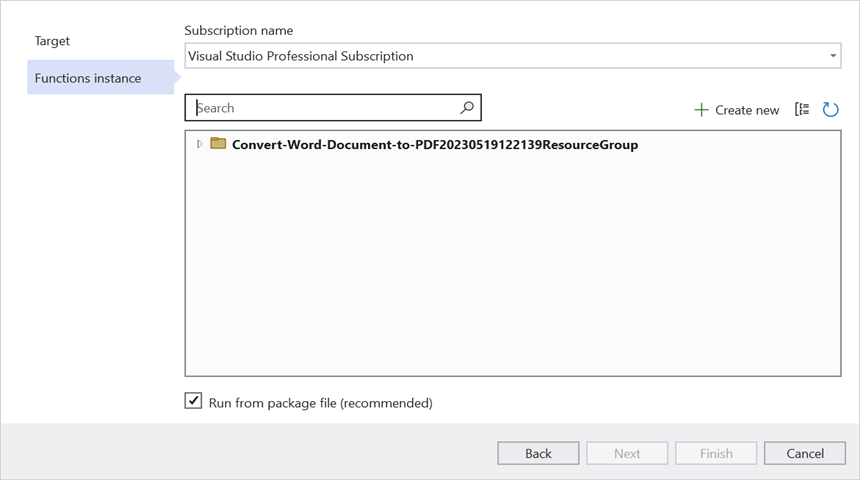
Step 9: Select the Create new button.
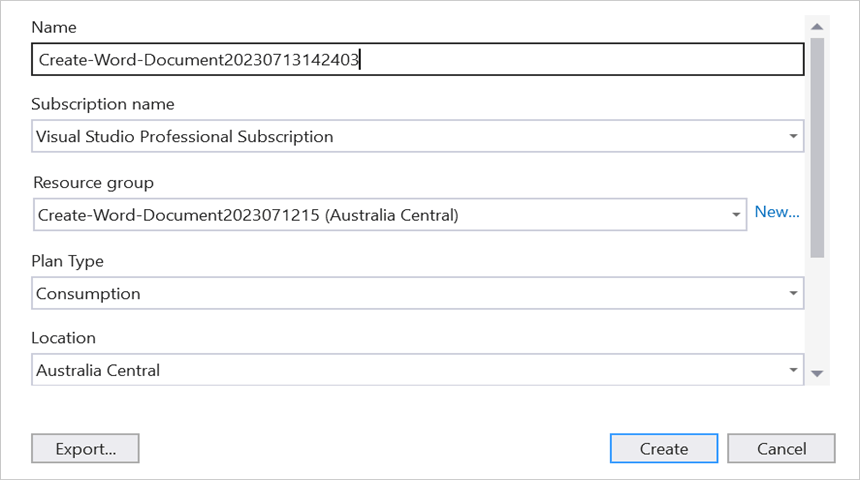
Step 10: Click the Create button.
Step 11: After the app service is created, click the Finish button.
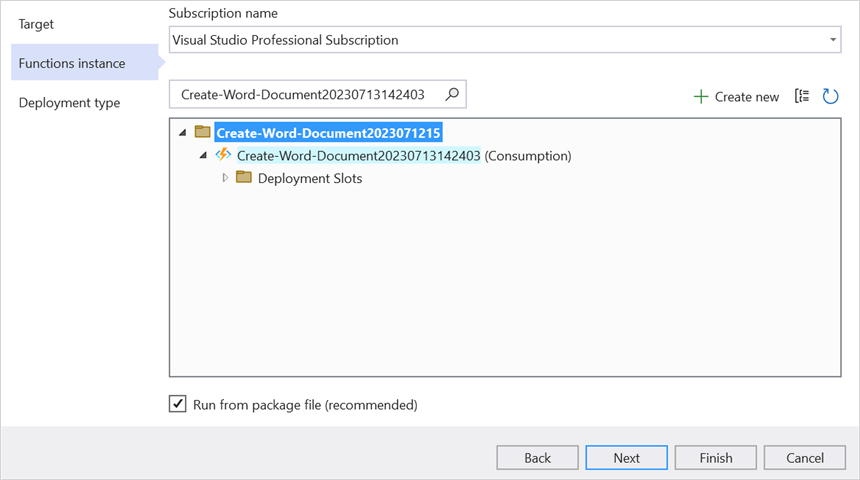
Step 12: Click the Publish button.
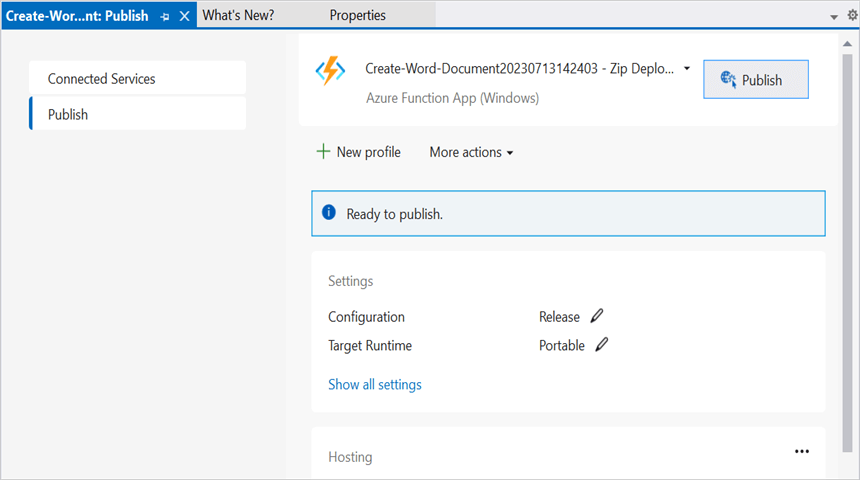
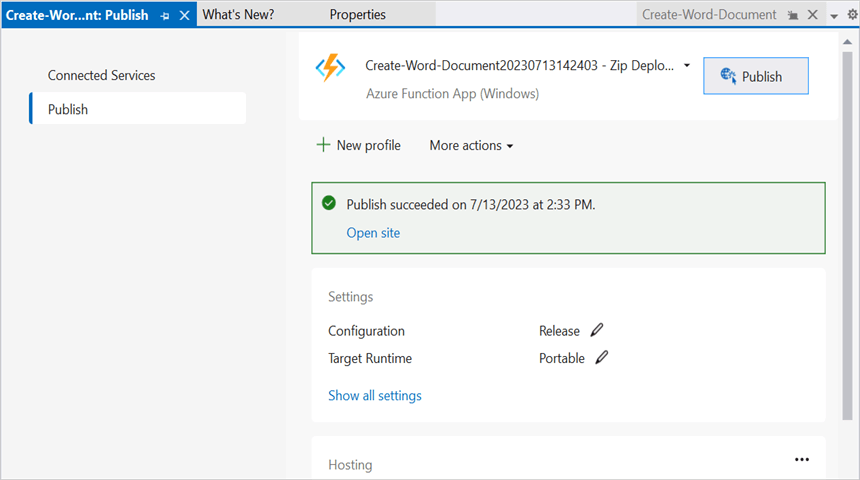
Step 13: Publish succeeded.
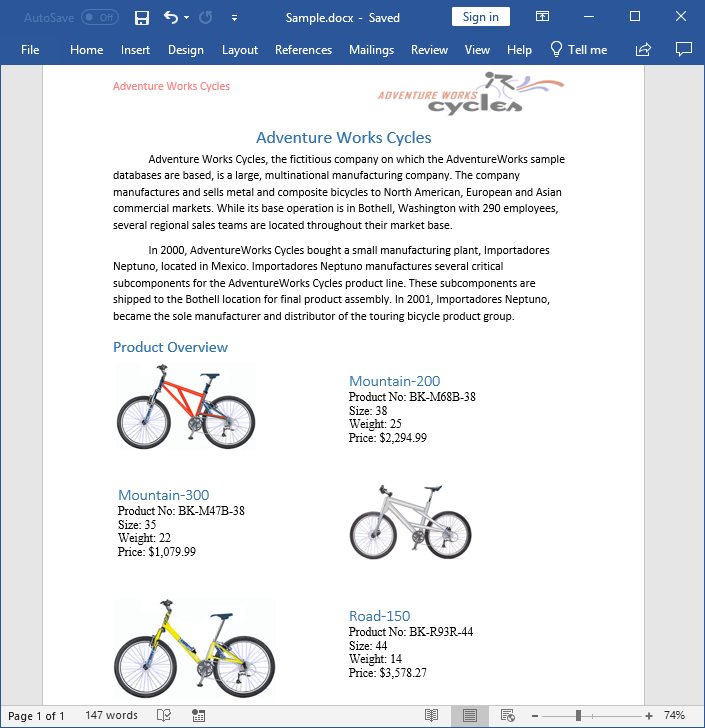
Step 14: Go to the Azure portal and select App Services. After running the service, click Get Function URL and copy it. Then, use it in the client sample below, which requests the Azure Functions to create a Word document. You will get the output Word document as follows.
Steps to post the request to Azure Functions
Step 1: Create a console application to request the Azure Functions API. Make sure these using directives are present:
using System;
using System.IO;
using System.Net;
Step 2: Add the following code snippet into the Main method to post a request to the Azure Functions endpoint and save the returned Word document. The Azure Functions URL should include the function key as a code= query parameter if authorization is enabled.
//Reads the template Word document.
FileStream fs = new FileStream(@"../../Data/Input.docx", FileMode.Open, FileAccess.ReadWrite, FileShare.ReadWrite);
fs.Position = 0;
//Saves the Word document in memory stream.
MemoryStream inputStream = new MemoryStream();
fs.CopyTo(inputStream);
inputStream.Position = 0;
try
{
    Console.WriteLine("Please enter your Azure Functions URL :");
    string functionURL = Console.ReadLine();
    //Create HttpWebRequest with hosted azure functions URL.
    HttpWebRequest req = (HttpWebRequest)WebRequest.Create(functionURL);
    //Set request method as POST
    req.Method = "POST";
    //Get the request stream to save the Word document stream
    Stream stream = req.GetRequestStream();
    //Write the Word document stream into request stream
    stream.Write(inputStream.ToArray(), 0, inputStream.ToArray().Length);
    //Gets the response from the Azure Functions.
    HttpWebResponse res = (HttpWebResponse)req.GetResponse();
    //Saves the Word document stream.
    FileStream fileStream = File.Create("Sample.docx");
    res.GetResponseStream().CopyTo(fileStream);
    //Dispose the streams
    inputStream.Dispose();
    fileStream.Dispose();
}
catch (Exception ex)
{
    Console.WriteLine($"An error occurred: {ex.Message}");
}
From GitHub, you can download the console application and Azure Functions v4 samples.
The code sample references image files (AdventureCycle.jpg, Mountain-200.jpg, Mountain-300.jpg, Road-550-W.jpg). Download these assets from the GitHub sample Data folder and add them to a
Datafolder in the Functions project with their Build Action set to Embedded Resource so theGetManifestResourceStreamcalls resolve correctly at runtime.
Looking for the full .NET Word Library overview, features, pricing, and documentation? Visit the .NET Word Library page.
An online sample link to create a Word document in ASP.NET Core.