Workbook Operations in UWP Spreadsheet
14 Aug 20262 minutes to read
This section explains how to manage Excel workbooks in SfSpreadsheet, including creating new files, opening existing workbooks from various sources, and saving changes efficiently.
Creating a new Excel Workbook
A new workbook can be created by using the Create method with the specified number of worksheets. By default, a workbook will be created with a single worksheet.
spreadsheet.Create(2);Opening an existing Excel Workbook
The Excel Workbook can be opened in SfSpreadsheet using the Open method in the following ways:
//Using Stream,
spreadsheet.Open(Stream file)

//Using StorageFile,
spreadsheet.Open (StorageFile file)

//Using Workbook,
spreadsheet.Open(IWorkbook workbook)

// Example: Open Excel file from Embedded Resource

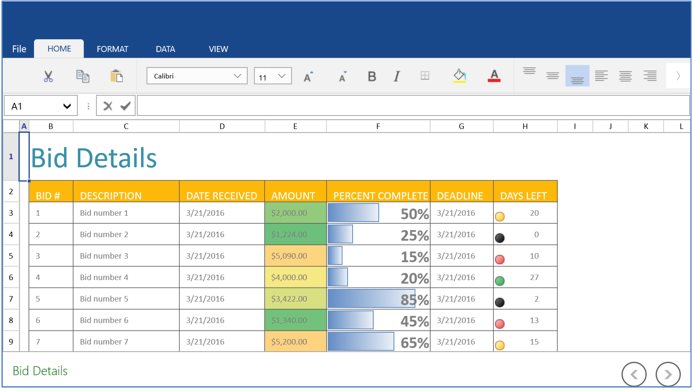
Stream fileStream = typeof(MainPage).GetTypeInfo().Assembly.GetManifestResourceStream("SfSpreadsheetDemo.Assets.BidDetails.xlsx");
this.spreadsheet.Open(fileStream);
Note: Follow the steps below to ensure the above code properly loads and displays the Excel file:
- Add the Excel file inside the Assets folder of your UWP application
- Right-click the file and select Properties
- Set the Build Action to Embedded Resource
Saving an Excel Workbook
The Excel workbook can be saved in SfSpreadsheet using the Save method. If the workbook already exists on the system drive, it will be saved in the same location; otherwise, a Save Dialog box opens to save the workbook to a user-specified location.
spreadsheet.Save();Use the SaveAs method to save an existing Excel file with modifications to a different location.
The SaveAs method in SfSpreadsheet can be used in the following ways:
//Using Storage File,
spreadsheet.SaveAs (StorageFile file);

//Using String,
spreadsheet.SaveAs (string file);

//For Dialog box,
spreadsheet.SaveAs();